
GPS MANN
The politics of freebies in India has moved far beyond occasional populism. It is now a calibrated electoral strategy. In Punjab, the Aam Aadmi Party appears to be executing that strategy with precision as 2027 approaches.
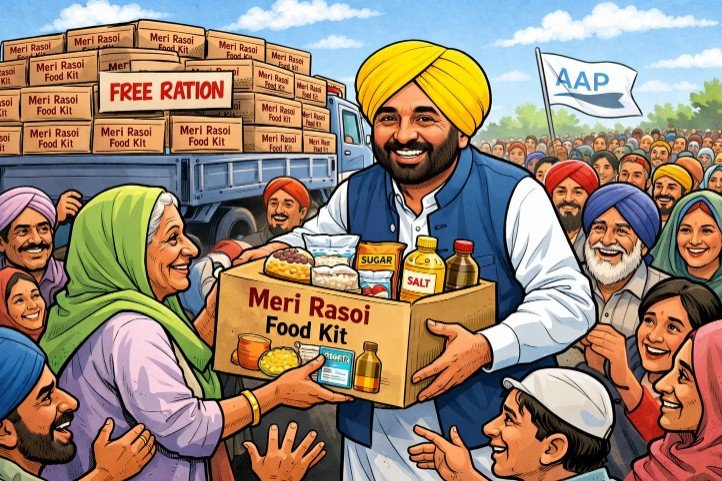
The announcement of Meri Rasoi — quarterly food kits for nearly 40 lakh National Food Security Act families — is not merely welfare. As widely reported, the kits will include pulses, sugar, salt, turmeric and mustard oil, supplementing wheat already provided under the food security framework. With an estimated annual cost of ₹950–1,000 crore, the scheme directly touches the poorest and lower-income households — the broadest layer of Punjab’s electorate. Parallel to this is the expected rollout of ₹1,000 per month to women above 18 years — a long-pending promise repeatedly reaffirmed by Chief Minister Bhagwant Mann. Media estimates suggest that if extended to over one crore women, the annual outgo could range between ₹12,000 crore and ₹15,600 crore. Even if eligibility filters reduce beneficiaries to 30–50 lakh women, the political arithmetic remains formidable: roughly ₹300–500 crore per month, or ₹3,600–6,000 crore annually.
Punjab already carries a heavy subsidy legacy. Free farm power, entrenched during successive governments of the Shiromani Akali Dal-BJP combine and the Indian National Congress, has cumulatively cost over ₹1.34 lakh crore. AAP expanded the subsidy architecture with 300 free units of domestic electricity, with reports indicating that nearly 90% of households received zero bills in certain billing cycles. Combined annual power subsidies alone are estimated in the ₹16,000–18,000 crore range. Add Meri Rasoi and women’s transfers, and recurring welfare expenditure swells further in a state whose debt is projected around ₹4.17 lakh crore.
From a fiscal perspective, critics are right to caution that revenue expenditure crowds out capital formation. Roads, irrigation reform, industrial corridors and job creation require sustained capital investment. Cash and consumption transfers generate immediate relief but limited productive capacity.
Yet elections are rarely won on capital expenditure charts.
India’s political history demonstrates that targeted welfare often reshapes verdicts. Tamil Nadu’s subsidised rice politics redrew its electoral map decades ago. Bihar’s bicycle scheme under Nitish Kumar combined social impact with electoral consolidation. More recently, in Bihar, the National Democratic Alliance’s victory was widely attributed in political circles to the direct transfer of ₹10,000 to women beneficiaries shortly before the elections — a move that created immediate, tangible gratitude among households and blunted anti-incumbency. The timing mattered. The delivery mattered. The directness mattered.
Punjab itself witnessed the power of welfare promises in 2022. Voters respond when benefits are visible, regular and personal.
AAP’s 2026–27 strategy reflects a sharp reading of demography. The electorate resembles a pyramid — broadest at the bottom, where economic vulnerability and voter density converge. A quarterly ration kit affects the kitchen. A predictable ₹1,000 monthly transfer affects the household ledger. When funds are credited to a woman’s account, it enhances agency and embeds political association within family economics.
Opposition fragmentation strengthens AAP’s prospects. Congress faces internal churn and leadership recalibration. SAD is attempting revival but lacks unified statewide momentum. BJP’s rural penetration remains constrained after the farm agitation fallout. Recent rural local body results and by-election performances suggest AAP retains organisational depth at the grassroots.
Politically, therefore, if Meri Rasoi is delivered consistently from April 2026 and the ₹1,000 scheme is operationalised well before the 2027 campaign intensifies, AAP will enter the contest with a vast, directly benefiting constituency experiencing recurring support. That is structural advantage.
Risks remain — fiscal stress, implementation delays, or economic shocks could alter the equation. The Supreme Court’s broader remarks on unchecked “freebie culture” add a moral dimension to the debate. But electoral politics is ultimately transactional at the household level. Voters weigh immediate economic security more heavily than abstract fiscal prudence. In pure political calculus, welfare that is tangible and recurring often outweighs long-term reform narratives. If execution matches announcement, AAP’s twin pillars — Meri Rasoi and ₹1,000 for women — could decisively shape the 2027 battlefield, not because they solve Punjab’s structural challenges, but because they consolidate the widest base of the electoral pyramid where verdicts are ultimately decided.