A dramatic confrontation between central and state authorities unfolded in Himachal Pradesh after the arrest of Indian Youth Congress activists linked to the protest at the AI Summit in New Delhi, turning a routine police operation into a full-blown centre–state political and administrative tussle.

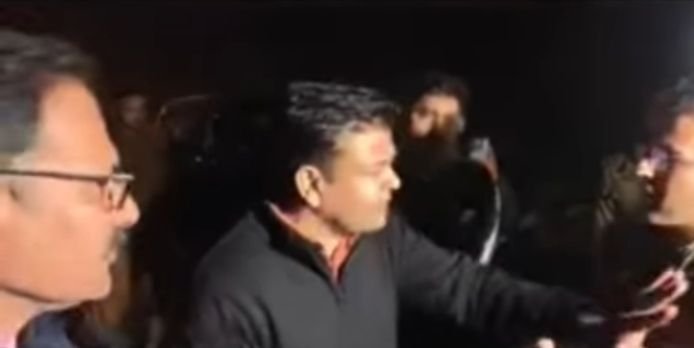
What began as an action by the Delhi Police against Youth Congress workers over the February 20 “shirtless protest” at Bharat Mandapam soon escalated into a high-voltage standoff with the Himachal Pradesh Police, exposing deep political fault lines between the Union government and the Congress-led Himachal government.
Three activists of the Indian Youth Congress — Saurabh, Siddharth and Arbaz — were arrested by Delhi Police from a hotel in Rohru (Shimla district) and were being taken to the national capital after medical examinations and a late-night transit remand granted by an Additional Chief Judicial Magistrate. However, what followed was a tense 24-hour “cops vs cops” confrontation across multiple checkpoints in and around Shimla.
Himachal Police alleged illegal detention, procedural violations and failure to inform local authorities before the arrests. A kidnapping case was registered against unknown Delhi Police personnel, and police vehicles were stopped repeatedly at Kanlog and the Shoghi border near Shimla. One Delhi Police vehicle carrying digital evidence, documents and CCTV material was barricaded, triggering a fresh deadlock over seizure rights and legal jurisdiction.
Delhi Police maintained that they had secured an 18-hour transit remand and accused the state police of obstructing justice. Shimla Police, on the other hand, demanded legal documentation and access to digital evidence, claiming the arrests violated due process. The impasse finally ended when Delhi Police shared the seizure memo listing the evidence in their possession, after which they were allowed to proceed to New Delhi with the accused.
Beyond the legal confrontation, the episode rapidly transformed into a political flashpoint.
The Himachal Pradesh government openly stood with the protesting party workers, framing the action as a crackdown on dissent. Chief Minister Sukhwinder Singh Sukhu termed the Delhi Police operation “unfortunate” and “against constitutional procedure,” projecting it as an example of central overreach and political intimidation.
In sharp contrast, the BJP-led opposition in the state accused the Congress government of shielding those who embarrassed the country on an international मंच. Leader of Opposition Jai Ram Thakur alleged that the state government was protecting “outsiders” who tried to defame India globally, and accused the Sukhu government of turning policing into partisan politics to please the central Congress leadership.
The confrontation also drew the national leadership into the narrative, with BJP leaders linking the entire episode to Congress politics around Rahul Gandhi and the party’s strategy of using youth protests as a political tool against the Modi government.
The background to the clash lies in the February 20 protest at the AI Summit in New Delhi, where Youth Congress activists created a security breach at Bharat Mandapam, prompting strong action by central agencies. Multiple cases were registered, including serious charges under the Bharatiya Nyaya Sanhita (BNS). Several Youth Congress leaders were arrested, including IYC president Uday Bhanu Chib and former national spokesperson Bhudev Sharma, with total arrests crossing double digits.
The subsequent raids, arrests, transit remand disputes and the unprecedented face-off between two police forces have now turned the issue into more than a law-and-order matter. It has become a symbolic battle between the Centre and a Congress-ruled state — between a Union government taking a hard line on protests at high-profile international events, and a state government openly aligning with party workers who challenged the Modi government through street politics.
What should have been a routine interstate police operation has thus transformed into a political narrative of federal tension, institutional confrontation and ideological conflict — a rare spectacle where governance, policing and politics collided on the same battlefield, exposing the fragile balance between authority, dissent and federal cooperation in contemporary India.