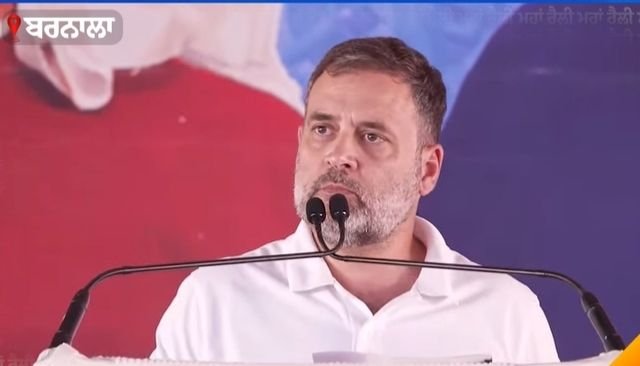
At a politically significant rally in Barnala, senior Congress leader Rahul Gandhi delivered one of his strongest internal messages yet to the Punjab Congress leadership, making it clear that unity, discipline, and collective leadership are now non-negotiable for the party’s future in the state. With elections approaching and political competition intensifying, Gandhi’s speech was widely seen as a decisive intervention aimed at addressing growing factionalism within the Punjab Congress cadre.
Addressing party leaders, workers, and supporters, Rahul Gandhi stressed that the Congress can only return to power in Punjab if it functions as a united team rather than as competing power centres. Using the metaphor of a sports team, he said that elections cannot be won by individual stars but only through teamwork. His message was unambiguous: leaders who refuse to work collectively and disrupt party discipline will be sidelined, regardless of their stature or influence.
Without naming any individual, Gandhi made it clear that no leader is bigger than the organisation. He asserted that the party comes before personalities and positions, and that internal groupism will not be tolerated. This statement directly reflects the growing concern within the Congress high command about internal divisions in the Punjab unit, where rival camps and leadership tussles have weakened organisational strength and public credibility over the years.
Political observers see this as a strategic warning ahead of the next electoral cycle. The Congress has historically been a strong force in Punjab, but internal conflicts, leadership struggles, and lack of coordination at the grassroots level have damaged its electoral prospects. Rahul Gandhi’s message was therefore not just motivational, but corrective — a signal that the party must restructure itself around unity and grassroots mobilisation if it hopes to regain power.
He placed special emphasis on party workers, calling them the real backbone of the Congress. According to him, leadership structures mean little without the strength and commitment of workers at the booth and village levels. He said that any political revival in Punjab must be built through the participation, respect, and empowerment of grassroots workers, not through elite leadership politics alone.
Speaking emotionally about Punjab, Rahul Gandhi described the state as the foundation of India’s strength. He highlighted the historical role of Punjab’s farmers and workers in building the nation, especially during the Green Revolution, which transformed India into a food-secure country. He said that Punjab represents the spirit, resilience, and core strength of India, and reaffirmed his deep personal connection with the people of the state.
The speech also carried a strong policy dimension. Rahul Gandhi sharply criticised trade policies that could open Indian agricultural markets to foreign products, particularly from the United States. He warned that such agreements would seriously harm farmers in Punjab, Himachal Pradesh, Maharashtra, and other agrarian states. According to him, exposing Indian farmers to unequal global competition would destroy livelihoods and weaken rural economies.
He reiterated that the Congress party stands firmly with farmers, labourers, and small traders, positioning the party as a defender of rural and working-class interests. This narrative is central to Congress’s broader national strategy, especially in states like Punjab where agriculture remains the backbone of the economy.
From a political strategy perspective, the Barnala rally was not just a public address but an internal organisational signal. Rahul Gandhi’s words were aimed as much at the Congress leadership structure as at the public. The message was clear: unless factionalism is curbed and collective discipline is enforced, the party’s hopes of returning to power in Punjab will remain weak.
Analysts believe this intervention reflects the Congress high command’s growing urgency to stabilise state units ahead of upcoming elections. Punjab, once a stronghold of the Congress, has seen declining organisational cohesion, and without structural reforms and unity, electoral recovery will remain difficult.
By directly addressing unity, leadership discipline, grassroots empowerment, and किसान-मजदूर politics, Rahul Gandhi attempted to redefine the internal direction of the Punjab Congress. His warning was both a challenge and an opportunity: unity can revive the party, but internal divisions can permanently weaken it.
In essence, the Barnala rally marks a turning point in Punjab Congress politics. It signals that the era of internal power struggles must end, and a new phase of collective leadership, organisational discipline, and people-centric politics must begin — or the party risks losing relevance in one of its most historically important states.