
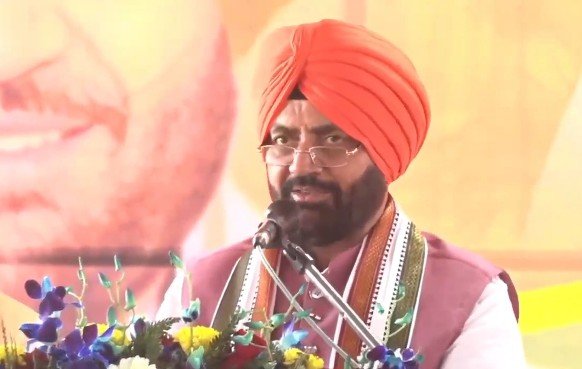
In a politically charged address that underscored intensifying regional contestation ahead of upcoming elections, Nayab Singh Saini sharpened his critique of governance in Punjab while projecting Haryana’s development model as a viable alternative. Speaking at a public gathering in Kurali, the Haryana Chief Minister positioned his remarks within a broader narrative of accountability, governance credibility, and voter awareness, asserting that citizens are increasingly evaluating governments based on performance rather than promises.
Saini argued that Punjab has entered a phase of deep structural challenges, alleging that issues such as drug abuse, crime, administrative disorder, financial strain, and a weakening law-and-order framework have become visible across the state. Without naming individuals directly, he questioned the effectiveness of successive governments, suggesting that both the Congress and the current ruling formation had failed to deliver on their electoral assurances. His remarks reflected a broader political strategy to frame governance in Punjab as a case of unmet expectations and systemic decline.
At the core of his speech was a direct appeal to voters to reassess their political choices. Saini emphasized that electoral mandates should be grounded in tangible outcomes rather than rhetoric, adding that prolonged reliance on what he described as “politics driven by narratives rather than delivery” cannot sustain public trust indefinitely. He suggested that a shift in leadership could redefine Punjab’s trajectory, particularly at a time when economic pressures and governance concerns are intersecting.
Highlighting what he described as a contrast in governance approaches, Saini pointed to the policy framework of Bharatiya Janata Party under the leadership of Narendra Modi. He reiterated the party’s guiding principle of inclusive development and collective progress, presenting it as a model that prioritizes transparency, delivery, and long-term planning. According to him, the concept of a “double-engine government,” where the same political party governs both the state and the Centre, enables faster decision-making and more effective implementation of welfare schemes.
Saini framed the upcoming electoral cycle in Punjab as a decisive moment, arguing that it represents not only a political choice but also a broader decision about the state’s economic future, employment opportunities, and agricultural sustainability. He emphasized that governance must be rooted in decisive leadership and policy clarity, particularly in a state where agriculture and small-scale industries remain critical to livelihoods.
Drawing comparisons with Haryana, Saini outlined what he described as key achievements of his government over the past decade. He highlighted administrative reforms aimed at ensuring transparency, including the dismantling of informal recruitment practices and the introduction of merit-based employment systems. According to him, nearly 200,000 government jobs have been provided without favoritism, a claim intended to reinforce the credibility of governance reforms in the state.
The Chief Minister also emphasized targeted welfare initiatives designed to strengthen social security and economic inclusion. He cited schemes aimed at supporting women through direct financial assistance, noting that large-scale disbursements have been made to beneficiaries in Haryana. In addition, he referenced subsidized cooking gas support for economically weaker households, presenting it as an example of how policy interventions can directly ease the financial burden on families.
Agriculture featured prominently in his address, reflecting its political and economic significance in both Haryana and Punjab. Saini highlighted that Haryana procures all major crops at minimum support prices, ensuring income stability for farmers. He further pointed to compensation mechanisms for crop losses and financial assistance under national schemes, suggesting that these measures have strengthened the agricultural economy and reduced uncertainty for farmers.
He also spoke about initiatives aimed at sustainable farming practices, including subsidies for crop residue management machinery to address stubble burning. Additionally, he referenced schemes designed to protect farmers from market volatility by compensating them for price fluctuations in horticultural produce, positioning these efforts as part of a broader strategy to stabilize rural incomes.
Throughout his speech, Saini maintained that governance must ultimately be judged by its impact on everyday lives. He argued that policy success is reflected in improved access to opportunities, financial security for vulnerable groups, and consistent delivery of public services. By drawing a parallel between Haryana’s governance model and Punjab’s current challenges, he sought to present a narrative of contrast aimed at influencing voter sentiment.
The address signals a growing intensification of political messaging in the region, with leaders increasingly framing state-level governance debates within a larger national context. As Punjab approaches its next electoral phase, such narratives are likely to play a central role in shaping public discourse, particularly around issues of development, accountability, and institutional performance.
Saini’s remarks, while critical in tone, ultimately converge on a broader electoral pitch: that governance rooted in policy clarity, administrative efficiency, and delivery-focused leadership can redefine the future of a state seeking economic stability and social progress.