
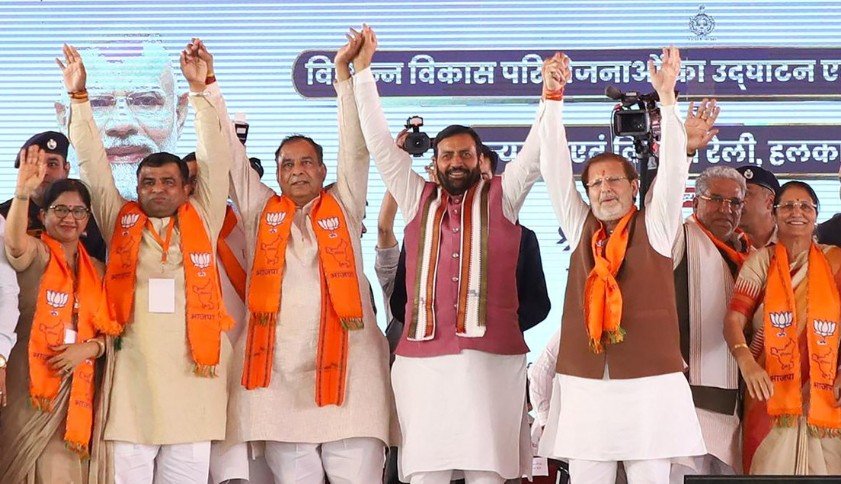
Reinforcing his government’s development-centric narrative in Haryana, Nayab Singh Saini on Sunday presented an expansive account of infrastructure growth, welfare delivery, and future planning during a large public rally in Gohana. The Chief Minister positioned the constituency as a key example of the state’s accelerated development model, asserting that targeted investments and policy execution have significantly transformed the region over the past decade.
Addressing a large gathering, Saini stated that the government has invested approximately ₹1,794 crore in the Gohana Assembly segment over the last eleven and a half years, marking a substantial increase compared to previous administrations. He emphasized that a majority of development announcements made for the region have already been fulfilled, while the remaining projects are progressing at a steady pace. The Chief Minister framed this as evidence of a governance approach focused on delivery, accountability, and measurable outcomes.
During the event, Saini inaugurated and laid the foundation for 16 development projects worth ₹113.62 crore, spanning urban infrastructure, public utilities, and civic amenities. The projects include both completed works and new initiatives aimed at strengthening local infrastructure and improving quality of life. He reiterated the government’s commitment to accelerating development in Gohana, describing it as part of a broader strategy to ensure balanced regional growth across Haryana.
Highlighting the state’s overall progress, Saini credited the leadership of Narendra Modi and the alignment between the Centre and the state government for enabling faster implementation of development schemes. He noted that the “double-engine governance” framework has helped ensure that welfare benefits and infrastructure projects reach citizens more efficiently, particularly in semi-urban and rural areas.
The Chief Minister also referred to the government’s electoral commitments, stating that a significant portion of the promises made in its policy agenda have already been fulfilled, while work continues on the remaining commitments within the stipulated timeframe. He sought to reassure citizens that the administration remains focused on completing all pledged initiatives through a structured and time-bound approach.
A major part of his address was dedicated to outlining welfare measures aimed at strengthening social and economic security. Saini highlighted financial assistance schemes for women, noting that large-scale direct benefit transfers are being made to eligible beneficiaries. He also pointed to subsidized household energy support and pension schemes as key pillars of the state’s social welfare architecture.
In the agriculture sector, the Chief Minister emphasized that all major crops are being procured at minimum support prices, ensuring income stability for farmers. He also highlighted compensation provided under crop insurance programs and direct income support schemes, which together aim to reduce financial uncertainty and strengthen rural livelihoods. According to him, these measures have significantly improved the economic resilience of the farming community.
Saini further underlined reforms in public sector recruitment, stating that government jobs are being awarded through transparent, merit-based processes. He described the elimination of informal practices in recruitment as a major step toward restoring trust among youth and ensuring equal opportunity.
Beyond policy announcements, the rally also served as a platform for unveiling a series of new infrastructure and development proposals for Gohana. These include plans for a modern sports stadium, urban infrastructure upgrades, and expanded healthcare facilities, including advanced medical units in existing institutions. The government also announced initiatives to strengthen power infrastructure, improve irrigation systems, and enhance drinking water supply across multiple villages.
Urban development proposals featured prominently, with plans for transport infrastructure, commercial facilities, and tourism-related projects aimed at boosting local economic activity. The Chief Minister also spoke about improving road connectivity, addressing traffic congestion through new bridges and bypasses, and upgrading civic amenities in both urban and rural areas.
In addition, Saini outlined measures to modernize educational infrastructure, including potential upgrades to schools and the introduction of new academic programs in higher education institutions. He emphasized that investment in education and skill development remains central to the state’s long-term growth strategy.
The Chief Minister also touched upon environmental and agricultural sustainability initiatives, including efforts to make previously unproductive land suitable for farming and the promotion of modern agricultural practices. He noted that these steps are intended to enhance productivity while addressing challenges such as water management and soil quality.
Throughout his address, Saini maintained that the government’s approach is rooted in inclusive development, ensuring that benefits reach all sections of society. He argued that infrastructure expansion, welfare delivery, and governance reforms together form the foundation of Haryana’s growth story.
The event in Gohana reflects a broader political and administrative push to highlight regional development achievements while setting the stage for future initiatives. By combining large-scale investments with targeted welfare measures, the state government is seeking to reinforce its image as a delivery-focused administration committed to long-term progress.
As Haryana continues to position itself as a model of governance and development, Saini’s address underscores the importance of sustained investment, policy continuity, and citizen-centric planning in shaping the state’s future trajectory.