
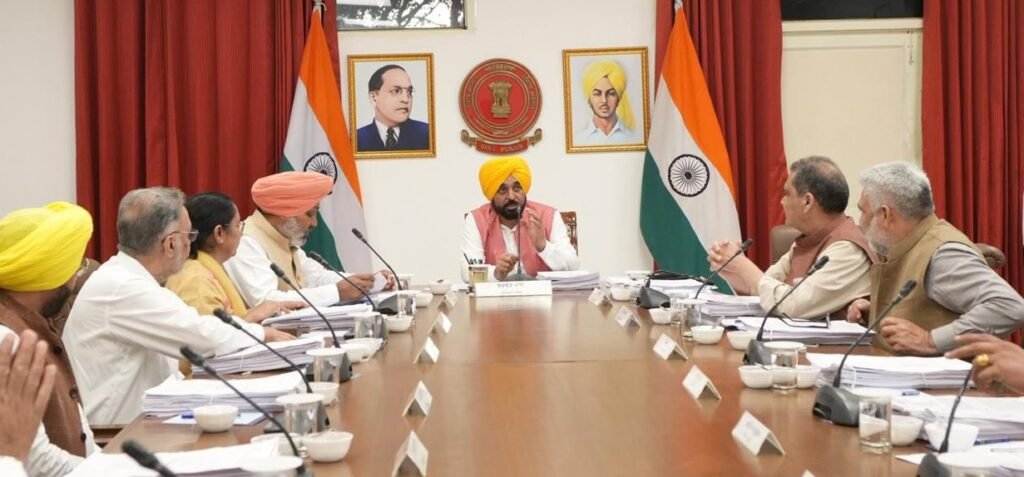
In a significant policy move aimed at reshaping social welfare delivery and strengthening economic security for women, the Punjab Cabinet led by Chief Minister Bhagwant Singh Mann has approved the rollout of one of India’s most expansive direct income support programmes for women, alongside a series of administrative, industrial, and infrastructure reforms that underline the state government’s evolving governance model.
At the centre of the Cabinet’s decisions is the launch of the Mukh Mantri Mawan Dheeyan Satkar Yojna, a flagship initiative designed to provide direct monthly financial assistance to women across the state. Under the scheme, women will receive a monthly benefit of ₹1000, while women belonging to Scheduled Castes will receive ₹1500. With eligibility extending to women aged 18 years and above who are registered voters in Punjab and possess valid identity documentation, the scheme is expected to cover more than 97 percent of the female population in the state, making it one of the largest gender-focused cash transfer programmes in the country.
The initiative has been structured as a Direct Benefit Transfer mechanism, ensuring that funds are deposited directly into beneficiaries’ bank accounts. Notably, the scheme does not impose any cap on the number of eligible women per household, significantly widening its outreach. In a move that enhances its inclusivity, women already receiving social security pensions will continue to draw those benefits in addition to the new financial assistance, effectively increasing their total monthly support.
The Punjab Government has earmarked a substantial allocation of ₹9,300 crore in the 2026–27 state budget for the implementation of the scheme, reflecting both its scale and fiscal commitment. Officials describe the initiative as a structural intervention aimed at addressing long-standing gaps in women’s financial independence, particularly among economically vulnerable households. By linking income support with financial literacy and banking inclusion, the programme is expected to encourage savings behaviour, enhance household stability, and strengthen women’s role in decision-making processes.
The government has also outlined an extensive enrolment and outreach strategy to ensure that the scheme reaches even the most remote and underserved regions. This includes mobilisation campaigns, assistance with documentation, and facilitation of bank account activation, signalling a strong focus on last-mile delivery and administrative efficiency.
Beyond social welfare, the Cabinet’s decisions reflect a broader governance agenda. Approval has been granted to fill 70 direct recruitment posts in the state’s planning framework, following the ongoing restructuring of the Economic Policy and Planning Board and the Directorate of Statistics. This move is expected to strengthen data-driven governance and policy planning capacity within the administration.
In the energy sector, the Cabinet has approved revisions to the eligibility criteria and experience requirements for the appointment of senior leadership positions in Punjab State Power Corporation Limited and Punjab State Transmission Corporation Limited. The changes are intended to align leadership appointments with evolving sectoral demands and improve operational efficiency in power generation and transmission.
Further, the Cabinet has cleared the deployment of contractual manpower for the operation and maintenance of the Pachhwara Central Coal Mine in Jharkhand, a key asset linked to Punjab’s power generation requirements. An empowered committee comprising senior administrative and technical officials will oversee recruitment and operational decisions, ensuring timely execution and accountability in managing the coal resource.
Industrial policy reforms also featured prominently in the Cabinet’s agenda. Amendments have been approved to facilitate the conversion of leasehold industrial plots into freehold ownership, even in cases where properties are mortgaged with financial institutions, subject to regulatory safeguards. This measure is expected to ease business operations, unlock asset value for industries, and improve the overall investment climate in Punjab.
Complementing this, the Cabinet has approved the introduction of the Punjab Common Infrastructure (Regulation and Maintenance) (Amendment) Bill, 2026. The proposed legislation seeks to modernise the framework governing industrial infrastructure management by strengthening Special Purpose Vehicles (SPVs). These entities will be established across industrial zones to manage shared infrastructure such as roads, lighting, drainage, and security on a self-sustaining basis. The creation of District Monitoring Authorities is also envisaged to enhance oversight, transparency, and dispute resolution mechanisms.
In a move linking environmental management with infrastructure development, the Cabinet has also approved relaxed conditions for desilting operations in the Sutlej River. The extracted material will be utilised for construction purposes by the National Highways Authority of India, thereby supporting ongoing and upcoming highway projects in the state. This initiative is part of a broader river management strategy aimed at flood mitigation, channel maintenance, and sustainable utilisation of natural resources.
Collectively, these decisions signal a multi-dimensional governance approach by the Punjab Government, combining welfare expansion with structural reforms in administration, industry, and infrastructure. While the women-centric income support scheme stands out for its scale and social impact, the accompanying policy measures indicate an effort to align economic development with institutional strengthening.
As Punjab navigates fiscal pressures and development challenges, the Cabinet’s latest decisions reflect a strategic attempt to balance welfare commitments with long-term governance reforms, positioning the state for both social equity and economic resilience.