
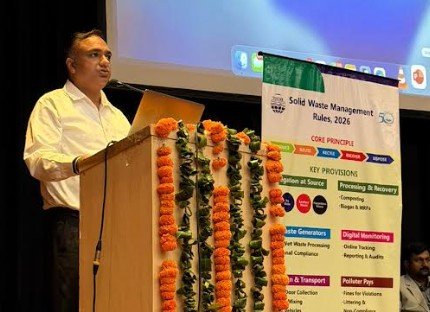
In a significant move aimed at strengthening environmental governance and urban sanitation systems, the Punjab Pollution Control Board (PPCB) has initiated an intensive capacity-building exercise to prepare stakeholders for the rollout of the newly notified Solid Waste Management Rules, 2026. The training programme, held in Chandigarh under the leadership of PPCB Chairperson Ms. Reena Gupta, marks a proactive step by the Punjab government to align administrative machinery with evolving national environmental standards.
The workshop was conducted at the Mahatma Gandhi State Institute of Public Administration and brought together a wide spectrum of officials responsible for waste management across the state. A total of 268 participants, including Executive Officers from Urban Local Bodies, Solid Waste Management nodal officers, programme coordinators, and PPCB officials, attended the session. The scale of participation reflects the seriousness with which the state is approaching the implementation of the revised regulatory framework, which is set to come into effect from April 1, 2026.
The Solid Waste Management Rules, 2026, notified by the Ministry of Environment, Forest and Climate Change, represent a comprehensive upgrade over the earlier 2016 guidelines. The revised rules are designed to address emerging urban challenges, with a sharper focus on scientific waste processing, mandatory segregation at source, and clearly defined accountability across all stakeholders involved in waste generation, collection, and disposal. The new framework is expected to play a critical role in tackling the growing burden of municipal waste in rapidly urbanising regions like Punjab.
Officials at the programme highlighted that one of the core objectives of the initiative was to ensure that implementing agencies at the ground level fully understand their roles and responsibilities under the updated rules. By fostering clarity and coordination among departments, the PPCB aims to prevent gaps in execution that have historically hindered waste management efforts in many parts of the country.
The technical sessions were led by subject experts with extensive experience in environmental management and policy implementation. Dr. Dhamodharan K from the Department of Energy and Environment at Thapar Institute of Engineering and Technology served as the key resource person, delivering a detailed presentation on the structural changes introduced in the 2026 rules. His session focused on bridging the gap between policy design and practical execution, offering insights into the challenges that urban local bodies may face during implementation.
Complementing this, Mr. Akshit Kapil, Assistant Environmental Engineer at PPCB, provided a structured overview of the revised provisions, highlighting operational aspects that will directly impact field-level functioning. His session emphasized the need for robust monitoring mechanisms, data-driven decision-making, and the adoption of modern waste processing technologies to meet compliance standards.
The discussions also underscored the importance of integrating digital tools and real-time monitoring systems into waste management operations. With increasing emphasis on accountability, authorities are expected to maintain detailed records of waste generation and processing, ensuring transparency and traceability across the entire value chain.
Punjab, like many other states, has been grappling with the dual challenge of rising waste volumes and limited infrastructure for scientific disposal. Rapid urbanisation, changing consumption patterns, and increasing population density have added pressure on existing systems. In this context, the implementation of the new rules is being viewed as a critical opportunity to modernise waste management practices and transition towards a more sustainable and environmentally responsible model.
The training programme also served as a platform for dialogue and feedback, with participants actively engaging in discussions around operational bottlenecks and region-specific challenges. This interactive component allowed officials to share ground realities and seek practical solutions, thereby enhancing the overall effectiveness of the initiative.
Senior officials indicated that this workshop is part of a larger, phased strategy to build institutional capacity across departments. Similar training sessions are expected to be conducted in the coming months to ensure that all stakeholders, including municipal workers and local administrators, are adequately equipped to handle the transition.
The emphasis on preparedness ahead of the enforcement date reflects the state government’s intent to avoid last-minute disruptions and ensure a smooth rollout of the new regulations. By investing in training and awareness at this stage, Punjab is positioning itself to achieve higher compliance levels and improved environmental outcomes.
As the April 2026 deadline approaches, the success of the Solid Waste Management Rules will largely depend on coordinated action, sustained monitoring, and active public participation. With initiatives like this training programme, Punjab is signalling a shift towards more structured, accountable, and technology-driven waste governance, setting the stage for cleaner cities and healthier living conditions across the state.