
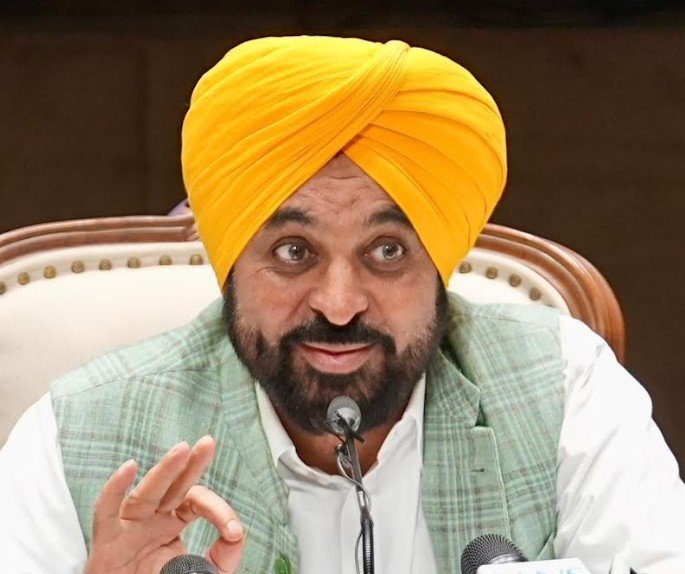
In a comprehensive presentation marking four years of governance, Punjab Chief Minister Bhagwant Singh Mann outlined what he described as a structural transformation of the state’s education system, positioning the “Shiksha Kranti” as a cornerstone of Punjab’s development strategy. The report card, released under the broader “Shandaar Char Saal” accountability series, detailed sweeping reforms in school and higher education, backed by increased public investment, administrative restructuring, and measurable improvements in academic outcomes.
At the heart of the government’s narrative is a significant expansion in financial commitment. The state’s education budget has risen sharply from ₹12,657 crore in 2021–22 to ₹19,279 crore in 2026–27, reflecting a sustained prioritisation of the sector. Officials argue that this increase has enabled not just infrastructure upgrades but also deeper systemic changes aimed at improving both access and quality.
Addressing the media, the Chief Minister framed education as the primary driver of long-term economic and social progress. He pointed to a historical divide between private and government schools, which, he said, had widened inequalities over time. According to him, previous administrations failed to address this imbalance, reducing public schools to basic service providers rather than centres of academic excellence. The current government, he asserted, has attempted to reverse this trend by upgrading government schools to compete with private institutions in terms of facilities, teaching quality, and outcomes.
One of the most prominent claims in the report card is Punjab’s performance in national assessments. The state secured the top position in the National Achievement Survey 2024, surpassing traditionally strong performers. This achievement, the government said, reflects improvements in foundational learning as well as higher-order competencies among students. Additionally, students from government schools have shown increasing success in competitive examinations, with hundreds qualifying for national-level entrance tests such as engineering and medical admissions in recent years.
The government has also emphasised transparency and accountability within the education system. Measures such as real-time communication with parents regarding student attendance and teacher availability are being introduced to ensure closer monitoring of school functioning. Notably, the administration highlighted the absence of examination paper leaks over the past four years, positioning it as a significant governance achievement in contrast to recurring issues reported in several other states.
Institutional expansion has been another key pillar of the reform agenda. The state is in the process of establishing 118 Schools of Eminence, with more than half already operational. These institutions are designed to provide specialised, high-quality education aligned with students’ interests and career aspirations. Alongside this, the government has organised large-scale parent-teacher interactions, with participation reaching into the millions, aimed at strengthening community engagement in education.
Teacher recruitment and professional development have also received focused attention. Since 2022, thousands of teachers have been recruited, while a large number of contractual employees have been regularised. The government has complemented this with international and national training programmes, sending educators to countries such as Singapore and Finland, as well as premier Indian institutions like the Indian Institute of Management Ahmedabad, to enhance leadership and pedagogical skills. These initiatives are intended to align teaching practices with global standards and modern educational methodologies.
Infrastructure development forms a visible component of the transformation. Government schools across Punjab have been equipped with upgraded classrooms, science and computer laboratories, digital connectivity, and essential facilities such as sanitation and medical rooms. The introduction of high-speed internet connectivity across all government schools has been highlighted as a unique achievement, aimed at bridging the digital divide and enabling access to modern learning resources.
The reform programme has also incorporated elements of innovation and skill development. Initiatives such as the Business Blaster scheme are encouraging entrepreneurial thinking among students, with reported outcomes including student-led projects generating significant economic value. The introduction of entrepreneurship as a formal subject at the senior secondary level reflects a shift towards preparing students not just for employment but for enterprise creation.
Inclusivity has been addressed through targeted interventions, including transportation support for girl students and the expansion of academic streams across institutions to ensure broader access. The government has also integrated mentorship programmes, connecting students with senior administrative officers to provide guidance and career orientation.
Beyond school education, the report card outlines steps taken in higher education and cultural preservation. The state has introduced a Digital Open University policy, aimed at expanding access through online learning platforms. Plans are underway to establish a new university at Sri Anandpur Sahib, while existing institutions are being modernised through digital admission systems and language accessibility initiatives.
Efforts to promote Punjabi language and heritage have also been integrated into the broader education strategy. Digitisation of literary works, preservation of rare manuscripts, and the launch of digital linguistic tools are part of an attempt to combine cultural preservation with technological advancement.
The presentation of the education report card follows similar reviews in sectors such as health, irrigation, and law enforcement, reflecting the government’s attempt to institutionalise performance tracking and public accountability. While the claims made by the administration highlight significant progress, the long-term impact of these reforms will ultimately depend on sustained implementation, independent evaluation, and the ability to maintain quality standards across the system.
For now, the Punjab government is projecting its education model as a replicable framework, positioning “Shiksha Kranti” not only as a policy success but as a defining feature of its governance narrative.