
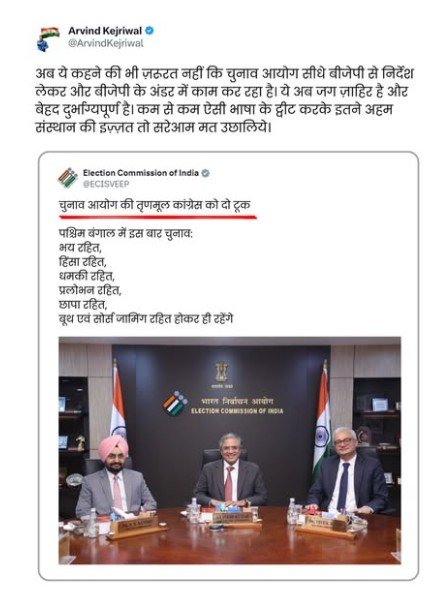
As political activity intensifies ahead of elections in West Bengal, a fresh controversy involving the Election Commission of India has further sharpened the already heated contest between opposition parties and the ruling Bharatiya Janata Party. The latest flashpoint emerged after Aam Aadmi Party national convenor Arvind Kejriwal publicly questioned the neutrality of the poll body, amplifying concerns raised by the Trinamool Congress.
Kejriwal’s remarks came in response to a social media post by the Election Commission related to the Trinamool Congress. Reacting strongly, he alleged that the Commission was acting under the influence of the BJP, suggesting that its independence was being compromised. In his statement, he indicated that the situation had reached a point where such allegations no longer required subtlety, claiming that the perceived alignment was now “visible in the open.” He also cautioned that the language used in official communications could damage the credibility of an institution as critical as the Election Commission.
The controversy follows a tense meeting between a delegation of the Trinamool Congress and the full bench of the Election Commission. According to TMC representatives, the interaction was brief and ended on an acrimonious note, with allegations that the Commission’s leadership used dismissive language. On the other hand, the Election Commission countered these claims, stating that the delegation had engaged in disruptive behavior during the meeting, including raising their voices.
This public exchange marks a significant escalation in the ongoing political friction surrounding the conduct of elections in West Bengal. The state, known for its intense electoral battles, is witnessing a renewed confrontation not only between political parties but also involving constitutional institutions tasked with ensuring free and fair polls.
The BJP, which has been aggressively expanding its political footprint in West Bengal, has consistently rejected opposition allegations of institutional bias, maintaining that the Election Commission operates independently and within the framework of the Constitution. However, opposition parties, including the Trinamool Congress and the Aam Aadmi Party, have increasingly voiced concerns over what they describe as selective actions and communication by the poll body.
Political analysts note that such public disputes risk eroding trust in electoral institutions at a time when credibility and transparency are paramount. The Election Commission, as the custodian of India’s democratic process, plays a crucial role in maintaining confidence among voters and political stakeholders. Any perception of bias—whether substantiated or not—can have far-reaching implications for the legitimacy of the electoral process.
The situation also reflects a broader trend in Indian politics, where institutional decisions are increasingly scrutinized and contested in the public domain. Social media platforms have become key battlegrounds for shaping narratives, with leaders and parties directly engaging with voters and amplifying their positions in real time.
As West Bengal moves closer to a critical electoral phase, the stakes continue to rise. The interplay between political rhetoric, institutional authority, and public perception is likely to remain a defining feature of the campaign. Whether the Election Commission can navigate these challenges while maintaining its credibility will be closely watched, not just in Bengal but across the country.
In the coming weeks, the focus will remain on how the Commission addresses these allegations and ensures a level playing field, even as political parties intensify their campaigns in what is shaping up to be a fiercely contested election.