In a crucial intervention aimed at stabilising Punjab’s strained procurement ecosystem, Chief Minister Bhagwant Singh Mann held a high-level meeting with Union Food and Public Distribution Minister Pralhad Joshi in New Delhi, securing immediate relief measures while pressing for long-pending structural reforms affecting farmers, mandis and commission agents.

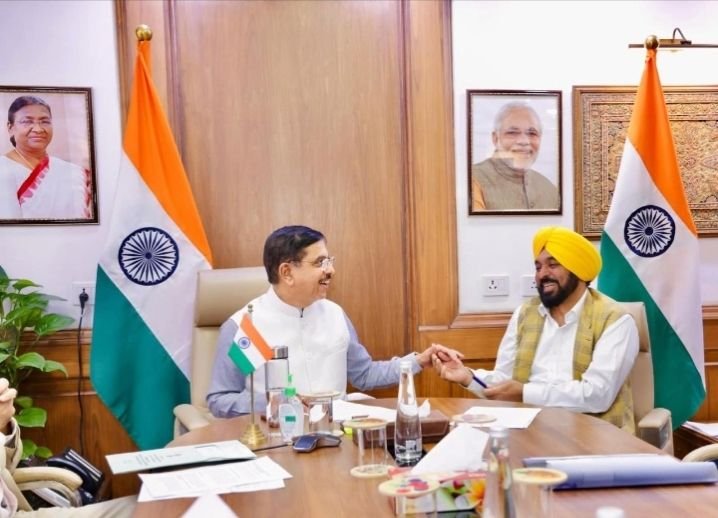
At the centre of the discussion was Punjab’s acute storage crisis, which has intensified with the onset of the Rabi Marketing Season. The Union government has agreed to deploy special trains to expedite the lifting of approximately 155 lakh metric tonnes of foodgrains currently lying in the state. This step is expected to significantly ease pressure on storage infrastructure and ensure smoother procurement operations in the coming weeks.
Punjab’s storage capacity has been stretched to its limits. With nearly the entire covered storage space already occupied—primarily by rice and wheat stocks from previous procurement cycles—only a marginal capacity remains available. The situation is further complicated by the expectation that over 130 lakh metric tonnes of wheat will arrive in mandis during the ongoing procurement season. A substantial portion of existing stock is already being stored in open or suboptimal conditions, raising concerns over quality preservation and logistical efficiency.
During the meeting, Chief Minister Bhagwant Singh Mann emphasised that timely lifting of foodgrains is not just a logistical necessity but critical to safeguarding farmers’ interests. Delays in lifting often disrupt procurement cycles, affect payments, and place additional strain on state agencies.
Beyond immediate relief, the Chief Minister raised a series of structural issues that continue to burden Punjab’s agricultural economy. Among these was the demand for the release of nearly ₹9,000 crore pending under the Rural Development Fund, a key financial resource for rural infrastructure and mandi operations. He also urged the Centre to reconsider the high interest rates imposed under the Cash Credit Limit, which significantly increase the financial burden on the state during procurement seasons.
Another major concern highlighted was the dissatisfaction among arhtiyas (commission agents), who play a crucial role in the mandi system. Their commission rates have remained largely stagnant for several years, with only a marginal increase recently approved by the Centre. While the Union government has raised the commission slightly for the upcoming season, this increment has not met the expectations of arhtiyas, who are demanding a commission linked to a fixed percentage of the Minimum Support Price.
Chief Minister Bhagwant Singh Mann urged the Centre to review the existing framework and align it with provisions under the Punjab Agricultural Produce Markets Act, arguing that a more equitable commission structure is essential to maintain the efficiency and sustainability of the mandi system.
The issue of withheld payments to mandi labourers and arhtiyas also featured prominently in the discussions. A significant portion of labour charges has reportedly been held back by the Food Corporation of India due to concerns related to EPF compliance. The Chief Minister pointed out that state agencies have been releasing payments based on undertakings from stakeholders and called for a similar approach at the central level to resolve the issue and release pending dues.
In addition, he sought compensation for farmers affected by recent unseasonal weather events, underlining the need for timely financial support to mitigate losses and maintain confidence among the farming community.
The Union Minister responded positively to the concerns raised and assured that a structured mechanism, including Secretary-level engagement, would be put in place to address pending issues and ensure coordinated action between the Centre and the state.
Reiterating Punjab’s pivotal role in the national food procurement system, Chief Minister Bhagwant Singh Mann stressed that sustained central support is essential not only for the state’s economy but also for the country’s food security framework.
For Punjab’s farmers and mandi stakeholders, the outcome of this meeting offers both immediate relief and cautious optimism. While the deployment of special trains addresses the urgent storage bottleneck, the resolution of deeper financial and policy issues will be critical in shaping the long-term stability of the state’s agrarian economy.