
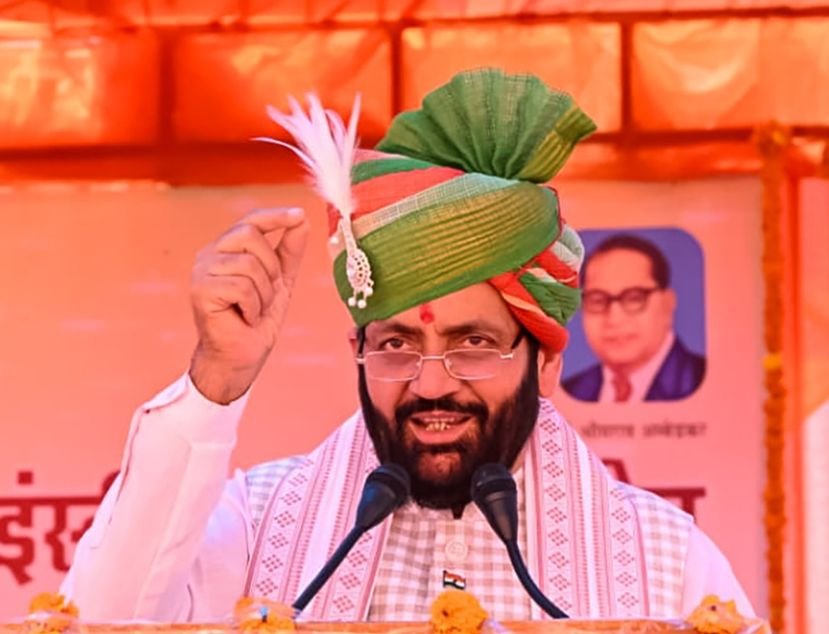
In a politically significant outreach rooted in social reform and education, Haryana Chief Minister Nayab Singh Saini reaffirmed his government’s commitment to building an inclusive and progressive society inspired by the teachings of Jyotiba Phule. Addressing a state-level commemorative event in Kurukshetra, the Chief Minister emphasized that education, equality, and social justice remain central to the state’s governance philosophy.
The occasion marked the birth anniversary celebrations of Jyotiba Phule, organized in Babain, where the Chief Minister also laid the foundation stone for a new educational initiative under the Savitribai Jyotiba Phule Group of Institutions. The event, attended by senior leaders including Haryana Agriculture Minister Shyam Singh Rana, was positioned as both a tribute to reformist ideals and a platform to announce developmental commitments ahead of evolving political dynamics in the state.
Highlighting the transformative role of education in social upliftment, Saini drew parallels between Phule’s 19th-century reform movement and contemporary governance priorities. He underscored that Phule’s lifelong struggle against caste discrimination, social inequality, and gender injustice continues to guide policy frameworks aimed at empowering marginalized communities. Referring to Savitribai Phule, he noted that the establishment of India’s first girls’ school in Pune was not merely an educational milestone but a social revolution that reshaped the country’s moral and intellectual foundations.
During the event, the Chief Minister announced approval for the establishment of a nursing college under the institution, responding to long-pending demands from local stakeholders. In addition, he sanctioned financial assistance of ₹51 lakh from the discretionary fund to support the institution’s development. Infrastructure development also featured prominently in his announcements, with a commitment to widen the Mathana-Babain road at a cost exceeding ₹13 crore, aimed at improving connectivity and facilitating regional growth.
The leadership of the organizing body, Saini Sabha Kurukshetra, presented a memorandum outlining additional demands, most of which, according to officials, received positive assurances from the Chief Minister. Complementing the state’s contribution, Agriculture Minister Shyam Singh Rana, along with another cabinet colleague, pledged financial support for the institution, reinforcing the government’s emphasis on education-led development.
In his address, Saini framed the event as more than a ceremonial gathering, describing it as an opportunity to revive the ideals of social awakening and equality championed by Jyotiba Phule. He reiterated that the Haryana government is actively promoting such values through initiatives like the Sant-Mahapurush Vichar Prasar Evam Samman Yojana, designed to disseminate the teachings of social reformers among younger generations.
The Chief Minister also linked these historical ideals to contemporary national campaigns, citing alignment with initiatives inspired by Narendra Modi, particularly in advancing women’s education and empowerment. He suggested that programmes like “Beti Bachao, Beti Padhao” echo the foundational vision laid down by Phule and his contemporaries.
While the event remained focused on social reform and education, it also carried subtle political undertones. With Haryana navigating complex socio-economic challenges—including rising concerns over youth vulnerability, substance abuse, and employment—such initiatives are increasingly being framed as part of a broader governance strategy aimed at strengthening social resilience. Though not directly addressed in the speech, the state’s ongoing efforts to tackle drug-related issues and enhance law enforcement mechanisms form a parallel track in the government’s agenda.
Observers note that the emphasis on education, infrastructure, and social justice reflects an attempt to consolidate public trust while addressing structural challenges facing the state. By invoking widely respected reformers like Jyotiba Phule, the government is seeking to anchor its policies in a legacy that transcends political divides and resonates across communities.
As Haryana moves closer to future electoral cycles, such initiatives are likely to play a pivotal role in shaping public perception. The integration of historical inspiration with modern policy delivery presents a narrative of continuity and reform—one that the current administration appears keen to project as it balances governance with political messaging.
Ultimately, the success of these announcements will depend on their execution. While symbolic gestures and financial commitments set the tone, the real measure will lie in how effectively these projects translate into tangible benefits for citizens, particularly in sectors like education and social welfare that define long-term development trajectories.