
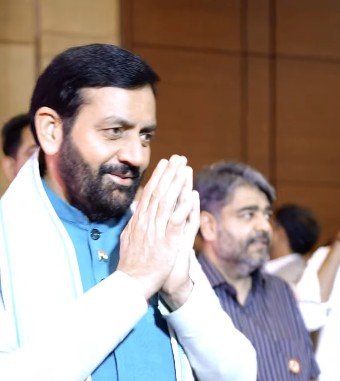
At a time when Indian states are aggressively competing to attract global capital and innovation, Haryana has stepped forward with a strong investment pitch, projecting itself as a rapidly evolving hub for manufacturing, logistics, startups, and next-generation industries. Addressing entrepreneurs and industry leaders at TiECon Chandigarh Summit 2026, Chief Minister Nayab Singh Saini outlined an ambitious roadmap aimed at transforming the state into a key driver of India’s economic growth story.
Speaking before a diverse gathering representing over a dozen countries and multiple Indian states, the Chief Minister emphasized that Haryana is no longer confined to its traditional identity as an agrarian economy. Instead, it is rapidly transitioning into a modern industrial and innovation-driven ecosystem, supported by policy reforms, infrastructure expansion, and a governance model focused on efficiency and transparency.
Saini highlighted that the state government has worked consistently to create a business-friendly environment where investors can operate with confidence. He stressed that ease of doing business and ease of living are not just policy slogans but are being implemented through digital governance, streamlined approvals, and reduced regulatory burdens. The introduction of a single-window clearance mechanism offering more than 230 services, along with the simplification of over 1,100 compliance requirements across departments, signals a deliberate attempt to eliminate bureaucratic bottlenecks that have historically deterred investors.
A key focus of Haryana’s growth narrative lies in its expanding food processing sector, which the Chief Minister described as one of the most promising areas for investment. With nearly 28,000 units already operational, the sector is witnessing rapid expansion, driven by both domestic consumption and export potential. The government is further incentivising this growth through capital subsidies and targeted schemes, particularly in underdeveloped blocks, where up to 50 percent project cost support is being offered.
Equally significant is Haryana’s emergence as a logistics powerhouse. With a substantial portion of its geography falling within the National Capital Region, the state enjoys a strategic advantage in connectivity. Saini pointed out that Haryana ranks among the top logistics destinations in India and is being developed into a critical node for supply chains, supported by integrated transport networks and proximity to key markets. The ongoing development of multimodal logistics hubs and industrial corridors is expected to further strengthen this position.
The Chief Minister also made a strong push for investments in the electric vehicle ecosystem, highlighting the state’s progressive EV policy that offers incentives for manufacturers and infrastructure developers. As India accelerates its transition towards clean mobility, Haryana aims to position itself at the forefront of EV manufacturing and innovation, particularly through planned industrial clusters and dedicated parks.
In addition to large-scale industrial development, the state is placing significant emphasis on nurturing startups and entrepreneurship. Haryana currently ranks among the leading states in terms of recognized startups, with over 9,500 ventures operating across sectors such as information technology, fintech, agri-tech, and health-tech. Notably, nearly half of these startups are led by women, reflecting a broader push towards inclusive growth. The government has set an ambitious target to increase women’s participation in the startup ecosystem to 60 percent in the coming years.
The Chief Minister also underlined Haryana’s growing contribution to India’s export economy, noting that the state recorded exports worth ₹2.75 lakh crore in the last financial year. With strong connectivity through road, rail, and air networks, Haryana continues to attract industries seeking efficient access to both domestic and international markets.
Major infrastructure projects currently underway further reinforce the state’s long-term vision. These include the development of electronics manufacturing clusters, integrated industrial townships, and sector-specific hubs designed to attract high-value investments. The expansion of industrial model townships on the lines of Manesar and the creation of specialized zones for manufacturing and logistics reflect a strategy aimed at decentralised and sustainable growth.
Political observers note that such high-profile investor outreach efforts also carry significant electoral implications. As competitive politics intensifies, showcasing economic performance and investment potential has become a central theme for governments seeking to build credibility among both voters and industry stakeholders. By positioning Haryana as a model of economic transformation, the current administration appears to be aligning governance with a broader narrative of development and opportunity.
The event concluded with assurances from the Chief Minister that the government would continue to support investors at every stage, from conceptualisation to execution. By combining policy support, infrastructure readiness, and a proactive administrative approach, Haryana is attempting to redefine its role in India’s economic landscape—moving from a regional player to a national growth engine.
As India’s economic trajectory increasingly depends on state-level innovation and execution, Haryana’s aggressive push at forums like TiECon Chandigarh signals its intent to remain at the forefront of this transformation, where governance, industry, and entrepreneurship converge to shape the future.