
Punjab’s evolving education landscape has received a powerful endorsement as Chief Minister Bhagwant Singh Mann highlighted what he described as a “transformational shift” driven by the state’s ongoing ‘Sikhya Kranti’. The latest results of the Punjab School Education Board (PSEB) Class 8 examinations have placed the spotlight firmly on this change, with girls securing 19 out of the top 20 positions—an outcome that the Chief Minister termed both historic and symbolic of deeper social progress.
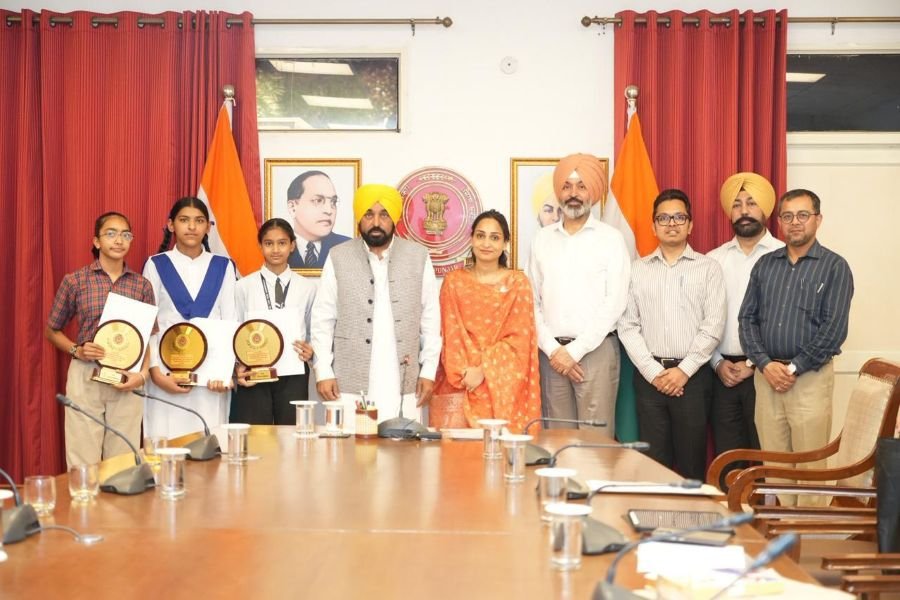
At a ceremony held at his official residence in Chandigarh, Mann personally honoured the state’s top-performing students, underscoring the government’s intent to celebrate merit while reinforcing confidence among young achievers. In a significant policy gesture, he announced that the top 20 students would be granted direct admission into the state’s prestigious Schools of Eminence without having to undergo any entrance examination. The move, he said, is aimed at ensuring that talent is nurtured without procedural barriers and that deserving students are fast-tracked into institutions designed to deliver high-quality, future-ready education.
The Chief Minister’s interaction with the toppers reflected a broader narrative that the Punjab government is keen to build—one where public education is not only accessible but also aspirational. He emphasized that the dominance of girls in the merit list is a powerful testament to their determination, discipline, and growing opportunities in the state’s academic ecosystem. Calling it a “moment of pride,” Mann noted that such outcomes indicate a gradual but decisive shift in societal attitudes, where daughters from modest households are emerging as leaders in education.
What stood out prominently in this year’s results was the socio-economic background of the toppers. The highest-ranking student, who achieved a perfect score, comes from the family of a munim working at a brick kiln, while the second and third rank holders are daughters of a small shop owner and a government school teacher respectively. These stories, Mann said, are not isolated achievements but represent a broader transformation where education is increasingly bridging economic divides and enabling upward mobility.
The Chief Minister credited sustained public investment in education for these outcomes, pointing to improvements in school infrastructure, timely availability of textbooks, enhanced teacher training, and the introduction of modern learning systems. According to him, the government’s approach has been to shift from mere enrollment numbers to measurable learning outcomes, ensuring that classrooms are not just functional but effective.
He also reiterated that education remains the top priority of his administration, describing it as the foundation for long-term socio-economic development. Over the past few years, Punjab has undertaken significant reforms in its school system, with Schools of Eminence emerging as flagship institutions meant to provide global-standard education within the public sector. By offering direct admission to meritorious students, the government is attempting to create a seamless pathway for talent to thrive without socio-economic constraints becoming a hurdle.
During the ceremony, the top three students were awarded cash prizes of ₹50,000 each, a gesture that was both symbolic and motivational. Mann urged the students to remain grounded despite their achievements and to continue pursuing excellence through consistent effort and discipline. He also advised them to choose their role models wisely, stressing that success is built not only on academic performance but also on values and vision.
The Chief Minister’s remarks also carried a broader message about the role of government schools in shaping the future of the state. He asserted that Punjab’s public education system is increasingly being seen as a model across India, challenging long-held perceptions that quality education is confined to private institutions. By strengthening government schools, the administration aims to ensure that every child, regardless of background, has access to opportunities that can transform their life trajectory.
Officials present at the event, including senior representatives from the education department, echoed similar sentiments, highlighting that the state’s education reforms are now entering a phase where results are becoming visible on the ground. The participation of over 2.6 lakh students in the Class 8 examinations further underlines the scale at which these changes are being implemented.
For Mann, the event was not merely about celebrating academic excellence but about reinforcing a larger political and social narrative—one that positions education as the cornerstone of governance. By aligning policy initiatives with tangible outcomes, the Punjab government is attempting to build credibility around its “education revolution,” particularly at a time when public service delivery is increasingly shaping political discourse.
As Punjab continues to invest in its education sector, the success stories emerging from its classrooms are likely to play a crucial role in defining both its developmental trajectory and its political narrative. The message from the Chief Minister was clear: the future of Punjab lies in empowering its youth, and education is the most powerful tool to achieve that vision.