
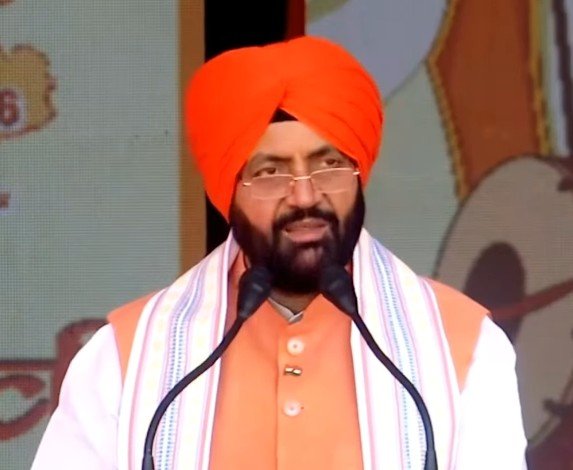
In a carefully choreographed blend of cultural celebration and governance messaging, Nayab Singh Saini used the state-level Baisakhi Mahotsav 2026 in Kurukshetra to reinforce his government’s commitment to heritage preservation, social harmony, and inclusive development, while also positioning Haryana within a broader national narrative of cultural resurgence.
Addressing a large gathering at the KDB Mela Ground, where the festival was organised under the aegis of the state’s Art and Cultural Affairs Department along with the district administration, the Chief Minister framed Baisakhi not merely as a seasonal harvest celebration but as a civilisational marker deeply rooted in India’s spiritual and social ethos.
The event, marked by vibrant cultural displays, traditional sporting events, and exhibitions, carried a distinct political undertone as the Chief Minister repeatedly invoked the teachings of Sikh Gurus as guiding principles for governance. He asserted that both the Union and state governments are actively working to take these teachings—centered on equality, service, and unity—to every household, thereby strengthening India’s cultural fabric while promoting social cohesion.
Saini began the day by inaugurating an exhibition highlighting Sikh history alongside the achievements and welfare initiatives of the Haryana government, a symbolic juxtaposition that linked historical legacy with contemporary governance. He also flagged off wrestling competitions, launched an international kite festival, and inspected the Haryana Heritage Pavilion, which showcased the state’s folk traditions and rural craftsmanship. These activities were designed not only to celebrate cultural identity but also to reinforce the government’s outreach to diverse communities.
Extending greetings on Baisakhi and paying homage to the Sikh Gurus, the Chief Minister underlined the historical significance of the day, particularly the founding of the Khalsa Panth in 1699 by Guru Gobind Singh at Anandpur Sahib. He described the moment as a turning point in Indian history, when values of courage, equality, and resistance against injustice were institutionalised through the Khalsa order. By recalling how the “Panj Pyare” came from diverse castes and regions, Saini highlighted the enduring message of social equality and unity in diversity—principles that continue to resonate in contemporary governance narratives.
At the same time, the Chief Minister situated Haryana’s developmental trajectory within the national vision of a “Developed India 2047,” led by Narendra Modi. He argued that achieving this goal would require not only economic growth but also moral and cultural grounding inspired by the teachings of great spiritual leaders. This alignment with national leadership and ideology reflects the broader political messaging strategy of the ruling establishment.
The event also served as a platform for announcing and reiterating welfare and cultural initiatives aimed at the Sikh community. Saini highlighted the establishment of the Haryana Sikh Gurdwara Management Committee in December 2022, describing it as a long-pending demand that has now granted greater administrative autonomy to Sikh institutions in the state. He further listed commemorative efforts, including large-scale celebrations of key Sikh anniversaries and the development of infrastructure projects linked to Sikh heritage.
Among the notable announcements was the upcoming launch of a pilgrimage train under the Chief Minister’s Tirth Darshan Yojana, which will depart from Kurukshetra to Nanded in May, enabling devotees to visit Takht Sri Hazur Sahib. This follows an earlier initiative where hundreds of pilgrims were facilitated to visit Ayodhya, indicating a broader push to integrate religious tourism with welfare outreach.
The Chief Minister also referred to the state’s decision to provide government jobs to one member of each of the 121 families affected by the 1984 anti-Sikh riots, presenting it as a step toward restorative justice and reconciliation. Such measures, he suggested, are aimed at healing historical wounds while ensuring socio-economic support for affected communities.
In terms of infrastructure and cultural preservation, Saini announced that Haryana’s first dedicated Sikh museum will soon be developed in Kurukshetra, with a project cost exceeding ₹124 crore. The museum, to be built on a five-acre site, is envisioned as a comprehensive repository of Sikh history, philosophy, and contributions, further embedding cultural identity into the state’s development agenda.
The Chief Minister also highlighted initiatives such as naming institutions and public infrastructure after Sikh Gurus, including a medical college and key roadways, as part of a broader effort to institutionalise cultural memory within public spaces.
Adding a spiritual dimension to the event, Swami Gyananand Maharaj praised the government’s efforts, describing the Baisakhi festival as a celebration of heritage, seasonal change, and spiritual discipline. His endorsement added a layer of moral legitimacy to the event, reinforcing its cultural significance.
Beyond the festivities, the Mahotsav underscored a larger political narrative. In a state where identity, community engagement, and cultural symbolism often intersect with electoral dynamics, such events serve as platforms for governments to connect with citizens beyond policy announcements. By blending religious reverence, historical memory, and development messaging, the Haryana government appears to be crafting a narrative that resonates across social and cultural lines.
As Haryana moves closer to future electoral cycles, the emphasis on cultural integration, welfare delivery, and symbolic outreach—evident in events like the Baisakhi Mahotsav—suggests a calibrated effort to consolidate public trust while reinforcing ideological positioning.