
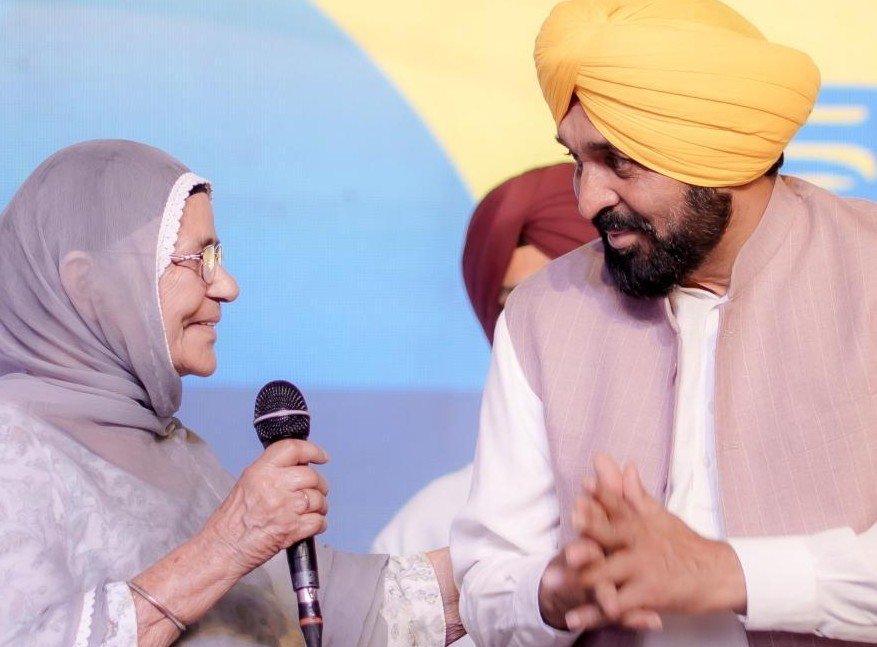
Punjab Chief Minister Bhagwant Mann transformed the state-level celebration of Dr. B.R. Ambedkar’s birth anniversary at Adampur into a politically charged platform, combining ideological messaging with sharp attacks on rival parties while projecting the Aam Aadmi Party (AAP) government’s governance model centred on education, social justice, and economic empowerment.
Addressing a large gathering, Mann invoked the legacy of B. R. Ambedkar to frame a broader political narrative, alleging that decades of rule by Congress and Shiromani Akali Dal governments had systematically deprived marginalised communities of access to education. He argued that this exclusion was not incidental but deeply political, claiming that keeping weaker sections undereducated ensured their continued dependence and limited upward mobility.
In a speech that blended governance claims with electoral messaging, Mann positioned his administration as a departure from past regimes, asserting that his government is actively dismantling entrenched inequalities by prioritising public education and direct financial support to vulnerable sections, particularly women and Scheduled Castes. He stressed that education, rather than subsidies alone, is the most sustainable tool for social transformation, echoing Ambedkar’s long-standing emphasis on learning as a pathway to empowerment.
The Chief Minister’s remarks reflected a deliberate attempt to reshape the political discourse ahead of future electoral battles. By linking historical grievances of Dalit communities with present policy interventions, Mann sought to consolidate AAP’s support base among socially and economically disadvantaged groups. His criticism extended to specific past policies, which he argued had diluted academic accountability and undermined the prospects of students from poorer backgrounds.
Central to his address was the announcement and promotion of the ‘Mawan-Dhiyan Satikar Yojana’, a flagship welfare scheme aimed at providing monthly financial assistance to women across Punjab. Under the scheme, Scheduled Caste women are entitled to ₹1,500 per month, while women from other categories will receive ₹1,000. Mann highlighted that a significant majority of women in the state stand to benefit, with funds being directly transferred to bank accounts, reinforcing transparency and direct state-citizen engagement.
The Chief Minister used the occasion to underline the broader governance philosophy of his administration, presenting welfare schemes as instruments of dignity rather than dependency. He also emphasised the government’s focus on employment generation, free electricity for households, and enhanced power supply to farmers, portraying these measures as part of a comprehensive effort to stabilise Punjab’s socio-economic landscape.
At the same time, Mann sharpened his political attack on opposition parties, accusing both Congress and Akali leadership of corruption, misgovernance, and betrayal of public trust. He alleged misuse of scholarship funds meant for disadvantaged students and criticised what he described as a legacy of policy failures that entrenched inequality rather than addressing it. His rhetoric also targeted the perceived disconnect between political elites and ordinary citizens, suggesting that previous leaders lacked an understanding of grassroots realities.
The political tone was further amplified by references to religious and historical issues, including past sacrilege incidents and the recently passed legislation aimed at ensuring stricter punishment for such acts. Mann argued that previous governments had failed to deliver justice in sensitive cases, positioning his administration as one committed to accountability and legal enforcement.
Senior AAP leader Manish Sisodia, who was present at the event, reinforced the party’s ideological positioning by linking Ambedkar’s vision with AAP’s governance model. He criticised national political developments and framed AAP’s policies as aligned with constitutional values of equality and inclusion.
The event also served as a platform to highlight AAP’s broader narrative of governance reform, with emphasis on education, healthcare, and economic redistribution. Mann reiterated that public funds are being utilised for welfare rather than political patronage, contrasting his government’s approach with what he described as decades of exploitative politics in the state.
Beyond the political rhetoric, the Ambedkar Jayanti function underscored a strategic shift in Punjab’s political landscape, where identity, welfare, and governance are increasingly intertwined. By leveraging a symbolic occasion rooted in social justice, Mann sought to reinforce AAP’s ideological legitimacy while directly engaging with voter concerns around inequality, opportunity, and representation.
As Punjab moves closer to its next electoral cycle, such events are likely to play a crucial role in shaping public perception. Mann’s address made it clear that the AAP government intends to anchor its political campaign not just in administrative achievements but in a broader narrative of systemic change—one that seeks to position the party as both a disruptor of old political structures and a custodian of Ambedkarite ideals in contemporary governance.