
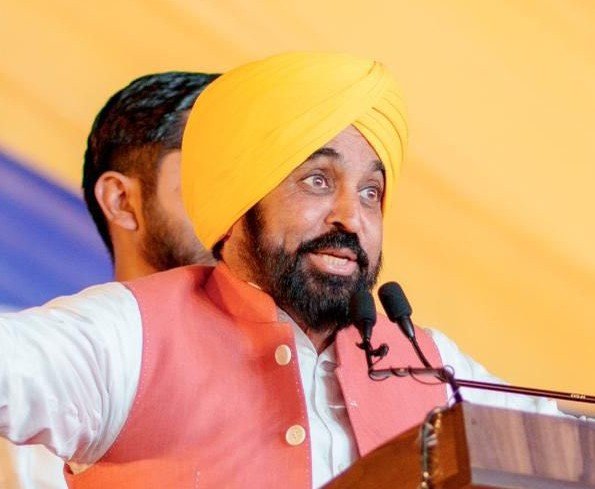
The national debate over women’s political representation and parliamentary restructuring took a sharper turn on Thursday as Bhagwant Mann weighed in on the proposed changes linked to the Constitution (131st Amendment) Bill. While reiterating his government’s firm support for women’s reservation in legislatures, the Punjab Chief Minister raised serious concerns about the manner in which parliamentary seat distribution could be altered alongside the reform.
The Bill, introduced in the Lok Sabha after a division of votes, seeks to modify provisions related to the implementation of women’s reservation. However, the broader implications of the move—particularly those tied to delimitation and the potential expansion of the House—have triggered political debate across party lines.
Mann’s position reflects a dual approach: endorsing gender representation while insisting on equity among states in any future restructuring of parliamentary seats. He argued that if the women’s quota is to be implemented, it should ideally be done on the basis of the current strength of the Lok Sabha, which stands at 543 seats. Any deviation from this, he suggested, must be handled with caution and fairness.
The Chief Minister expressed apprehension over proposals that could expand the Lok Sabha to as many as 850 seats, a possibility often discussed in the context of future delimitation exercises following the next census. According to Mann, such an expansion must ensure proportional representation for all states, rather than selectively benefiting certain regions.
Highlighting Punjab’s case, he pointed out that the state currently holds 13 seats and argued that any increase in the total number of parliamentary constituencies should translate into a proportionate rise for Punjab as well. His remarks implied a concern that uneven seat expansion could distort the federal balance and political representation across states.
Mann went further to allege that there could be a political dimension to how seat redistribution is being approached, suggesting that areas where the ruling Bharatiya Janata Party has historically performed well might see a greater increase in representation, while others could be relatively sidelined. He cautioned that delimitation—an exercise meant to ensure fair representation based on population—should not be influenced by electoral considerations.
Emphasizing the need for transparency and objectivity, Mann stated that the delimitation process must rely strictly on updated census data and follow constitutional principles. Any perception of bias, he warned, could undermine trust in democratic institutions.
Echoing similar concerns, senior Aam Aadmi Party leader Manish Sisodia also voiced support for women’s reservation but questioned the broader implications of the Bill. He argued that changes being proposed under its ambit could inadvertently alter the existing balance of parliamentary constituencies in ways that do not align with the country’s demographic realities.
Sisodia alleged that there is a growing trend of using structural changes in electoral systems for political advantage, suggesting that constituency boundaries and seat allocations should remain insulated from partisan interests. His remarks added to the intensifying discourse around the intersection of gender representation and electoral fairness.
The Bill itself was introduced after a closely contested division in the Lok Sabha, with 251 members voting in favour and 185 opposing its introduction. The numbers reflect both support for the principle of women’s reservation and unease about the accompanying structural changes.
The debate now moves beyond the question of whether women should have greater representation—a point on which there is broad consensus—to how that representation is implemented without disrupting the federal and democratic balance. For leaders like Bhagwant Mann, the issue is not just about inclusion, but also about ensuring that reforms are carried out in a manner that is equitable, transparent, and free from political bias.
As discussions continue, the spotlight remains firmly on how India navigates this complex intersection of gender justice and electoral restructuring, with states like Punjab demanding clarity and fairness before any sweeping changes are finalized.