
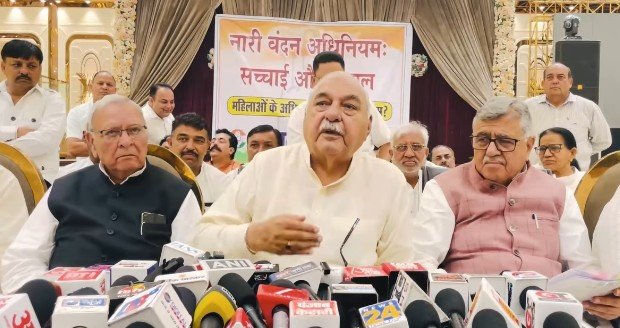
Rohtak witnessed a sharp escalation in political rhetoric as senior Congress leader and former Haryana Chief Minister Bhupinder Singh Hooda launched a pointed attack on the Bharatiya Janata Party (BJP), questioning both its intent and execution on key governance issues, including the Women’s Reservation framework and the ongoing wheat procurement season.
Addressing media interactions, Hooda raised serious concerns over the delay in implementing the much-discussed Nari Shakti Vandan Adhiniyam. He argued that despite the legislation being passed in 2023, the absence of timely notification reflects a lack of political will. According to him, the government had ample opportunity to operationalize the law once the disruptions caused by the pandemic had subsided by 2022. The continued delay, he suggested, raises broader questions about the sincerity of the ruling establishment in advancing women’s political representation.
Hooda also reacted strongly to the state government’s move to convene a special session of the Assembly, where the BJP is expected to bring in a motion critical of the opposition. He asserted that the Congress would counter this narrative by highlighting what it sees as policy failures and governance gaps. The tone of his remarks suggested that the opposition is preparing for an aggressive political confrontation in the coming days, positioning itself as a watchdog on issues of public interest.
Shifting focus to agrarian concerns, Hooda accused the government of mismanaging the wheat procurement process, a critical economic activity in Haryana. Drawing comparisons with past performance, he pointed out that during the Congress tenure, procurement levels had reached significant volumes, indicating a more efficient system. In contrast, he claimed that the current arrangement has led to confusion and distress among farmers and commission agents alike.
A key issue highlighted was the alleged delay in lifting procured wheat from mandis, which has created logistical bottlenecks. Hooda argued that despite assurances of payments being cleared within a fixed timeframe, farmers are facing delays, impacting their financial stability. For an agrarian state like Haryana, where timely procurement and payments are vital, such disruptions carry both economic and political consequences.
He further criticized the increasing reliance on digital platforms for governance, suggesting that technology cannot substitute effective ground-level administration. While acknowledging the role of digital systems, he emphasized that their success ultimately depends on seamless execution at the grassroots level. Without that, he argued, even well-intentioned reforms risk failing to deliver tangible benefits.
The remarks come at a time when political activity in Haryana is intensifying, with both ruling and opposition parties sharpening their narratives ahead of future electoral contests. Hooda’s intervention reflects a broader strategy by the Congress to consolidate its position by focusing on governance issues that directly impact citizens, particularly farmers and women.
As the debate around women’s reservation and agrarian management continues to evolve, the coming weeks are likely to see further political exchanges, with both sides attempting to shape public perception. The issues raised in Rohtak underscore the intersection of policy, implementation, and political accountability, which remains central to the state’s evolving political landscape.