
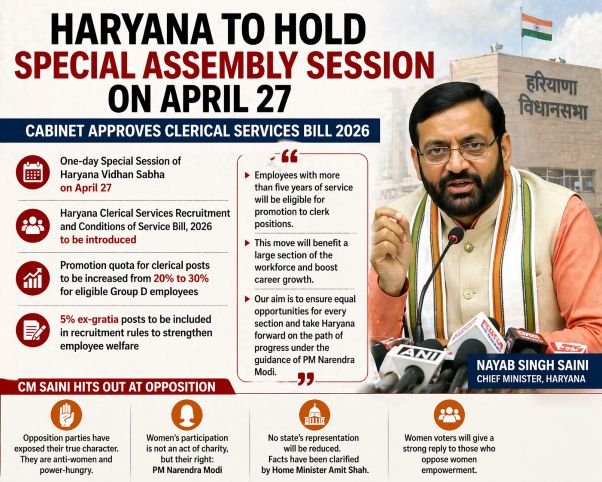
Haryana Chief Minister Nayab Singh Saini has announced that the state Cabinet has approved the convening of a one-day special session of the Haryana Legislative Assembly on April 27, a move that signals a focused legislative push toward administrative reforms and employee welfare. At the centre of this session will be the introduction of the Haryana Clerical Services Recruitment and Conditions of Service Bill, 2026, a proposal aimed at expanding career progression opportunities within the government workforce, particularly for employees in the Group D category.
The decision was taken during a high-level Cabinet meeting held in Gurugram, often described as the economic engine of Haryana, marking the first such बैठक of “Team Haryana” in the city. Addressing the media after the बैठक, the Chief Minister underlined that the proposed legislation represents a structural reform designed to create a more equitable and dynamic promotion framework within the state’s administrative system.
According to the draft provisions approved by the Cabinet, the Bill seeks to increase the promotion quota for clerical positions from the existing 20 percent to 30 percent for eligible Group D employees working under the common cadre system. The reform is expected to open new pathways for thousands of employees who have long awaited upward mobility in government service. Saini clarified that employees with more than five years of service will qualify for promotion under the revised framework, a change that significantly lowers barriers for career advancement and recognizes experience within the system.
In addition to expanding promotional avenues, the proposed legislation introduces a provision for reserving five percent of clerical posts under the ex-gratia category. This measure, officials say, is intended to further strengthen the state’s commitment to employee welfare and social responsibility, ensuring that compassionate considerations are embedded within the recruitment structure.
The Chief Minister framed the initiative as part of a broader governance philosophy aligned with the vision of Narendra Modi, emphasizing inclusive growth and equal opportunity across all sections of society. He noted that empowering lower-tier employees through structured promotions not only improves morale but also enhances administrative efficiency by retaining experienced personnel within the system.
Beyond administrative reforms, Saini used the occasion to deliver a sharp political critique of opposition parties, referencing recent parliamentary developments. Without naming specific parties, he accused the opposition of resisting measures aimed at enhancing women’s representation and empowerment. He argued that such positions reveal a deeper reluctance to enable meaningful participation of women in governance.
Reiterating the Centre’s stance, the Chief Minister invoked remarks by Narendra Modi, stating that women’s participation in governance should be viewed as a fundamental right rather than a concession. He also dismissed concerns raised by critics regarding delimitation, pointing to clarifications already provided by Amit Shah that no state’s parliamentary representation would be adversely affected.
Political observers believe the upcoming Assembly session is likely to witness robust debate, not only on the clerical services reform but also on broader questions of representation, administrative restructuring, and governance priorities in Haryana. The Bill is being seen as a significant step toward modernising the state’s human resource framework, especially at a time when demands for transparency, fairness, and upward mobility in public employment are intensifying.
If enacted, the legislation could mark a turning point in how entry-level and support staff within the Haryana government perceive their long-term career prospects. For the Saini administration, the move also carries political significance, reinforcing its narrative of pro-employee governance while simultaneously positioning itself as a champion of structural reform.
As the April 27 session approaches, attention will remain firmly on the Assembly proceedings, where the proposed Bill is expected to set the tone for Haryana’s administrative and political discourse in the months ahead.