
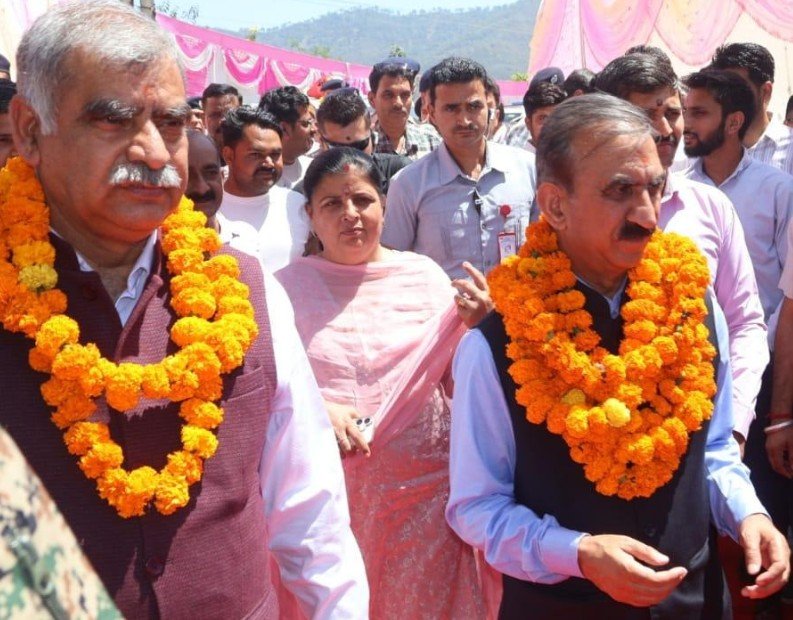
In a politically charged yet development-focused address in Himachal Pradesh’s Kangra district, Chief Minister Sukhvinder Singh Sukhu unveiled a series of infrastructure and welfare initiatives aimed at transforming the Fatehpur विधानसभा क्षेत्र, while simultaneously launching a sharp critique of the previous government led by Bharatiya Janata Party.
Addressing a large public gathering in Jakhbar, Fatehpur, the Chief Minister announced a financial outlay of ₹10 crore for the establishment of an industrial area in the region, positioning it as a catalyst for local employment and economic expansion. He also declared that the office of the Chief Engineer of the Shah Canal project, which had earlier been shifted to Mandi, would be reinstated in Fatehpur, a move expected to restore administrative accessibility and regional importance.
Further strengthening grassroots institutions, Sukhu announced financial assistance of ₹20,000 each for Mahila Mandals in the constituency and sanctioned ₹50 lakh for the renovation of Wazir Ram Singh Stadium. These measures, he said, reflect the government’s commitment to both social empowerment and sports infrastructure.
Highlighting political narratives, Sukhu praised local legislator Bhavani Singh Pathania, noting his decision to leave a high-paying private sector job to enter public service. He described Pathania as a leader closely connected to grassroots concerns and committed to regional development.
However, the speech also carried a strong political undertone as Sukhu contrasted his government’s fiscal constraints with what he described as the previous administration’s financial advantage. He claimed that the earlier regime received significantly higher central assistance, including revenue deficit grants and GST compensation, yet failed to translate these funds into sustainable development. He alleged that large sums were spent on constructing buildings that remain unused, suggesting inefficiency and misplaced priorities.
The Chief Minister further accused the previous government of administrative irregularities, particularly in healthcare schemes, claiming discrepancies that warranted investigation. He stated that his administration has already initiated inquiries into such matters to ensure accountability.
Focusing on governance reforms, Sukhu emphasized that his government is prioritizing transparency and public-centric policymaking. He cited improvements in the education sector as a key achievement, noting that Himachal Pradesh has climbed significantly in national rankings. Initiatives such as the introduction of English-medium education from the प्राथमिक स्तर and the expansion of schools under a national curriculum framework were highlighted as steps toward bridging rural-urban disparities.
In the healthcare sector, Sukhu pointed to the establishment of model health institutions across constituencies, including Fatehpur, where specialist doctors and modern equipment are now available. He stressed that access to quality healthcare should not be limited by geography.
The Chief Minister also outlined measures aimed at strengthening the rural economy. These include enhanced procurement prices for agricultural and dairy products, along with the development of a ₹200 crore milk processing plant in Kangra. Policies supporting fisheries and direct income support during seasonal restrictions were also announced, reflecting a broader strategy to stabilize rural livelihoods.
Social welfare remained a central theme, with Sukhu reiterating his government’s commitment to vulnerable sections, including orphaned children, widows, and economically weaker families. He highlighted ongoing efforts to identify the poorest households and extend targeted benefits through schemes designed to ensure financial security and access to basic services.
Addressing long-standing regional concerns, Sukhu mentioned steps taken to support families displaced by the Pong Dam project, including land allocation on a lease basis. He also spoke about infrastructure projects such as bridges and administrative buildings that are expected to enhance connectivity and governance efficiency in the region.
The event underscored the dual narrative shaping Himachal Pradesh’s current political landscape—development-driven announcements coupled with pointed political messaging. As the state moves toward future electoral contests, such public engagements are likely to play a crucial role in shaping voter perception and consolidating regional support.
By combining infrastructure investment, welfare initiatives, and political critique, Sukhu’s address signaled an attempt to reinforce his government’s developmental credentials while challenging the legacy of the opposition.