
Saptrishi Soni:
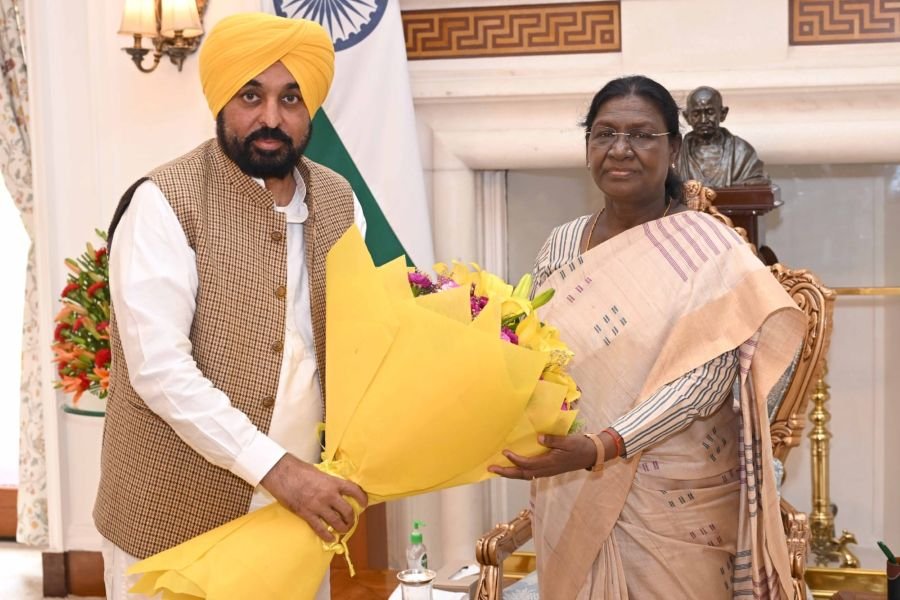
Punjab Chief Minister Bhagwant Singh Mann on Tuesday took an intensifying political confrontation over recent defections to the highest constitutional office, meeting the President in New Delhi and seeking the cancellation of the membership of several Rajya Sabha members who, he alleged, had switched allegiance in violation of democratic norms. The move marks a significant escalation in the dispute, with the state leadership framing the issue as a test of constitutional propriety and federal balance.
Arriving in the capital accompanied by legislators from Punjab, the Chief Minister submitted a memorandum endorsed by members of his party, arguing that the shift of multiple Upper House members to the Bharatiya Janata Party amounted to a distortion of the electoral mandate. He contended that the numerical rise of the party in the Rajya Sabha, despite its limited legislative presence in Punjab, raised fundamental questions about the integrity of representative democracy.
Addressing the media after the meeting, Mann described the defections as unconstitutional and urged that those involved should have first relinquished their positions before aligning with another political formation. He maintained that the actions of the lawmakers undermined the spirit of parliamentary representation, asserting that such shifts could not be justified as routine political realignment but instead reflected a breach of public trust.
The Chief Minister went further, calling for broader institutional reform, including the introduction of a legal provision that would allow voters to recall elected representatives under specific circumstances. Such a mechanism, he argued, would serve as a deterrent against opportunistic defections and reinforce accountability within the political system.
Framing the issue in sharper political terms, Mann accused the ruling party at the Centre of using investigative agencies as instruments of coercion, alleging that leaders facing scrutiny were able to secure relief after switching political sides. He described this pattern as corrosive to democratic institutions, suggesting that it created incentives for political defection rather than principled governance.
The controversy has also revived debate around so-called “Operation Lotus,” a term used by opposition parties to describe alleged efforts to engineer defections in state legislatures and Parliament. Mann asserted that such strategies would not succeed in Punjab, where, he said, political consciousness among voters remained strong and resistant to what he characterised as external interference.
In a pointed message to the defecting members, the Chief Minister challenged them to resign and seek a fresh mandate from the electorate if they believed their decisions reflected genuine public support. He argued that legitimacy in a लोकतांत्रिक व्यवस्था rests not merely on holding office but on maintaining the confidence of the electorate that enabled that position in the first place.
The Chief Minister also indicated that legal accountability would not be compromised by political affiliations, warning that any evidence of wrongdoing would be pursued irrespective of party alignment. He stressed that joining a different political platform would not grant immunity from investigation or prosecution under state laws.
Beyond the immediate dispute, Mann used the occasion to reiterate long-standing grievances regarding the Centre’s approach to Punjab. He alleged that the state had faced repeated instances of neglect in matters ranging from institutional control to financial allocations, claims that have frequently surfaced in the broader federal discourse between state governments and the Union administration.
The meeting and subsequent statements reflect a broader political strategy aimed at consolidating support within Punjab while positioning the issue as part of a national debate on democratic norms. By taking the matter directly to the President, the Chief Minister has sought to elevate what might otherwise have remained a partisan disagreement into a constitutional question requiring institutional scrutiny.
Political observers note that the development comes at a time when party alignments across several states remain fluid, and the role of central agencies and legislative mechanisms in shaping political outcomes continues to be contested. The episode is likely to intensify debate in Parliament and beyond, particularly around the interpretation of anti-defection laws and the limits of political realignment.
For now, the focus shifts to how constitutional authorities respond to the memorandum and whether the issue prompts any formal review of the circumstances surrounding the defections. Regardless of the outcome, the confrontation underscores the evolving dynamics of Indian politics, where questions of mandate, legitimacy, and institutional balance are increasingly at the forefront of public discourse.