
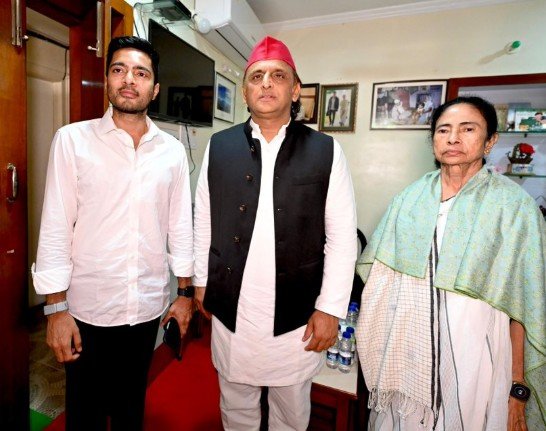
In a politically significant development amid evolving opposition dynamics in the country, Akhilesh Yadav met Mamata Banerjee in Kolkata on Thursday and expressed solidarity with the leadership of the All India Trinamool Congress following the party’s recent electoral setback in the West Bengal Assembly elections.
The meeting took place at Mamata Banerjee’s residence in Kalighat and drew considerable political attention as opposition parties across India continue to reassess strategies and strengthen communication channels after a series of state election outcomes. Akhilesh Yadav was warmly received by TMC national general secretary Abhishek Banerjee before holding discussions with the Bengal Chief Minister.
Political observers viewed the interaction as more than a courtesy visit, seeing it instead as a reflection of growing efforts among regional leaders to maintain dialogue and cooperation in the changing national political landscape. The meeting also highlighted the continuing importance of regional parties in shaping opposition politics and reinforcing democratic coordination across states.
Sources familiar with the discussions indicated that the interaction focused on the current political environment, the need for stronger issue-based cooperation among opposition parties and the importance of protecting democratic institutions and regional voices. Both leaders are regarded as influential figures with strong grassroots support in their respective states, and the meeting underscored the significance of regional political leadership in national discourse.
Akhilesh Yadav’s visit was seen as a gesture of political goodwill and solidarity at a time when opposition parties are navigating a period of transition and introspection following recent electoral contests. His outreach also reflected an emphasis on maintaining communication and unity among parties that advocate federal values and regional aspirations.
The Samajwadi Party chief has consistently positioned himself as a leader focused on social justice, democratic participation and coalition-based politics. His interaction with Mamata Banerjee reinforced the broader message that opposition politics in India continues to remain active, adaptive and interconnected despite electoral setbacks in some regions.
Mamata Banerjee, meanwhile, remains one of the most prominent regional leaders in Indian politics and continues to play an important role in opposition coordination at the national level. The meeting at Kalighat therefore carried symbolic and strategic importance, particularly at a time when political parties are preparing for future electoral battles and exploring new alignments.
While no formal political announcement emerged from the discussions, the optics of the meeting conveyed a clear message of mutual respect, continued engagement and shared democratic commitment between two major opposition leaders. Analysts believe such interactions are likely to gain greater significance in the months ahead as political parties work towards recalibrating strategies and strengthening alliances in an increasingly competitive national political environment.