Saptrishi Soni।
Punjab’s political landscape is witnessing an increasingly sharp confrontation between the state’s ruling Aam Aadmi Party (AAP) government and the Akal Takht, the highest temporal authority of the Sikh community, with both sides hardening their positions on issues that have steadily moved beyond governance into the realm of religious authority and public perception.
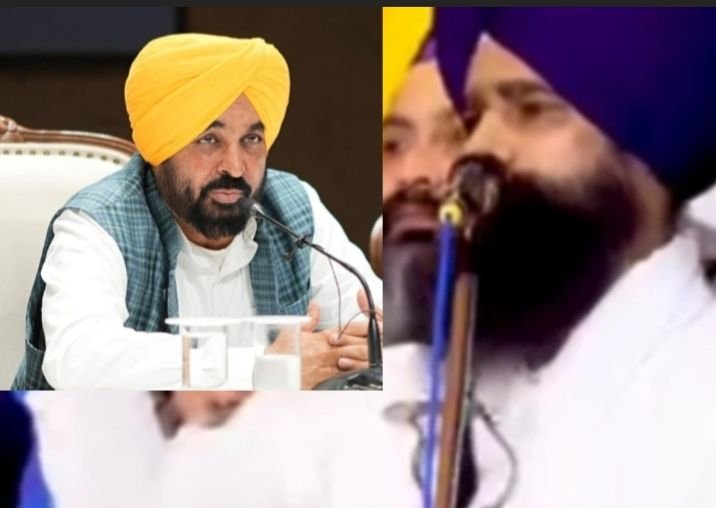
The latest escalation came when Akal Takht Jathedar Giani Kuldeep Singh Gargaj alleged that organised social media operations were being run from two centres—one in Mohali and another in Chandigarh—to malign the Akal Takht and other revered Sikh institutions.
Addressing a Panthic congregation convened by the Shiromani Gurdwara Parbandhak Committee (SGPC) at the Golden Temple in Amritsar, the Jathedar claimed that individuals allegedly operating from these locations, including people “from Delhi”, were systematically attempting to create a negative narrative against Sikh religious institutions.
He urged the Punjab government to act within ten days against those allegedly involved in the campaign, warning that if no action was taken, members of the Sikh Panth would march to the identified locations and seek to have the operations shut down.
Although the Jathedar did not publicly present evidence supporting the allegations, his statement represents one of the strongest warnings issued by the Akal Takht since its recent differences with the Punjab government began to intensify.
The Aam Aadmi Party rejected the allegations outright.
AAP spokesperson Baltej Pannu denied the existence of any such facilities or organised social media centres linked to the party. He said the party neither operated the alleged IT cell nor any centre designed to target Sikh religious institutions.
The exchange is the latest chapter in a widening dispute that has unfolded over recent months between the Akal Takht and the Bhagwant Mann government.
The relationship became increasingly strained after disagreements over the Punjab government’s Jaagat Jot Sri Guru Granth Sahib Satkar (Amendment) Act, 2026. While the Mann government has defended the legislation as one of the country’s toughest legal measures against acts of sacrilege, providing for stringent punishment including life imprisonment, the Akal Takht and the SGPC have argued that the legislation was enacted without adequate consultation with the Sikh Panth and contains provisions they believe encroach upon matters traditionally governed by Sikh religious authority.
The confrontation later expanded beyond legislation. The Akal Takht declared Chief Minister Bhagwant Mann “Guru Dokhi” and “Khalsa Panth Virodhi” over a controversial video that it considered objectionable. Mann denied appearing in the video, maintaining that the individual shown was wearing a mask resembling him, and reiterated that he respects the authority of the Akal Takht.
The latest Panthic gathering also adopted a Gurmata reaffirming the supremacy of the Akal Takht and resolved to organise similar congregations across Punjab. These meetings are expected to engage the Sikh community on issues concerning religious institutions, Panthic traditions and the role of the Akal Takht.
Political analysts say the dispute has gradually evolved into a broader contest over public influence rather than a disagreement confined to a single issue. Religious authority and electoral politics have historically intersected in Punjab, where institutions such as the Akal Takht and the SGPC command significant moral influence among sections of the Sikh community, while elected governments derive their legitimacy from democratic mandates.
With the next Punjab Assembly election approaching, both the ruling AAP and opposition parties are expected to sharpen their outreach to voters. Since forming the government with a decisive mandate in 2022, the Aam Aadmi Party has sought to project itself as a governance-focused administration through welfare programmes, anti-corruption initiatives, education reforms and public service delivery. The party continues to hold a substantial legislative majority, giving it an organisational advantage as preparations for the next electoral contest gather pace.
At the same time, opposition parties, including the Shiromani Akali Dal and the Congress, have increasingly aligned themselves with issues raised by Sikh religious institutions, arguing that questions relating to Panthic traditions and institutional autonomy deserve wider public attention. The Akali Dal, whose political identity has long been intertwined with Panthic politics, has been particularly vocal in supporting the Akal Takht on recent controversies.
Observers caution, however, that while religious institutions have considerable influence in shaping public opinion on matters of faith, electoral outcomes in Punjab are also driven by governance, employment, agriculture, law and order, and economic concerns. As a result, the political impact of the current confrontation will depend on how voters weigh religious issues alongside everyday governance.
For now, the dispute reflects two parallel narratives unfolding in Punjab. The Akal Takht and allied Panthic bodies argue they are defending the autonomy and dignity of Sikh institutions, while the AAP government maintains that it remains committed to respecting religious institutions and rejects allegations of orchestrating campaigns against them.
Whether the current war of words remains confined to public statements or develops into a larger political mobilisation is likely to become clearer in the months ahead. With election season gradually approaching, both religious and political stakeholders appear determined to carry their respective narratives directly to the people of Punjab, ensuring that the debate over faith, governance and public trust remains at the centre of the state’s political discourse.