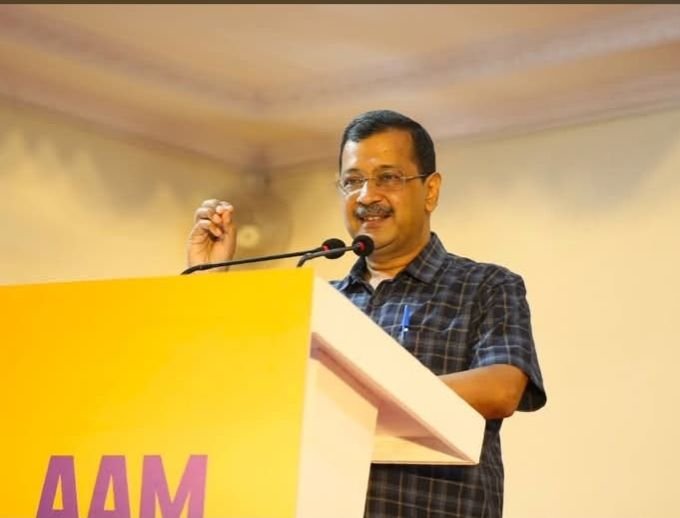
Saptrishi Soni: The political battle over Punjab’s drug crisis has intensified, with Aam Aadmi Party national convenor Arvind Kejriwal claiming that the state has substantially reduced the flow of narcotics from Pakistan while accusing BJP-ruled states of becoming major sources of drugs reaching Punjab.
In a post on social media, Kejriwal said that when the AAP government came to power in Punjab in 2022, around 80 per cent of the drugs entering the state were allegedly coming from Pakistan. He claimed that the deployment of anti-drone systems and intensified enforcement had significantly disrupted that supply route, reducing its alleged share to around 20 per cent.
Kejriwal then made a much broader political claim, alleging that approximately 80 per cent of the drugs now reaching Punjab originate from states governed by the BJP, including Gujarat, Rajasthan, Haryana, Uttar Pradesh and Delhi. He questioned whether the BJP governments in these states were unable to stop the trafficking networks or were unwilling to act against them.
The claims come at a time when drugs have once again moved to the centre of Punjab’s political debate, with the state preparing for the next Assembly election and rival parties increasingly using the issue to challenge one another’s record. The BJP has also begun an anti-drug campaign in Punjab, while the Congress has accused both the AAP government and the BJP-led Centre of turning the drug problem into a political contest rather than dismantling the networks behind the supply chain.
Kejriwal specifically raised the issue of the movement of narcotics through Gujarat’s Mundra port, arguing that control over ports and international entry points falls substantially within the Centre’s responsibilities. His intervention therefore shifts the political argument from Punjab’s borders alone to the wider national supply chain.
The distinction is important. Punjab’s geographical position along the Pakistan border has historically made cross-border trafficking a major security concern. Security agencies have increasingly confronted the use of drones to move drugs and weapons across the border. Recent reporting has also highlighted other methods allegedly used by traffickers, including attempts to exploit waterways and human couriers, underlining the adaptability of organised narcotics networks.
The debate, however, is now moving beyond traditional narcotics such as heroin and opium derivatives. The growing availability and use of synthetic and chemical drugs is emerging as a new challenge for Punjab, potentially making the drug problem more difficult to tackle through conventional border surveillance alone.
Synthetic narcotics can be produced or processed through supply chains that are not necessarily dependent on a direct Pakistan-to-Punjab route. That makes the question of precursor chemicals, pharmaceutical diversion, clandestine manufacturing, interstate transportation and online networks increasingly important to the state’s anti-drug strategy.
For Punjab, this represents a significant shift in the nature of the challenge. Preventing drones from crossing the international border can disrupt one route, but it does not necessarily eliminate demand or prevent alternative suppliers from entering the market. A sustainable anti-drug campaign therefore requires action at several levels — border security, interstate policing, financial investigations, control of precursor chemicals, dismantling of trafficking networks and rehabilitation of people affected by addiction.
The AAP government has sought to present Punjab as a state taking a more aggressive approach against the drug trade. The party has recently argued that Punjab is waging one of the country’s most decisive battles against narcotics, while Chief Minister Bhagwant Mann has highlighted large-scale action against drug traffickers and criminal networks.
But the political counterattack has been equally strong. Congress Leader of Opposition Partap Singh Bajwa has accused both AAP and BJP of concentrating on political optics rather than dismantling the drug mafia. The BJP, meanwhile, has begun organising anti-drug yatras in Punjab, seeking to turn narcotics into a major political issue ahead of the Assembly election.
This has created an increasingly sharp contest over who can claim ownership of the anti-drug narrative.
For Kejriwal and the AAP, the argument is straightforward: Punjab has taken action against a major cross-border route and should not be blamed for drugs entering the state through networks operating elsewhere. By pointing towards Gujarat, Rajasthan, Haryana, Uttar Pradesh and Delhi, Kejriwal is attempting to broaden the debate from Punjab’s policing record to the performance of governments across the country.
For the Opposition, however, the continuing availability of drugs in Punjab remains evidence that the problem cannot be declared solved simply because one trafficking route has been disrupted.
The emergence of chemical and synthetic drugs makes that argument even more relevant. Punjab’s next phase of the anti-drug campaign may depend less on where a particular consignment crosses the border and more on whether authorities can trace the entire chain — from chemical suppliers and manufacturers to interstate transporters, financiers, distributors and local dealers.
The political rhetoric is likely to intensify as the 2027 Punjab Assembly election approaches. But behind the competing claims lies a more complicated reality: the state’s drug problem is no longer simply a story of drugs crossing the Pakistan border. It is increasingly a story of multiple supply routes, evolving trafficking technology, synthetic substances and a battle over who controls the wider narcotics economy.
For Punjab, the real test will ultimately be measured not by political claims or anti-drug campaigns, but by whether the availability of drugs falls, trafficking networks are dismantled and fewer young people are drawn into addiction.