
TARN TARAN, Kumar Soni:
Shiromani Akali Dal (SAD) president Sukhbir Singh Badal has accused the Aam Aadmi Party (AAP) government in Punjab of resorting to what he described as “fear politics” ahead of the 2027 Assembly elections, questioning why the ruling party was warning voters about the consequences of supporting the opposition instead of highlighting its own record in government.
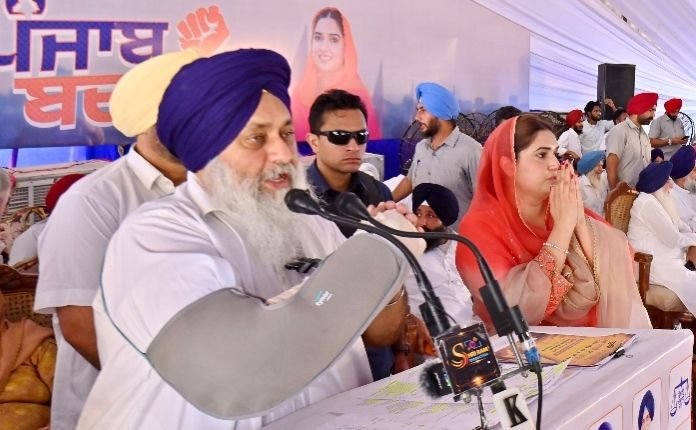
Addressing a large rally in Tarn Taran as part of the SAD’s Punjab Bachao campaign, Badal said AAP workers had begun a door-to-door campaign in villages and were distributing pamphlets that, according to him, warned people that several welfare schemes and government initiatives could be discontinued if the SAD returned to power. The AAP had formally launched its campaign for the 2027 Punjab Assembly elections in Ludhiana a day earlier and released its own election pamphlet outlining what it described as the achievements of the Bhagwant Mann government.
Badal challenged AAP to present a list of its achievements for Punjab rather than telling voters what might happen if they voted for the opposition. He alleged that the ruling party had failed on several fronts and was now attempting to influence voters by creating apprehensions about a possible return of the SAD.
One of the central issues raised by Badal was the drug problem in Punjab. He referred to claims being circulated through the AAP’s campaign that drugs could become freely available if the SAD came back to power. Badal questioned what, in his view, could be worse than the existing situation, arguing that an entire generation was already facing the consequences of drug abuse. His comments come at a time when the drug issue has become one of the major political battlegrounds in Punjab, with the ruling AAP and opposition parties trading allegations over the effectiveness of government action.
Badal also disputed claims that an SAD government would shut down Aam Aadmi Clinics. He argued that the clinics had been established after repainting existing Sewa Kendras and removing doctors from some village dispensaries. He similarly rejected suggestions that welfare and pilgrimage-related programmes would be discontinued under an SAD government, claiming that several such schemes had originated during previous Akali governments.
He alleged that AAP had discontinued or weakened schemes including the Aata-Daal programme, the Shagun scheme, free bicycles for girls, Sewa Kendras and free chemist shops. These are political claims made by the SAD and were central to Badal’s criticism of the Mann government.
Badal also criticised the handling of the Amritsar Bus Rapid Transit System, describing the project as an important piece of public transport infrastructure for the city. He alleged that the project was being disposed of at a very low value. The BRTS issue has remained part of the wider debate over how successive Punjab governments have dealt with the system and its infrastructure.
Agriculture and power supply formed another important part of Badal’s address. He criticised the suggestion that farmers could lose daytime electricity under a future SAD government, arguing that farmers were currently receiving limited hours of supply. He also pointed to the role of previous Akali governments in establishing thermal power projects in Punjab.
Water rights, another politically sensitive issue in Punjab, also featured prominently in Badal’s speech. He rejected allegations that an Akali government would divert Punjab’s water to Rajasthan, saying the SAD had already committed itself to seeking greater use of the state’s water resources for Punjab’s agricultural needs. He also promised to pursue the channelisation of the Beas and Sutlej rivers.
The SAD president used the rally to announce a series of proposed measures that he said would be implemented if his party returned to power. These included immediate tubewell connections for farmers who had been denied connections, distribution of 50 kg of wheat to beneficiaries under the Aata-Daal scheme, an increase in the Shagun benefit to Rs 1 lakh and an old-age pension of Rs 3,100 per month.
Badal also announced proposals for medical and veterinary colleges at every district headquarters and interest-free loans of up to Rs 10 lakh for young entrepreneurs. He promised a 75 per cent subsidy for livestock and agriculture-related projects, five-marla plots for homeless families, registration of houses located within village Lal Dora areas and the strengthening of roads and drains across Punjab’s villages.
He further said government jobs would be reserved for Punjabis, while promising that roads and drainage infrastructure in the state’s 11,000 villages would be strengthened.
The SAD leader also invoked the political legacy of his father, former Punjab chief minister Parkash Singh Badal, saying he was prepared to make sacrifices for the development of Punjab and continue his father’s political legacy.
Senior SAD leader Bikram Singh Majithia, who also addressed the Tarn Taran rally, raised a separate issue concerning farmers living along the Pakistan border. He called for an increase in compensation for farmers who cultivate agricultural land located beyond the barbed-wire fencing along the international border.
The Tarn Taran rally comes as Punjab’s political parties intensify their campaigns ahead of the 2027 Assembly elections. The AAP has begun its statewide campaign by highlighting its governance record and welfare measures, while the SAD is attempting to rebuild its political base through the Punjab Bachao campaign. The political contest is also being shaped by the emergence of the Amritpal Singh-led Waris Punjab De as another force seeking influence in the state, particularly in parts of the Majha region.
Badal also questioned why the AAP’s campaign material, while targeting the SAD, did not focus on Waris Punjab De. He alleged that the organisation had been supported by elements within the AAP and claimed that government resources were being used to finance it. He did not provide details or evidence for the allegation, and it remains a political claim rather than an established finding.
The exchange reflects the increasingly confrontational nature of Punjab’s political campaign, with AAP seeking to defend its record in government and the SAD challenging it on drugs, welfare, agriculture, power, infrastructure and Punjab’s water interests. For voters, the competing claims are now increasingly being accompanied by concrete promises from the opposition and a detailed account of governance from the ruling party, setting the stage for a broader debate over the state’s policy priorities ahead of the 2027 election.