Punjab Chief Minister Bhagwant Singh Mann sought to turn his government’s record in welfare delivery and public services into the central political narrative for the 2027 Assembly elections, saying the people of Punjab were witnessing a clear difference between what he called “Kaam Ki Rajneeti” and the “family politics” of earlier governments.
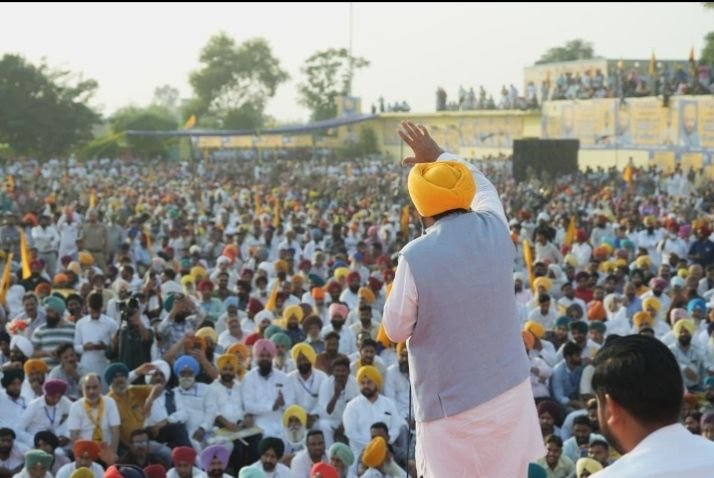
Addressing a large Lok Milni at Ghanie Ke Bangar in the Fatehgarh Churian Assembly constituency, Mann highlighted free electricity, healthcare, irrigation, education and financial assistance for women as the principal pillars of his government’s governance model. He said the objective was to ensure that government schemes translated into direct relief for ordinary families rather than remaining confined to administrative announcements.
Mann said around 90 per cent of Punjab’s households were receiving zero electricity bills and cited the government’s Mukh Mantri Sehat Yojana, under which families can receive healthcare treatment coverage of up to ₹10 lakh. He presented the two initiatives as examples of his government’s effort to reduce the financial burden on households and make essential public services more accessible.
The Chief Minister also placed agriculture and water management prominently in his account of the government’s performance. He said canal-water utilisation had risen to 88 per cent of agricultural land, arguing that greater dependence on canal irrigation could help reduce pressure on Punjab’s rapidly depleting groundwater resources. The 88 per cent figure has also been cited by Mann at other recent public programmes.
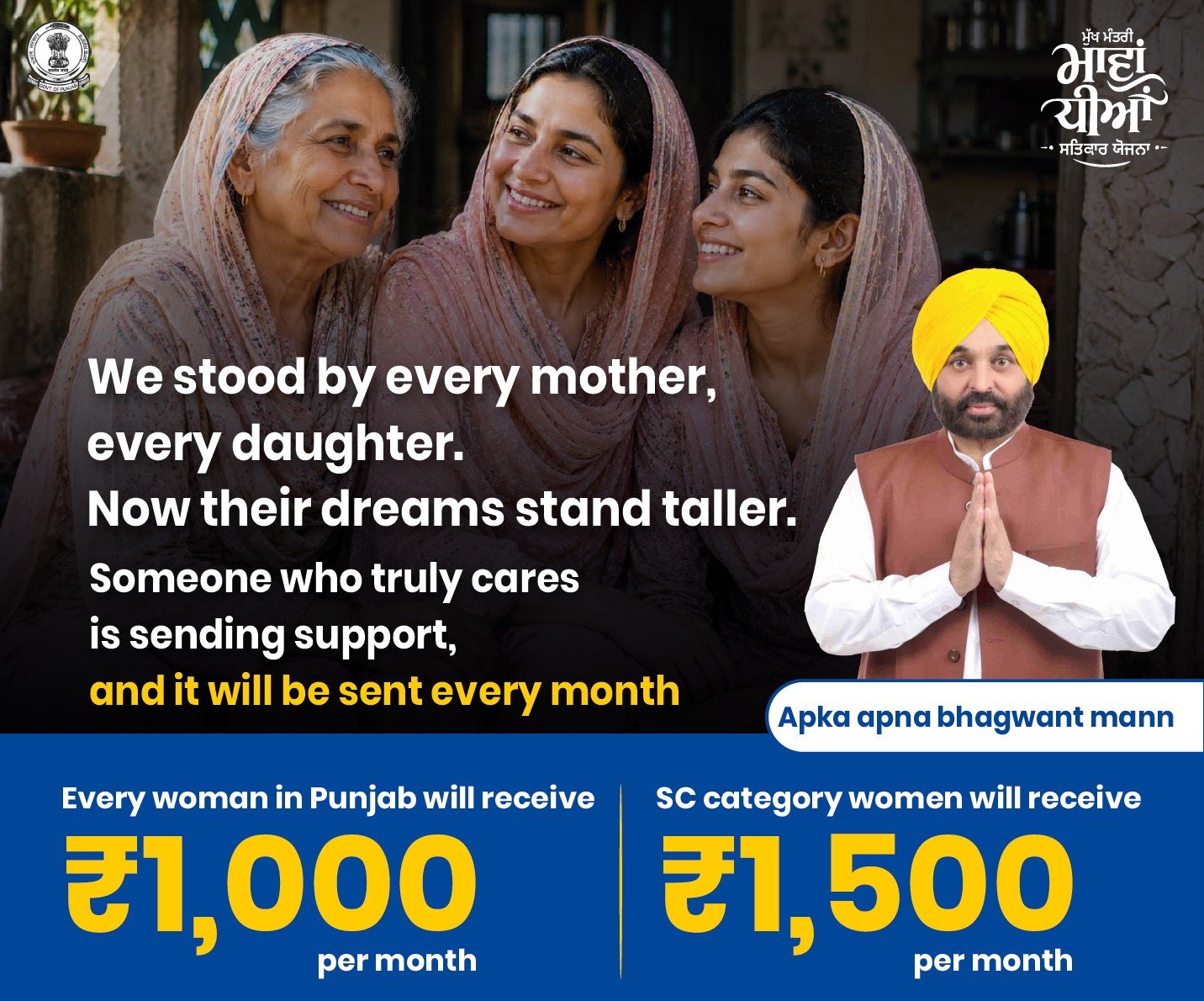
Women’s welfare was another major theme of his address. Mann highlighted direct financial assistance for women and described such measures as part of a broader effort to provide economic support to families. The state’s Maavan Dheeyan Satkar Yojana has been one of the government’s prominent recent welfare initiatives, under which financial assistance is being transferred directly to eligible women.
Mann used the occasion to make a sharp political comparison with Congress and the Shiromani Akali Dal. He accused successive governments of allowing family interests and dynastic politics to dominate Punjab’s political system, arguing that voters should instead judge governments by what they deliver in areas such as education, healthcare, electricity, irrigation, employment and infrastructure.
The Chief Minister claimed that his government had accomplished more in four-and-a-half years than Congress and Akali governments had delivered during their combined 22 years in power. That assertion formed part of his wider argument that Punjab’s political discourse should move away from personalities and political families and towards measurable governance outcomes.
Education occupied a particularly important place in Mann’s address. He said the government had transformed state-run schools that had suffered from years of neglect by improving infrastructure, facilities and the overall learning environment. He argued that strengthening government schools was essential because a large section of Punjab’s children depended on the public education system.
Mann further claimed that these reforms had helped Punjab achieve the top position in national education assessments. His government has repeatedly highlighted education reforms, school infrastructure and public-sector institutions as major components of its governance agenda.
The Chief Minister also linked his government’s policies on electricity, healthcare and irrigation to the broader economic pressures faced by Punjab’s families. According to Mann, reducing household expenditure on basic services while improving public institutions was central to the model of governance being pursued by his administration.
At the Lok Milni, Mann also interacted with residents and heard their concerns regarding local development and public services. He said such direct interactions allowed the government to understand problems at the constituency level and promised that issues raised by residents would be referred to the concerned departments for examination and necessary action.
The political tone of the programme, however, was unmistakable. With Punjab moving closer to the 2027 Assembly election cycle, Mann sought to frame the contest around the record of governance rather than the traditional political alignments of the state.
He also attacked the Congress, Akali Dal and BJP, alleging that the parties were attempting to regain political influence after having governed Punjab at different points in the past. Mann urged voters to examine the record of each political formation and decide on the basis of its performance.
His remarks echoed a broader strategy that he has adopted in recent public meetings: presenting AAP’s administration as a government focused on welfare delivery and public services while portraying traditional parties as representatives of an older political system. At a previous Lok Milni in Moga, Mann similarly highlighted free electricity for 90 per cent of households, expansion of canal irrigation and government recruitment as evidence of his administration’s performance.
Mann’s emphasis on governance also comes as the AAP government enters the final phase of its current term. The Chief Minister has increasingly used public outreach programmes to underline the government’s welfare and development record and to directly engage with voters across Punjab.
At Fatehgarh Churian, he said Punjab’s major challenges—including unemployment, drug abuse, groundwater depletion and weaknesses in public infrastructure—could not be addressed through political announcements alone. Sustained administrative action, he argued, was required to strengthen public institutions and improve the quality of services delivered to citizens.
“The real test of any government is what it delivers to the people,” Mann said, placing public welfare and service delivery at the heart of his political message.
The Fatehgarh Churian Lok Milni therefore served a dual purpose: it provided a platform for residents to raise local issues directly with the Chief Minister, while also allowing Mann to present his government’s record as the basis for the political choice facing Punjab ahead of 2027.
For Mann and the AAP government, the emerging political argument is increasingly centred on a simple proposition: that voters should compare governments through their record on electricity, healthcare, education, irrigation, employment and welfare. Whether that governance narrative translates into electoral support in 2027 will ultimately be decided by Punjab’s voters.