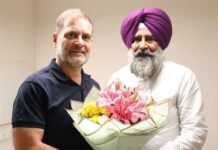



Saptrishi Soni: As Punjab inches towards the 2027 Assembly elections, Rahul Gandhi faces a crucial political test during his November 4 visit to the state. Beyond launching an aggressive campaign against the Bhagwant Mann government, the Congress leader will have to address a challenge that could prove even more decisive for the party’s electoral prospects: bringing a divided Punjab Congress together under one leadership umbrella.
For Congress, the battle for Punjab cannot be won merely by attacking the ruling Aam Aadmi Party or highlighting its alleged failures. The party first needs to restore confidence within its own ranks, resolve competing ambitions among senior leaders and demonstrate that it is capable of presenting a united alternative to the electorate.
The November 4 programme at Sangrur, where Congress is scheduled to launch its ‘Hisab Maango’ campaign, offers Rahul Gandhi an important opportunity to set that process in motion. The choice of Sangrur is politically significant. It is the home district of Chief Minister Bhagwant Mann and lies in the Malwa region, which plays a decisive role in Punjab’s electoral calculations.
The political message Congress wants to deliver is clear: the Mann government must answer questions about employment, drugs, law and order, farmers’ concerns, governance and the promises made before coming to power. But Rahul Gandhi will also have to ensure that his own party does not become a subject of public scrutiny for the wrong reasons.
Punjab Congress has repeatedly struggled with factional differences and competing leadership ambitions. Senior leaders have often appeared divided over organisational decisions, political strategy and their individual roles in the party. The differences involving former state Congress president Amarinder Singh Raja Warring, former chief minister Charanjit Singh Channi and other influential figures have highlighted the difficulty of maintaining a common political direction.
The presence of Leader of Opposition Partap Singh Bajwa and several other senior leaders further underlines the need for a clearly defined organisational framework. Each leader has political influence and supporters, but the party’s electoral strength will depend on whether these individual networks can be brought together for a collective campaign.
The appointment of Pargat Singh as Punjab Congress president was expected to help the organisation move towards greater coordination. However, a change in the state leadership cannot, by itself, end factionalism. The real test will be whether senior leaders accept collective decisions, work together during candidate selection and campaign across constituencies without allowing personal differences to damage the party.
Rahul Gandhi’s intervention could be decisive in this regard. He has the opportunity to make it clear that the 2027 election cannot become a contest for individual political supremacy within Congress. The party needs a common campaign, shared responsibilities and a commitment from every senior leader to strengthen the organisation rather than promote personal ambitions.
One of the most important decisions will be the question of leadership. Congress has indicated that it intends to fight the election collectively instead of projecting a chief ministerial face prematurely. This could prevent an early leadership contest, but only if the arrangement is accepted by all major factions. Otherwise, the uncertainty over who will lead the government if Congress wins could become another source of internal friction.
A successful unity initiative could significantly improve Congress’s electoral prospects. Party workers who have witnessed repeated factional confrontations may regain confidence. The organisation could strengthen its booth-level network, improve coordination across districts and reconnect with voters who have drifted away because of internal instability.
It could also help Congress turn anti-incumbency sentiment, if it develops against the AAP government, into electoral support. Voters dissatisfied with the ruling party will need to see a credible alternative, not simply a collection of leaders criticising the government from different political platforms.
The Malwa region will be particularly important. Its electoral weight makes it central to the Congress strategy, and Rahul Gandhi’s Sangrur visit provides an opportunity to give the campaign a strong start there. A coordinated state leadership, backed by an active local organisation, could make the Congress challenge more effective.
However, unity will have to extend beyond the stage. A public display of togetherness during Rahul Gandhi’s visit may generate headlines, but the real measure will be whether leaders continue to cooperate once the rally is over. Candidate selection, distribution of responsibilities, constituency-level campaigning and the handling of internal disagreements will determine whether the party has genuinely changed.
A divided Congress would give AAP an opportunity to portray its principal challenger as an organisation unable to manage its own affairs. The BJP and the Shiromani Akali Dal could also benefit from any continuing confusion within the Congress camp. In a multi-cornered contest, even small divisions in the opposition vote could influence the outcome in closely fought constituencies.
Conversely, if Rahul Gandhi succeeds in bringing the state leadership together, Congress could enter the 2027 contest with renewed confidence. It would be better positioned to challenge the Mann government on governance, employment, the drug problem, agriculture and public services while presenting its own political and policy agenda.
The November 4 visit, therefore, is more than the beginning of an election campaign. It is a test of whether the Congress high command can convert its Punjab unit from a faction-ridden organisation into a disciplined political force.
Punjab’s voters will ultimately decide the party’s fate on the basis of its leadership, credibility, promises and performance. But before seeking their mandate, Congress must answer a question within its own ranks: can its leaders stand together when the electoral stakes are highest?
If Rahul Gandhi can achieve that, the Congress may significantly strengthen its position for 2027. If he cannot, the party risks allowing its internal divisions to become its biggest electoral liability.