

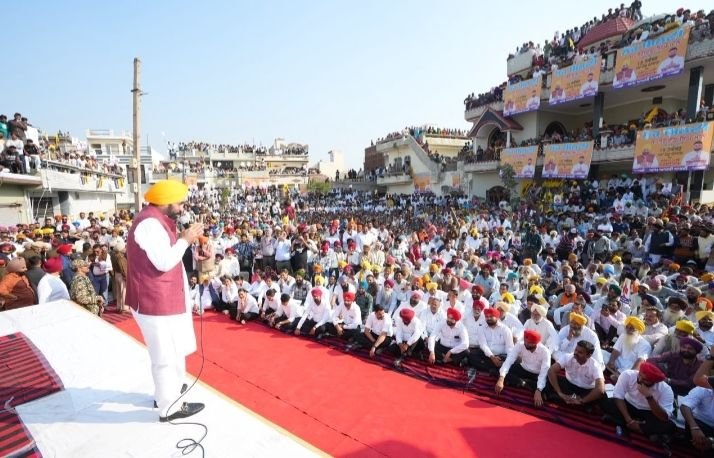
SHAHKOT (JALANDHAR), With Punjab moving towards another crucial electoral contest, Chief Minister Bhagwant Singh Mann on Wednesday sought to reinforce the Aam Aadmi Party’s political credentials by placing welfare delivery, employment, healthcare and development at the centre of his government’s record. Addressing residents during a Lok Milni programme at Donewal village in Shahkot, he promised that the flagship welfare schemes would remain in force for as long as the AAP continued to govern the state.
Mann specifically assured women that free bus travel and the proposed monthly financial assistance of ₹1,000, or ₹1,500 for eligible Scheduled Caste beneficiaries, would continue. He also pledged uninterrupted continuation of free electricity and the Mukh Mantri Sehat Yojna, which provides cashless medical treatment of up to ₹10 lakh per family.
The Chief Minister used the public interaction to launch a broad political offensive against the BJP, Congress and Shiromani Akali Dal, accusing successive governments of exploiting Punjab’s resources and failing to address its longstanding problems. He argued that parties which had governed the state for decades could not now present themselves as agents of change without answering for their previous tenures.
His remarks reflected an increasingly direct political positioning by the AAP government, with Mann seeking to connect its welfare initiatives and administrative claims to the wider question of who should govern Punjab in the coming years.
Welfare commitments and employment at the centre of AAP’s defence
Reiterating his government’s commitment to public welfare, Mann said the state exchequer was being utilised to improve the lives of ordinary families rather than serve the interests of political establishments. He maintained that public money was being channelled back to citizens through electricity subsidies, healthcare, education, infrastructure and employment opportunities.
Citing the government’s employment record, he said more than 71,000 young people had secured government jobs through a transparent recruitment process. He described this as a departure from the earlier system, alleging that public appointments had previously been influenced by corruption and political considerations.
The Chief Minister also highlighted the closure of several toll plazas, claiming that commuters were collectively saving around ₹70 lakh every day. He pointed to improvements in roads, government schools, hospitals and rural infrastructure as evidence of the administration’s development agenda.
On healthcare, Mann described the Mukh Mantri Sehat Yojna as a major step towards universal medical protection. Under the scheme, every resident family in Punjab is entitled to cashless treatment of up to ₹10 lakh. He said the initiative was intended to prevent medical emergencies from pushing ordinary households into financial distress.
He also referred to the Mawan Dheeyan Satkar Yojna, under which eligible women above 18 years are to receive monthly assistance of ₹1,000, with the amount fixed at ₹1,500 for eligible Scheduled Caste women. According to the Chief Minister, around 97 per cent of women in the state would benefit from the initiative. He said beneficiaries were being informed through mobile notifications and that another round of notifications was expected on December 1.
Drug menace becomes major political flashpoint
A substantial part of Mann’s address focused on Punjab’s continuing battle against narcotics. Targeting the previous BJP-Akali alliance, he alleged that the drug trade expanded during their tenure and accused political leaders of patronising the network that damaged generations of young Punjabis.
He questioned the credibility of the BJP’s promise to make Punjab drug-free, arguing that the party had shared power with the Akalis when the narcotics problem intensified. In a pointed political remark, he said meaningful action against drugs would require the Union Home Minister to share a platform with Akali leaders whom he accused of being associated with the drug menace.
Mann also attacked the Akali leadership over the historical and religious controversies surrounding the party, including the sacrilege incidents involving Sri Guru Granth Sahib and the subsequent developments at religious institutions. He alleged that the party had failed to uphold the sentiments of the Sikh community and had repeatedly compromised Punjab’s interests for political power.
Questioning the Akalis’ present political position, he accused them of reversing their earlier opposition to BJP interference in Sikh religious affairs merely to explore a possible political alliance with the saffron party.
Congress faces attack over internal divisions
The Chief Minister was equally critical of the Congress, describing it as a divided organisation without a coherent development agenda for Punjab. He alleged that its leaders were preoccupied with internal rivalries and the prospect of returning to power rather than presenting a credible programme for the state’s future.
Taking a swipe at former Chief Minister Charanjit Singh Channi’s cycle march, Mann questioned its political impact and claimed that the Congress leadership lacked sufficient public support. He alleged that the party’s internal differences would continue to undermine its political prospects.
He further argued that Congress and Akali governments had received repeated opportunities to govern Punjab but had failed to bring about the transformation expected by the people.
Mann’s broader political message was that traditional parties were unsettled by the emergence of an ordinary political worker without a dynastic background who had reached the Chief Minister’s office and was claiming to govern in the interests of common people.
Education, agriculture and village infrastructure
Beyond the political exchanges, Mann highlighted education as a central pillar of his government’s long-term development strategy. He argued that subsidies and concessions alone could not eliminate poverty, asserting that access to quality education was essential to improving living standards and creating opportunities for disadvantaged families.
Citing the performance of government school students in competitive examinations, he said the number of candidates qualifying for NEET had risen from around 80 in 2021 to 882 in 2026. He attributed the improvement to teacher training, better educational facilities and the establishment of Schools of Eminence.
The Chief Minister also drew attention to the government’s rural development programme, saying financial grants were being provided to villages for local infrastructure. He said approximately 3,100 sports stadiums were being developed across Punjab as part of efforts to encourage young people to participate in sports and steer them away from narcotics.
Agriculture featured prominently in his address. Mann claimed that the utilisation of canal water for irrigation had increased from approximately 22 per cent before the AAP government took office to nearly 85-86 per cent. The government, he said, was working towards raising this level to 90 per cent to reduce farmers’ dependence on groundwater.
He also projected Punjab’s contribution of around 200 lakh metric tonnes of rice to the national pool this year, compared with an earlier estimate of 180 lakh metric tonnes. He linked the anticipated increase to improved irrigation arrangements and better utilisation of available water resources.
Mann seeks public mandate on governance record
Concluding his political pitch, the Chief Minister maintained that Punjab had entered a phase of development after years of what he described as misgovernance by traditional political parties. He accused previous administrations of capturing lucrative sectors, including transport, cable television, mining and food businesses, for personal and political gains.
He said the AAP government had disrupted the established political arrangement by bringing an ordinary citizen to the centre of decision-making. According to Mann, the opposition’s criticism reflected its frustration over losing its traditional hold on power.
The Chief Minister asserted that the people of Punjab would judge political parties on their record rather than electoral promises. He warned that those who had allegedly exploited the state’s resources for years would face public accountability in the coming elections.
His Lok Milni address thus combined assurances on welfare continuity with an aggressive political challenge to the opposition, while presenting employment generation, healthcare, education, agriculture and rural infrastructure as the principal benchmarks of the AAP government’s performance.