

Saptrishi Soni:
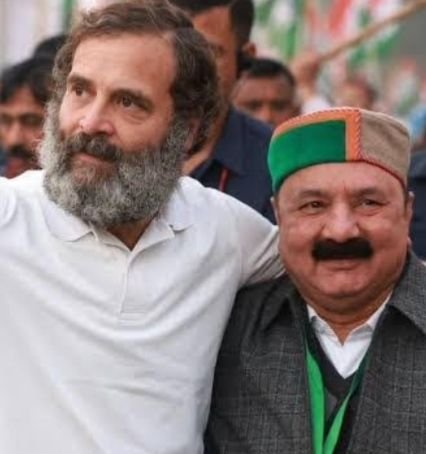
Chandigarh : For Kishori Lal Sharma, Punjab is more than the state where he began his political journey. It is the land of his early years, his education and the roots he has continued to acknowledge even after spending four decades working in Uttar Pradesh’s Amethi and Rae Bareli for the Gandhi family. Now, as the Congress prepares for the 2027 Punjab Assembly elections, Sharma’s inclusion in the party’s Pradesh Election Committee has brought his Punjab connection back into the political spotlight.
The appointment is significant not merely because Sharma is a Lok Sabha MP from Amethi, but because he belongs to a circle of leaders who have worked closely with the Gandhi family for decades. His political journey began in 1983, when he left Ludhiana to work with then Prime Minister Rajiv Gandhi in Amethi. Over the years, he became an important organisational figure in the Gandhi family’s traditional political constituencies, coordinating party activities in Amethi and Rae Bareli and serving as Sonia Gandhi’s representative in Rae Bareli.
His rise from an organisational worker to a Member of Parliament is a story of political trust, persistence and a long association with one of the Congress party’s most influential families. In the 2024 Lok Sabha elections, when the Congress fielded him from Amethi instead of a member of the Gandhi family, Sharma defeated BJP leader and former Union minister Smriti Irani by a substantial margin. The victory was widely viewed as a major political comeback for the Congress in a constituency that had become a national symbol of the party’s electoral setbacks.
Yet, Sharma has never completely detached himself from Punjab. He studied at Arya College in Ludhiana and has spoken about his continuing emotional connection with the city. In an interview last year, he described himself as an Amethi resident after spending around four decades there, while acknowledging that his Punjab roots remained alive. His reported birthplace in Hoshiarpur adds another layer to his connection with the state.
A trusted Gandhi family hand enters Punjab’s election arena
Congress president Mallikarjun Kharge’s approval of the 42-member Pradesh Election Committee on November 18 has placed Sharma among the senior leaders entrusted with the party’s candidate-selection process in Punjab. The committee is chaired by state Congress president Pargat Singh and includes prominent figures such as Charanjit Singh Channi, Partap Singh Bajwa, Amarinder Singh Raja Warring, Ambika Soni, Rajinder Kaur Bhattal, Sukhjinder Singh Randhawa and Manish Tewari, among others.
The composition is politically important because it brings together leaders associated with different power centres within the Punjab Congress. The party has faced persistent differences over leadership, organisational control, political influence and the distribution of responsibilities. The inclusion of Sharma, a leader with direct access to the Gandhi family’s political establishment, can therefore be read as an effort to strengthen the high command’s oversight of a sensitive phase of election preparation.
His presence may also provide the central leadership with an experienced organisational channel through which it can assess competing claims, evaluate constituency-level feedback and encourage greater coordination among senior state leaders. However, membership of an election committee does not automatically confer authority to settle factional disputes. The real test will be whether Sharma can help translate the high command’s expectations into cooperation on the ground.
Punjab Congress’s biggest challenge: Managing its own leaders
For the Congress, the road to the 2027 Assembly election is not simply about challenging the ruling Aam Aadmi Party. It is also about putting its own organisational house in order. The state unit has several established leaders with individual political bases, ambitions and support networks. Differences involving Charanjit Singh Channi and the camp associated with Amarinder Singh Raja Warring have been part of the wider factional debate, while the party also has to accommodate the influence of Partap Singh Bajwa and other senior figures.
The new election committee brings many of these leaders into a common institutional framework. Its effectiveness, however, will depend on whether the members can agree on a transparent process for selecting candidates and avoid turning ticket distribution into a contest of personal influence.
This is where Sharma’s organisational experience could become relevant. Having spent decades managing political work in constituencies closely associated with the Gandhi family, he understands the importance of local networks, candidate credibility, organisational discipline and communication between the state leadership and the central command. His role could be particularly useful in listening to rival groups, identifying areas of disagreement and conveying ground-level concerns to the party leadership.
The challenge will be to ensure that experienced local leaders do not feel sidelined by an outsider’s intervention. Sharma may have Punjab roots, but his political career has largely been built in Uttar Pradesh. Building confidence among Punjab’s leaders will require an understanding of the state’s distinct political, social and regional equations, along with sensitivity towards those who have spent decades nurturing the party organisation.
Candidate selection could determine the party’s prospects
The Pradesh Election Committee occupies an important position in the Congress’s multi-stage candidate-selection mechanism. It recommends names to the screening committee appointed by the All India Congress Committee. The screening committee then examines the recommendations before the names reach the Central Election Committee, chaired by the Congress president, for final approval.
This structure makes the state panel a crucial arena for political negotiation. Decisions over constituencies, sitting legislators, fresh faces, social representation and the claims of local workers can influence both the party’s internal unity and its electoral campaign. If the process is perceived as fair and based on constituency-level assessments, it could help reduce resentment. If it becomes dominated by factional bargaining, the same committee could become another source of friction.
The timing is particularly important. The Aam Aadmi Party has already moved ahead with its candidate announcements, while discussions about a possible renewed understanding between the Shiromani Akali Dal and the BJP have added another dimension to the emerging electoral contest. The Congress, meanwhile, must convert its established political presence into a coordinated campaign across all 117 Assembly constituencies.
Can Sharma help Congress regain its lost political ground?
Sharma’s appointment has inevitably raised questions about whether a trusted Gandhi family associate can help the Congress overcome its internal divisions and recover its political standing in Punjab. His experience in Amethi, his proximity to Rahul and Priyanka Gandhi Vadra, and his organisational background give him a profile different from that of most members of the state committee.
But the task ahead is considerably more complex than managing a single constituency or coordinating a campaign from the party headquarters. Punjab has its own political sensitivities, regional equations and leadership traditions. Any attempt to bring rival groups together will have to recognise the influence of state leaders while ensuring that the final decisions are accepted by the organisation at the grassroots level.
For Sharma, the immediate assignment is likely to be less about public political visibility and more about the difficult work behind the scenes: building consensus, assessing candidates, listening to competing voices and helping the high command maintain a consistent line of communication with the state unit.
His journey from Ludhiana to Amethi has been marked by an unusually long association with the Gandhi family. Now, as Punjab enters another crucial electoral cycle, those relationships and his organisational experience could become valuable assets for the Congress. Whether they translate into a united state unit and a stronger electoral challenge will depend not on his appointment alone, but on the willingness of Punjab’s senior leaders to work together and accept a common political strategy.
For a party seeking to reclaim its former position in Punjab, Kishori Lal Sharma’s return to the state’s political decision-making framework is an important development. The larger question is whether the trust he enjoys at the national level can help build the trust that the Congress needs within its own ranks.