
Saptrishi Soni
POLITICAL FEATURE | PUNJAB 2027 ASSEMBLY ELECTION
From women’s financial assistance, free electricity and healthcare to smart ration cards, education, employment and the fight against drugs, the ‘Khushhaal Punjab’ gathering presents the Mann government’s record as its principal electoral argument. But as Punjab approaches another Assembly election, the real test will be whether welfare achievements translate into lasting economic security, stronger institutions and solutions to the state’s deeper challenges.
The political contest for Punjab’s 2027 Assembly elections has effectively entered a new phase, with the Aam Aadmi Party choosing Moga as the launchpad for its campaign and placing the governance record of Chief Minister Bhagwant Singh Mann at the heart of its appeal for another term.
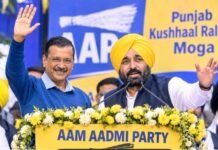
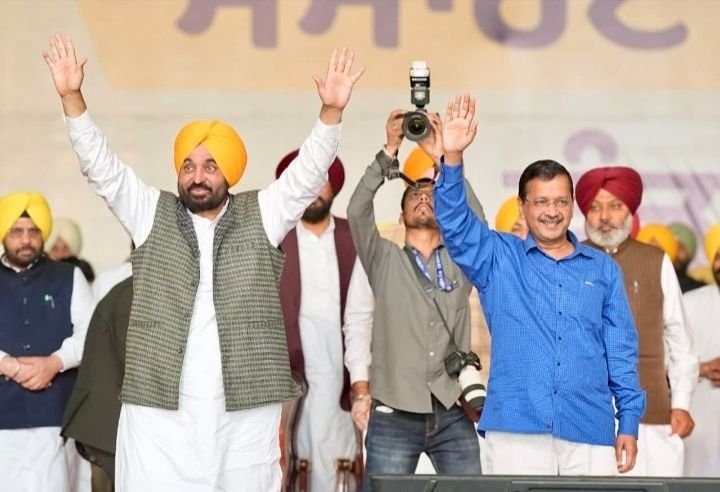
The ‘Khushhaal Punjab Maha Rally’, organised at Matwani village on November 26 to mark the party’s Foundation Day, brought AAP national convenor Arvind Kejriwal and Mann together before a large gathering of party workers, supporters and beneficiaries. The event was also presented as an opportunity to showcase the state government’s performance and take its political message beyond the party organisation.
The choice of Moga was significant. Located in the Malwa region, the district has considerable political importance, while its central location makes it accessible to people from different parts of Punjab. The rally also coincided with the launch of smart ration card distribution, giving the political gathering a direct connection with a government welfare programme.
For Kejriwal, the occasion was about defending the AAP model of governance and seeking a renewed mandate. For Mann, it was an opportunity to place his government’s administrative record, welfare interventions and political approach before voters, while responding to criticism from rival parties.
Yet the importance of the Moga gathering goes beyond the launch of an election campaign. It brings into focus a larger question confronting Punjab: how should the state balance immediate household relief with employment generation, agricultural transformation, industrial expansion, fiscal stability and the restoration of public confidence in governance?
A welfare-first campaign: Women, electricity, food security and healthcare
The strongest element of the AAP’s Moga campaign was its attempt to connect government policies with the everyday financial concerns of ordinary households. Rather than relying exclusively on political slogans, Kejriwal and Mann sought to make welfare delivery a central measure of the government’s performance.
The Mukh Mantri Mawan Dheeyan Satkar Yojana was particularly prominent. Under the scheme, eligible women from the general category are entitled to monthly financial assistance of ₹1,000, while eligible Scheduled Caste women receive ₹1,500 through direct bank transfers. The initiative was a major talking point at Moga, where women beneficiaries were invited to share their experiences on stage.
Their accounts brought a human dimension to the government’s welfare narrative. Women spoke about using the assistance for medicines, household expenditure and educational needs within their families. Kejriwal also appealed to women to persuade other family members, particularly men, to support the continuation of these programmes.
The political significance is clear: AAP is seeking to make women’s financial security an important part of its electoral proposition. However, the longer-term measure of the scheme will be its coverage, timely payments, accessibility and ability to improve women’s economic independence beyond modest monthly assistance.
Electricity relief remains another major pillar. The Mann government has maintained its policy of providing up to 300 units of free electricity every two months to eligible domestic consumers. The government has repeatedly claimed that more than 90 per cent of households receive zero electricity bills under the scheme.
For families facing rising living costs, this represents tangible monthly savings. Nevertheless, the larger policy question concerns the financial sustainability of subsidies, the quality of electricity distribution and the ability to maintain reliable power supply for domestic, agricultural and industrial consumers.
Food security was also brought into focus through the launch of smart ration card distribution at the rally. The government announced the inclusion of approximately 10 lakh additional beneficiaries following a verification exercise that received around 19.25 lakh applications.
Under the expanded arrangement, the number of people covered by free wheat distribution under the National Food Security Act is expected to reach 1.41 crore. The state government’s Meri Rasoi initiative is also being extended, with ration kits containing essential food items for eligible families.
The expansion is particularly relevant to daily-wage earners, economically weaker households, labourers and disadvantaged communities. The emphasis on verification and the stated policy of providing benefits without cash payments or political recommendations will need to be matched by transparent implementation and regular delivery.
Healthcare has emerged as another important component of the AAP government’s public welfare argument. The Mukh Mantri Sehat Yojana provides eligible families with cashless treatment coverage of up to ₹10 lakh annually. According to the 2026-27 Punjab Budget, the programme is intended to cover nearly 65 lakh families through more than 900 government and empanelled private hospitals.
The network of Aam Aadmi Clinics has also become a recognisable feature of the government’s healthcare model. The state budget reported 881 operational clinics, providing essential medicines and diagnostic services free of cost, with nearly five crore outpatient visits recorded.
For people in villages and smaller towns, accessible primary healthcare can reduce the need to travel to major cities for routine medical consultations. However, the real test remains the availability of doctors, medicines, diagnostic facilities, specialist referrals and hospital infrastructure. Insurance coverage must also translate into treatment without unnecessary administrative hurdles.
Education and employment: The next generation’s expectations
If welfare schemes address immediate household needs, education and employment will determine whether Punjab’s younger generation sees a future within the state.
The Mann government has promoted Schools of Eminence and the Punjab Sikhya Kranti programme as instruments for improving public education. The 2026-27 Budget proposed ₹19,279 crore for the education sector and outlined further investment in school infrastructure, laboratories, classrooms and teacher development.
The Schools of Eminence initiative aims to upgrade 118 government senior secondary schools, with a focus on students from Classes IX to XII. The government is seeking to make public institutions more competitive and improve access to quality education for children who cannot afford expensive private schooling.
Employment is equally important. The government has repeatedly highlighted its recruitment record, claiming that more than 70,000 young people have secured government jobs through its recruitment drives. By November 2026, the AAP’s published tally had reached 71,777 appointments.
These recruitments across education, police, electricity, healthcare and other departments form an important part of Mann’s governance narrative. The government has emphasised merit-based selection and reduced political interference in recruitment.
However, Punjab’s employment challenge cannot be measured solely by government appointments. Thousands of young people need private-sector opportunities, technical training, entrepreneurship support and stable employment with reasonable wages.
The government has also cited investment proposals worth approximately ₹1.89 lakh crore, carrying the potential to generate around 6.31 lakh jobs. These are projected employment opportunities, not jobs already delivered. Their eventual impact will depend on how many projects become operational, how much investment actually materialises and whether local youth secure the resulting positions.
The continued migration of young Punjabis overseas also raises questions about career opportunities, professional growth and confidence in the state’s economic future. Government recruitment is significant, but creating a broad employment ecosystem must remain a priority.
Farmers, agriculture and Punjab’s water future
For a state whose economy and social identity remain closely connected with agriculture, the concerns of farmers cannot be treated as a secondary issue in the election debate.
The AAP government has highlighted daytime electricity supply for agricultural operations and efforts to improve canal-water availability. These measures are intended to make irrigation more convenient and reduce dependence on groundwater.
However, the agricultural sector continues to face structural difficulties. The traditional paddy-wheat cycle, declining groundwater levels, rising input costs, farm indebtedness and uncertainty over crop diversification remain major concerns.
Punjab’s groundwater situation is particularly serious. Research drawing on Central Ground Water Board data has highlighted the extent of over-extraction in the state’s agricultural regions. The challenge is not simply to provide more irrigation water, but to redesign the cropping system so that farming remains economically viable without exhausting natural resources.
Farmers need viable alternatives to paddy, assured procurement arrangements, remunerative prices, improved irrigation infrastructure and incentives that compensate them for changing established cropping practices.
The question of Punjab’s river waters and the long-standing dispute over the Sutlej-Yamuna Link canal also remains politically sensitive. The state government has repeatedly maintained that Punjab’s water interests must be protected. Any sustainable resolution requires legal clarity, intergovernmental dialogue and consideration of the state’s actual water availability.
Mann’s political engagement with the Centre on water rights, border security and the drug supply chain has become part of his wider argument that Punjab’s challenges cannot be addressed by the state government alone.
Drug menace and law and order: The most difficult test
The fight against drugs remains one of the most consequential issues for Punjab’s political leadership.
Mann has made the anti-drug campaign, Yudh Nashean Virudh, a central part of his government’s public messaging. Launched in March 2025, the initiative combines police enforcement with public awareness, school-level prevention, community participation and rehabilitation.
The government has reported substantial action against drug networks, including arrests, FIRs and seizures of heroin and other narcotics. Its campaign has also attempted to involve village and ward-level committees in identifying suspected drug activity.
Yet the scale of enforcement itself demonstrates the continuing seriousness of the problem. Drug availability, addiction, the vulnerability of young people and the social consequences for affected families remain persistent concerns.
Treatment is as important as arrests. Government data reported a rise in admissions to de-addiction centres from 9,577 in 2024 to 25,290 in 2025. This increase can reflect greater access to treatment and willingness to seek help, but it also underlines the scale of addiction-related distress.
Mann has also repeatedly raised questions about the role of interstate and cross-border drug networks. He has urged the Centre to strengthen anti-drone arrangements along Punjab’s international border with Pakistan and questioned the focus on Punjab when large narcotics consignments have also been seized elsewhere, including Gujarat.
These are political arguments made by the Chief Minister, but the underlying issue requires coordinated action involving the BSF, Punjab Police, central investigative agencies and neighbouring state governments.
The opposition, particularly the BJP, has sought to make drugs and law and order central themes of its campaign. AAP, in turn, has argued that the problem has historical roots and cannot be separated from the responsibilities of the Centre and neighbouring states.
For ordinary families, however, political arguments matter less than visible results: dismantling supply networks, preventing young people from entering addiction, ensuring accessible treatment and bringing those responsible for trafficking to justice.
Gangster networks, extortion and organised crime also require sustained attention. Public confidence depends not only on police action but on whether citizens feel safe in their neighbourhoods, businesses and workplaces.
Industry, investment and the challenge of economic revival
Punjab needs a stronger industrial economy if it is to reduce unemployment, retain skilled youth and diversify beyond agriculture.
The Mann government has presented investment attraction as an important achievement. It has cited proposals worth ₹1.89 lakh crore over approximately four years, with an estimated employment potential of 6.31 lakh people.
Mohali, Ludhiana, Patiala and Hoshiarpur have featured prominently in the investment figures, with opportunities identified in manufacturing, steel, textiles, food processing, information technology, renewable energy and automobile components.
The state has also promoted industrial clusters and measures to simplify business approvals.
But investment announcements should not be confused with completed industrial projects. Punjab’s next phase of economic development will depend on actual capital expenditure, land availability, reliable power, logistics, industrial infrastructure and a predictable regulatory environment.
Small and medium enterprises, which provide employment across several districts, also need access to credit, modern technology and competitive markets.
The government will need to demonstrate that investment is reaching beyond a few established industrial centres and generating jobs for local workers rather than remaining concentrated in announcements and proposals.
Environment, pollution and the cost of development
Punjab’s environmental concerns are closely linked to its economic future.
Groundwater depletion, stubble burning, deteriorating river water quality, industrial discharge and urban pollution require long-term policy interventions.
Recent official environmental monitoring has continued to identify polluted stretches of the Sutlej and Ghaggar rivers. The Beas stretch near Mukerian, meanwhile, has achieved the prescribed Class-B water quality, showing that restoration efforts can produce measurable improvements.
The Commission for Air Quality Management has also reviewed Punjab’s measures to prevent paddy residue burning and called for stronger action at the ground level.
The state needs to move beyond seasonal campaigns towards practical solutions for farmers, including affordable residue-management machinery, market opportunities for crop residue, diversification incentives and effective monitoring of industrial pollution.
Clean rivers, safe drinking water and healthier air are not merely environmental targets; they are essential to public health and agricultural sustainability.
Punjab’s finances: Can welfare and development move together?
One of the most important questions facing the next government will be the state’s financial capacity to sustain welfare commitments while investing in infrastructure and economic growth.
Free electricity, healthcare, food security and financial assistance for women provide direct relief to households. At the same time, Punjab must meet expenditure requirements for salaries, pensions, debt repayments, infrastructure and public services.
The 2026-27 Budget projected a fiscal deficit of approximately 4.1 per cent of GSDP and net borrowings of ₹38,471 crore. The revised estimates for 2025-26 had placed the fiscal deficit at 4.2 per cent of GSDP.
These figures underline the pressure on the state’s finances. They do not, by themselves, establish that welfare spending is unsustainable, but they make revenue generation, expenditure management and productive investment increasingly important.
The political challenge for Mann is to show that immediate relief can coexist with long-term capital creation, rather than allowing the two priorities to compete for limited resources.
ED summons and political accountability add another dimension
The Moga rally also unfolded against the backdrop of an Enforcement Directorate investigation involving local AAP legislators.
Moga MLA Dr Amandeep Kaur Arora and Dharamkot MLA Devinderjeet Singh Laddi Dhose were summoned by the ED in connection with an alleged money-laundering investigation involving land transactions and compensation linked to National Highway 754A.
The agency has alleged irregularities involving government and institutional properties, manipulation of land records and wrongful disbursement of compensation. These are allegations under investigation and do not amount to a finding of guilt.
AAP questioned the timing of the summons issued to Arora, pointing out that she had been called for questioning on the same day as the party’s Moga rally. The party described the action as politically motivated and accused the BJP-led Centre of using central agencies against political opponents. Arora has also denied wrongdoing and alleged political vendetta.
The ED’s investigation, meanwhile, remains a matter of legal and institutional process. Political allegations on either side cannot substitute for evidence or the outcome of the investigation.
The episode illustrates how the coming election campaign is likely to combine governance claims with disputes over investigative agencies, political accountability and the relationship between the state government and the Centre.
Kejriwal sought to present the Punjab model as a continuation of the party’s politics centred on public services, welfare and d