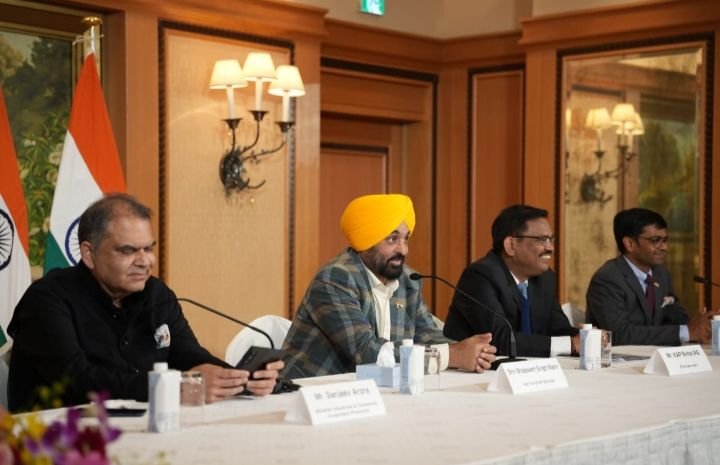
On a trade and investment mission that sought to recast Punjab’s economic narrative, Chief Minister Bhagwant Singh Mann used a stop in Osaka to present an assertive case for the state as a reliable manufacturing and agribusiness partner. Over four days, Mann and his delegation met corporate representatives, trade chambers, and technology providers, making a point-by-point pitch for why Punjab should be considered for investments in food processing, cold chain infrastructure, speciality manufacturing and logistics.
Why Osaka? Japan’s industrial clusters, logistics capabilities and advanced manufacturing footprint make it an attractive source of capital and technology for Indian states seeking to upgrade value-chains. Mann’s choice of Osaka is strategic: the Kansai region is home to SMEs with high technical competence, a strong freight gateway, and a cultural emphasis on long-term partnerships — attributes that dovetail with Punjab’s needs in agroprocessing, precision manufacturing and renewable energy integration.
What the pitch included
Mann foregrounded Punjab’s strengths: a skilled agricultural workforce, an established logistics corridor to northern India, and a rapidly evolving industrial policy that aims to reduce red tape for investors. He emphasized reforms the state has undertaken to make land and labour more investment-friendly, and detailed incentive structures for food processors, cold storages and companies willing to co-invest in technology transfers. He also highlighted the state’s existing research institutions and an emphasis on start-up incubation for agri-tech and clean energy.
The delegation showcased specific investment opportunities: cluster-based food parks near transportation hubs, packaging and value-addition units for horticulture, and pilot projects for solar-powered cold chains. Mann pressed the case for joint ventures that would boost employment in both urban and rural areas, giving examples of how pilot projects could be scaled while ensuring backward linkages for farmers.
Meetings and impressions
The CM held one-on-one meetings with industry captains and signed memoranda of intent for exploratory partnerships. Japanese partners, while cautious about speed of implementation and due diligence, responded with interest on technology transfer, contract farming frameworks, and pilot cold-chain projects. Mann’s team underscored ease-of-doing-business reforms, promising single-window clearances and facilitation cells to guide Japanese firms.
The delegation also trod the political line carefully — emphasizing continuity and the state’s commitment to investor protections and labor stability. Mann’s pitch purposely aimed to reassure investors that Punjab offers both an industrial base and an agricultural hinterland for integrated supply-chains.
Potential gains and challenges
If realized, the deals could diversify Punjab’s economy beyond commodity crops and into higher-value processing. Cold chains and food processing would reduce post-harvest losses and boost farmers’ returns. Technology imports for precision farming could ease input costs and enhance yields per unit of water used.
However, concrete implementation will face challenges: land acquisition issues, power reliability, and aligning skill development programs to Japanese manufacturing standards. Investors are likely to insist on clear timelines, predictable policy frameworks and guarantees against sudden regulatory reversal.
Why this matters for Punjab
For a state that has experienced slow industrial growth compared to some neighbours, the Osaka mission is a chance to rebrand Punjab as an investment destination that combines agriculture with smart manufacturing. Mann’s diplomacy aims not only to attract capital but to catalyze domestic reforms, nudging local industries towards higher value addition.
Chief Minister Mann’s Osaka outreach is a high-stakes effort to link Punjab’s fields with global markets through technology, investment and logistical cooperation. The initial interest from Japanese firms is encouraging, but the true test will be on-the-ground execution — translating MOUs into factories, processing hubs and value chains that deliver both jobs and higher incomes for Punjab’s farmers and youth.