
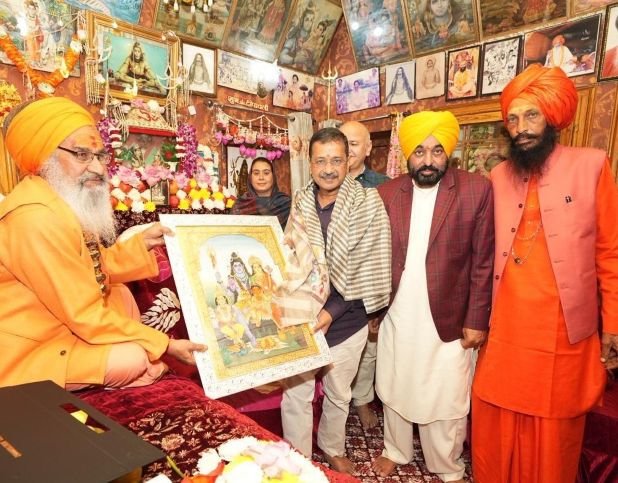
On the sacred occasion of Maha Shivratri, Aam Aadmi Party (AAP) National Convener Arvind Kejriwal and Punjab Chief Minister Bhagwant Singh Mann visited the revered Shri Rankeshwar Mahadev Temple in Dhuri, Sangrur district, where they offered prayers and performed rituals at the historic Siddh Peeth. The visit, marked by devotional fervour and political symbolism, underscored the Punjab government’s emphasis on preserving spiritual heritage while reinforcing social harmony and cultural continuity in the state.
Extending greetings to citizens on the festival, Arvind Kejriwal described Maha Shivratri as a civilizational celebration deeply rooted in India’s ancient spiritual traditions. He emphasized that such festivals transcend ritual observance and represent India’s enduring philosophical heritage. Sharing reflections from the temple visit on social media platform X, Kejriwal noted that the divine energy associated with Lord Shiva instills peace of mind and renewed spiritual strength. He prayed for prosperity, progress and collective well-being for both Punjab and the nation.
Chief Minister Bhagwant Mann echoed similar sentiments, stating that the Punjab government remains firmly committed to safeguarding and promoting the state’s rich spiritual and cultural legacy for future generations. He highlighted that Punjab’s identity has always been shaped by layers of devotion, sacrifice and faith traditions. Mann pointed to the state’s recent large-scale commemorations, including the 350th martyrdom anniversary of Sri Guru Teg Bahadur Ji and preparations for the 650th Parkash Purab of Sri Guru Ravidass Ji, as evidence of the government’s resolve to honour Punjab’s spiritual icons with dignity and scale.
The temple visit carried both religious and cultural significance. Shri Rankeshwar Mahadev Temple is regarded as a prominent Siddh Peeth in the Malwa region of Punjab. Historically, Siddh Peeths are revered as sacred sites where intense penance and spiritual practices were performed, leading to divine manifestations. According to traditional belief, the shrine is associated with the Mahabharata era, particularly the episode of Arjuna’s penance to seek Lord Shiva’s blessings. It is believed that after rigorous tapasya, Lord Shiva appeared before Arjuna and granted him divine weapons, including the Gandiv Dhanush. This mythological connection gives the temple deep resonance within India’s epic and Shaivite traditions.
By performing Pooja at this historically significant Tapasthali, Kejriwal and Mann sought to link governance with cultural rootedness. Both leaders emphasized that Maha Shivratri symbolizes spiritual awakening, self-discipline and the divine union of Lord Shiva and Goddess Parvati. They described the festival as not merely a religious observance but a foundational pillar of India’s civilizational ethos, embodying values of devotion, truth-seeking, mutual respect and harmony.
In their joint message, the leaders stated that sacred places like Shri Rankeshwar Mahadev represent centuries of uninterrupted devotion and spiritual energy. They underlined that such heritage sites serve as living symbols of Punjab’s pluralistic and layered cultural identity. Annual celebrations at the temple, they noted, ensure that it remains a vibrant center of faith rather than fading into historical obscurity.
Politically, the visit also reflected the AAP government’s broader strategy of integrating cultural engagement with governance. Since assuming office, the Punjab government under Bhagwant Mann has sought to position itself as both reform-driven and culturally sensitive. By actively commemorating major religious anniversaries and investing in heritage preservation, the administration has aimed to strengthen regional identity while fostering social cohesion across communities.
The leaders further stressed that cultural preservation is not limited to monuments but includes intangible heritage such as rituals, festivals, oral traditions and community participation. They noted that faith traditions evolve over time while retaining their core essence, making them central to Punjab’s social fabric. Events like Maha Shivratri, especially when celebrated at historically revered sites, bring together people from diverse backgrounds under a shared spiritual banner and reinforce communal harmony.
Highlighting the state government’s initiatives, Mann reiterated that Punjab is actively working to ensure that younger generations remain connected to their cultural roots. Large-scale commemorative events, infrastructure support for heritage sites, and inclusive public participation are part of a long-term cultural policy aimed at sustaining Punjab’s spiritual legacy in a modern context.
As Punjab navigates contemporary governance challenges, the symbolic resonance of such visits carries political weight. By aligning public administration with heritage conservation and religious inclusivity, the AAP leadership seeks to project a governance model that blends development with tradition. The Maha Shivratri visit to Shri Rankeshwar Mahadev Temple thus served as both a devotional act and a reaffirmation of the state’s cultural priorities.
In a state where spirituality, history and identity are deeply intertwined, the temple visit highlighted how political leadership can engage with faith institutions while promoting unity, peace and progress. With prayers offered for prosperity and harmony, the occasion reinforced Punjab’s enduring cultural narrative—one that balances historical reverence with contemporary aspirations for growth and collective well-being.