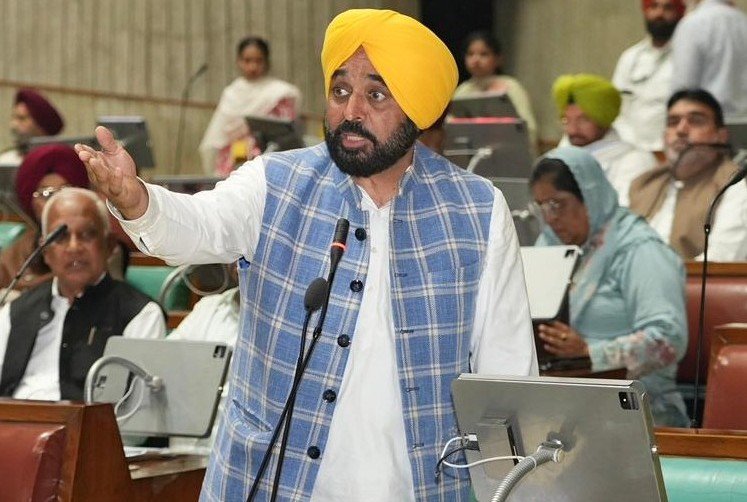
The ongoing Budget Session of the Punjab Legislative Assembly witnessed intense political confrontation between the ruling Aam Aadmi Party (AAP) and the opposition Indian National Congress, culminating in the passage of a censure motion against Congress MLA Sukhpal Singh Khaira. The motion was adopted by voice vote after heated exchanges in the House, following controversy over Khaira’s remarks on a social media post concerning the Punjab government’s proposed scheme to provide financial assistance to women.
The debate triggered a prolonged uproar in the Assembly, forcing repeated interruptions and ultimately leading to the adjournment of proceedings until 3 pm as legislators from both sides exchanged sharp accusations. The issue dominated the session, reflecting the increasingly combative political climate during the budget discussions in Punjab.
The controversy stemmed from remarks attributed to Khaira regarding the state government’s promise to provide ₹1,000 per month to women. Members of the treasury benches alleged that the Congress leader’s statement was derogatory and disrespectful towards women and marginalized communities. AAP MLA Saravjit Kaur Manuke formally moved the censure motion against Khaira, demanding that he apologise publicly for his comments. The motion received strong backing from the state’s Finance Minister Harpal Singh Cheema, who argued that the dignity of women could not be compromised in political discourse.
As the resolution was introduced, several AAP legislators gathered near the Speaker’s chair and raised slogans condemning Khaira’s remarks. Among those who spoke during the debate were AAP MLAs including Inderjit Kaur Mann, who insisted that no clarification was required from Khaira because the remarks were already widely circulated and offensive in nature. She stated that elected representatives have a responsibility to maintain decorum and respect, particularly when discussing policies that affect women and vulnerable sections of society.
Education Minister Harjot Singh Bains also intervened in the discussion and described the comments attributed to Khaira as reflecting a “feudal mindset,” accusing the Congress leader of refusing to express regret despite mounting criticism. Bains further alleged that Khaira had reiterated his stance on social media platform X instead of offering an apology, which, according to the minister, intensified public outrage.
The opposition benches, however, strongly objected to the manner in which the resolution was brought before the House. Leader of the Opposition Partap Singh Bajwa stated that Khaira should have been given an opportunity to clarify his position before the House passed any resolution. Bajwa emphasized that parliamentary traditions require fairness and due process, particularly when a member’s conduct is under scrutiny. He also argued that the issue could have been resolved through dialogue rather than an immediate condemnation motion.
Congress MLA Tript Rajinder Singh Bajwa echoed similar concerns and said that the Assembly should allow Khaira to present his explanation before taking punitive action. Another Congress legislator, Aruna Chaudhary, reminded the House that democratic institutions must remain open to debate and that the opposition’s voice should not be curtailed through procedural decisions.
Despite the opposition’s objections, Speaker Kultar Singh Sandhwan proceeded with the voting process. During the voice vote, Congress members did not actively participate, prompting the Speaker to clarify that their silence would be interpreted as opposition to the motion. Following this procedural clarification, the House declared the censure motion passed.
The debate also spilled over into wider political commentary within the Assembly. Minister Harpal Singh Cheema sharply criticised the opposition, accusing the Congress leadership of tolerating statements that insult women and Dalits. He argued that the House had a moral responsibility to condemn such remarks and uphold the dignity of social welfare initiatives introduced by the government.
Meanwhile, opposition leaders countered that the ruling party was attempting to divert attention from substantive issues such as governance and economic management by turning the Assembly debate into a political confrontation. They maintained that while offensive language should be avoided, the government must also respect the rights of legislators to question policy decisions and implementation of welfare schemes.
Outside the Assembly, the controversy has attracted wider institutional attention. The Punjab State Women Commission has taken suo motu cognisance of the matter and issued a notice to Khaira, directing him to appear before the commission and explain his remarks regarding the women’s scheme.
The episode has further deepened the political rift between the ruling AAP government led by Chief Minister Bhagwant Mann and the Congress opposition in the state legislature. Analysts believe that the confrontation reflects a broader pattern of increasingly polarised debates during Assembly sessions, where policy issues frequently evolve into political battles between the treasury and opposition benches.
With several crucial financial and policy matters still pending discussion during the Budget Session, political observers expect the Assembly proceedings in the coming days to remain equally contentious. The passage of the censure motion has already set the tone for further confrontations, as both the ruling party and opposition continue to defend their positions while appealing to public opinion ahead of future electoral contests.
In the midst of this heated political atmosphere, the Punjab Assembly’s fourth day has underscored the complex intersection of governance, social policy and partisan politics that continues to shape the state’s legislative discourse.