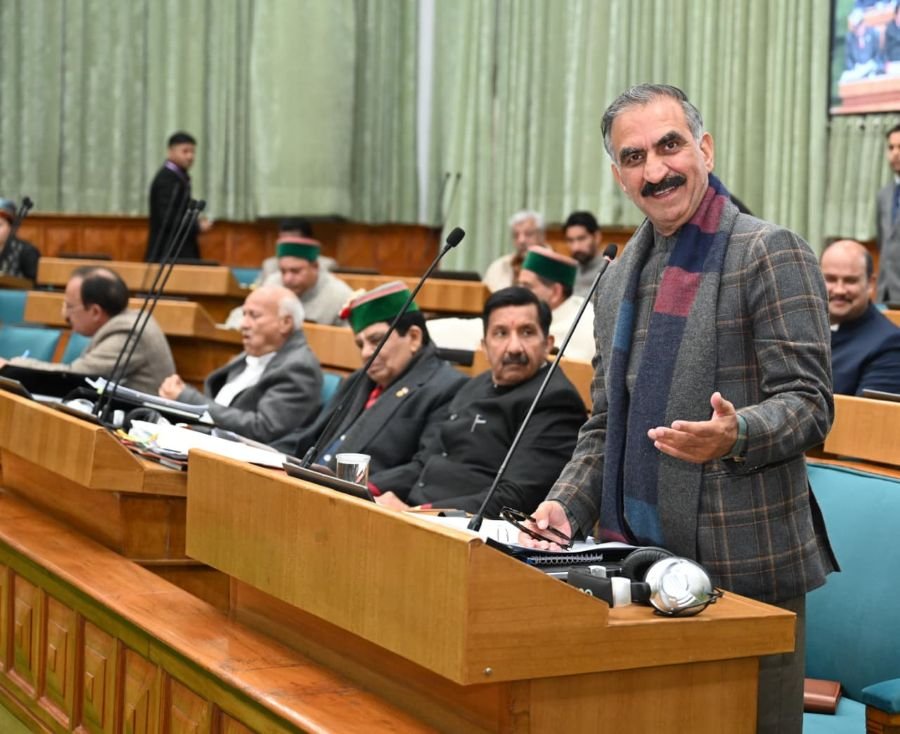
The Himachal Pradesh Legislative Assembly on Thursday witnessed a significant fiscal development as the state government presented supplementary demands for grants amounting to ₹40,461.95 crore for the financial year 2025–26. The proposals, introduced by Chief Minister Sukhvinder Singh Sukhu, who currently holds the finance portfolio, underline the government’s attempt to balance fiscal commitments while sustaining development momentum across key sectors.
According to the details shared in the House, a substantial portion of ₹36,374.61 crore has been earmarked for state-funded schemes, while ₹4,087.34 crore has been allocated for centrally sponsored programmes. The scale and composition of the supplementary demands reflect both the financial pressures faced by the hill state and its continued emphasis on welfare delivery and infrastructure development.
A major component of the state plan expenditure is directed towards financial liabilities, particularly the repayment of short-term borrowings. The government has proposed an allocation of ₹26,194.95 crore for clearing temporary loans and overdrafts availed from the Reserve Bank of India. This significant outlay highlights the fiscal stress on the state exchequer and the priority being given to maintaining financial discipline and creditworthiness.
In the energy sector, the government has sought ₹4,150.14 crore to sustain electricity subsidies and strengthen power infrastructure. Himachal Pradesh, being a hydropower-rich state, continues to rely heavily on energy as both a revenue source and a public utility. The allocation indicates a dual strategy of supporting consumers through subsidies while investing in infrastructure upgrades to improve efficiency and supply stability.
The supplementary demands also reflect a strong focus on disaster resilience, a critical concern for a state frequently impacted by landslides, flash floods and extreme weather events. An allocation of ₹818.20 crore has been proposed for disaster relief and mitigation efforts, signalling the government’s intent to enhance preparedness and response mechanisms in vulnerable regions.
Water supply and sanitation have been allocated ₹785.22 crore, reinforcing the state’s commitment to improving basic civic amenities, particularly in rural and hilly areas where access remains uneven. The government has also proposed ₹657.22 crore for health sector initiatives, including flagship schemes such as ‘Himcare’ and ‘Sahara’, alongside investments in advanced medical infrastructure like robotic surgery facilities and modern diagnostic laboratories in medical colleges.
Beyond these major heads, the supplementary budget includes provisions for education, rural infrastructure, road connectivity, bridges, social welfare programmes and ongoing development projects. These allocations are aimed at ensuring continuity of essential services and supporting economic activity across districts.
The centrally sponsored component of ₹4,087.34 crore further underscores the state’s reliance on federal support for large-scale programmes. Within this segment, ₹2,453.97 crore has been allocated for disaster management initiatives, reflecting alignment with national priorities in climate resilience and risk reduction.
Infrastructure development continues to receive attention, with ₹688.40 crore earmarked for the Pradhan Mantri Gram Sadak Yojana, which plays a crucial role in improving connectivity in remote areas. Additionally, ₹352.18 crore has been proposed for compensation related to displacement caused by the Renuka Ji Dam Project, a long-pending project with both regional and national significance.
Other central schemes covered under the supplementary demands include housing under the Pradhan Mantri Awas Yojana, employment generation through Mahatma Gandhi National Rural Employment Guarantee Act, healthcare initiatives under the National AYUSH Mission, and irrigation projects aimed at supporting agriculture in the state’s challenging terrain.
The government has sought legislative approval for these additional expenditures to ensure that both ongoing and new initiatives are adequately funded. The move is seen as part of a broader strategy to maintain development continuity while addressing immediate fiscal obligations.
Economic observers note that while the size of the supplementary demands reflects proactive governance, it also raises questions about fiscal sustainability, particularly in light of the high allocation towards debt servicing. However, the government maintains that these measures are necessary to stabilise finances and support long-term growth.
As the Vidhan Sabha deliberates on the proposals, the supplementary demands are expected to shape the state’s fiscal trajectory in the coming months, balancing welfare commitments with financial prudence in a challenging economic environment.