In a strong signal that the Haryana government is sharpening its focus on execution-driven governance, Chief Minister Nayab Singh Saini chaired a high-level review of major infrastructure and public service projects, directing departments to ensure strict adherence to deadlines and accelerate delivery of projects valued above ₹75 crore.
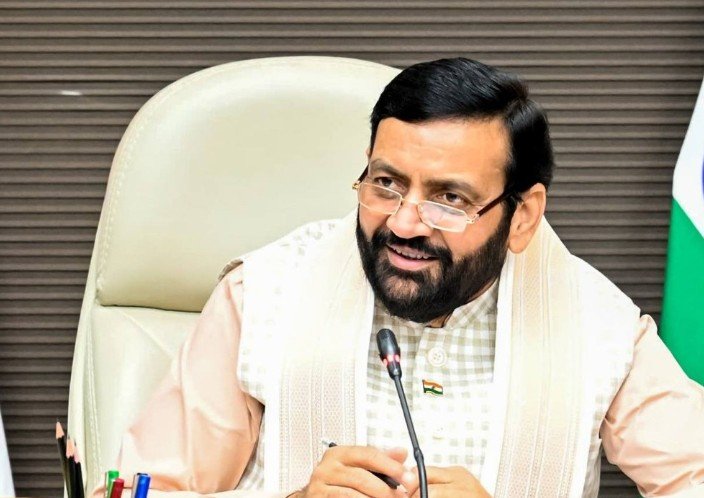
Held at the Haryana Civil Secretariat, the review under the “Pragati” monitoring framework reflected the government’s broader attempt to shift emphasis from announcements to implementation, with the Chief Minister personally examining the progress of projects spanning water supply, road infrastructure, health services, heritage conservation, emergency response and tourism-linked development.
At the centre of the review was the message that delays in execution would not be treated as routine administrative setbacks. Officials were instructed to remove bottlenecks, improve inter-departmental coordination and maintain accountability in delivering projects seen as critical to public service delivery and long-term growth.
One of the major projects reviewed was the master water supply augmentation scheme in Faridabad, valued at ₹217 crore, where officials reported significant progress in the development of rain wells in the Yamuna floodplain. The Chief Minister is understood to have sought not only updates on timelines but also details related to water quality standards, indicating that the government wants infrastructure expansion aligned with service reliability and public health outcomes.
Road connectivity also figured prominently in the review. A major road link in Rewari connecting a bypass corridor to National Highway-8 was reviewed, with the Chief Minister pressing for faster completion. Officials also briefed him on the proposed international-standard shooting range in Panchkula, where tender processes have moved forward, and on the integrated aqua park centre of excellence planned in Bhiwani, which is expected to support diversification and innovation in the sector.
Healthcare infrastructure emerged as another priority area. Saini reviewed progress on multiple hospital and critical care projects, including facilities in Fatehabad, Tohana, Gurugram and Ambala Cantonment. His emphasis, according to officials, was not limited to speed of construction but extended to quality standards, suggesting the government is seeking to balance pace with long-term institutional capacity in the public health system.
What gave the review added significance was its scope beyond conventional infrastructure. The Chief Minister also examined progress on heritage and cultural projects, including the museum at Rakhigarhi, a site of major archaeological importance linked to the Indus Valley Civilisation. His suggestion that school students should be connected to such sites through educational visits reflects an attempt to position heritage not only as tourism infrastructure but as part of civic and historical education.
Reviews of the Sikh Museum and Guru Ravidas Bhavan and Museum further underscored the government’s attempt to integrate cultural identity, spiritual heritage and institutional development into its policy narrative. Saini reportedly directed departments to fast-track approvals and ensure these projects evolve as high-quality heritage institutions rather than remain delayed public works.
Emergency preparedness also featured in the meeting, with attention given to procurement linked to modern fire and rescue systems, including specialized response equipment for complex urban emergencies. This reflects a broader recognition that urban growth and industrial expansion require parallel investments in safety infrastructure.
Political observers note that such project monitoring meetings have become increasingly central to Saini’s administrative style, particularly as the government seeks to reinforce an image of performance-led governance. The emphasis on review mechanisms, timelines and departmental accountability appears designed to project both administrative discipline and development momentum.
Beyond the immediate project updates, the larger message emerging from the meeting was one of state-led delivery, where infrastructure is being positioned not merely as construction activity, but as a tool for governance, public confidence and economic competitiveness.
As Haryana advances a development agenda that combines civic infrastructure, social services and heritage investment, the success of this approach will ultimately depend on whether these projects move from review tables to measurable outcomes on the ground. For now, the Chief Minister’s latest intervention signals that the government wants that transition to happen faster.