
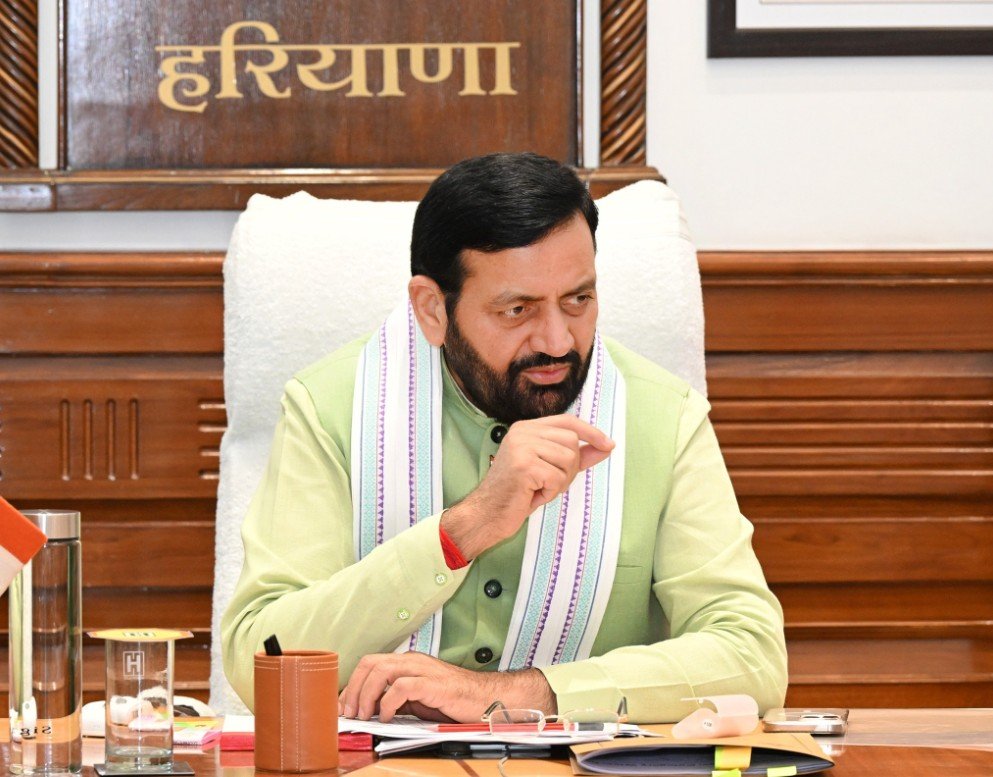
In a significant policy response shaped by global geopolitical disruption and local infrastructure priorities, Haryana Chief Minister Nayab Singh Saini has approved the use of imported bitumen for the next six months to ensure road construction and repair projects across the state do not slow down amid supply shortages and sharp price escalation.
The decision, taken during a high-level review of road construction and maintenance works, reflects an attempt by the Haryana government to insulate state infrastructure projects from the ripple effects of conflict in the Middle East, which has affected the availability and pricing of key petroleum-linked construction materials, including bitumen.
Officials informed the Chief Minister that bitumen prices had risen sharply within a short period, while domestic supply had also reportedly been disrupted. With supply constraints emerging as a direct threat to ongoing and planned road works, the state moved to align with broader policy flexibility allowing imported material to be used as a stopgap solution. Saini’s approval is being seen as a preventive intervention designed to keep project timelines intact rather than allow shortages to translate into stalled public works.
The move is notable not only because it addresses an immediate supply crisis, but because it links global instability directly to state-level governance decisions. At a time when infrastructure delivery is increasingly vulnerable to external shocks, the decision signals a more adaptive approach to project management.
The Chief Minister made it clear that road construction and maintenance cannot be allowed to suffer, particularly when public mobility and economic activity depend on reliable infrastructure. He also directed departments to accelerate repairs using patchwork machines in all districts, emphasizing faster response to damaged roads and improved maintenance standards.
The review covered a broad range of agencies involved in road development, including public works, urban authorities, rural bodies and industrial infrastructure agencies, underlining the scale of the state’s road network agenda. Officials also discussed the target of extensive road construction and repair works planned during the current financial year, with the government pushing departments to stay aligned with deadlines.
Equally significant was Saini’s emphasis on public accountability. He instructed officials to prioritize complaints received through the “Mhari Sadak” mobile application and ensure prompt redressal, reinforcing the government’s attempt to combine infrastructure execution with citizen feedback mechanisms. In cases where road maintenance falls under contractor responsibility, departments were told to ensure companies carry out repairs without delay.
The Chief Minister also raised concerns over variations in road quality across departments, directing all agencies to follow uniform construction standards aligned with the benchmarks of the Public Works Department. That intervention is being seen as an effort to address a longstanding concern that fragmented execution often produces inconsistent infrastructure outcomes.
Another major point of focus was timing. With the monsoon season approaching, Saini directed that ongoing road construction and repair works be completed before seasonal disruptions begin, a directive that carries added urgency given the risks rain poses to incomplete or weakened road surfaces.
Urban infrastructure also came under scrutiny, with the Chief Minister calling for immediate repair of damaged roads in city sectors and directing officials to remove confusion over which department is responsible for which roads in urban areas. He reportedly instructed the formation of a committee to address jurisdictional overlaps, a recurring issue that often delays repair work.
In a forward-looking element of the review, Saini also asked officials to develop select smart roads in urban centres, linking mobility planning not only to utility but also to urban aesthetics and citizen convenience.
Policy analysts say the approval for imported bitumen may appear technical on the surface, but it carries broader significance. It shows how state governments are increasingly being compelled to respond to international market disruptions while maintaining delivery on domestic development commitments.
For the Saini government, the decision also reinforces a governance narrative centered on continuity of infrastructure development, administrative responsiveness and practical adaptation to external challenges. Whether through imported materials, stricter maintenance oversight or citizen complaint monitoring, the message from the review was clear: road development is not to be slowed by supply shocks or administrative inertia.