
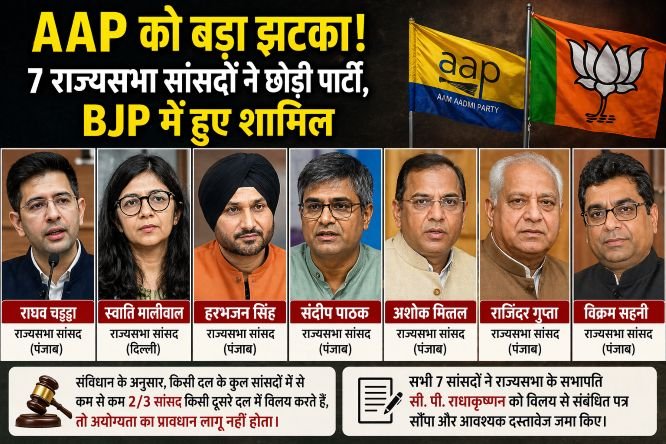
In a dramatic turn of events that could significantly reshape the political landscape, the Aam Aadmi Party (AAP) suffered a major setback on Friday as several of its senior Rajya Sabha members announced their exit from the party and alignment with the Bharatiya Janata Party (BJP). The development marks one of the most substantial internal ruptures within AAP since its emergence as a national political force.
Leading the defection, Raghav Chadha publicly confirmed that he, along with fellow parliamentarians including Sandeep Pathak and Ashok Mittal, had decided to sever ties with AAP. The announcement was made during a press conference in New Delhi, where Chadha indicated that the move was not isolated but part of a larger political realignment involving a majority faction of the party’s upper house representatives.
According to Chadha, seven out of AAP’s ten Rajya Sabha MPs have agreed to merge with the BJP, invoking constitutional provisions that allow such a shift if supported by at least two-thirds of a party’s parliamentary strength. He stated that the group had formally submitted documentation to Rajya Sabha Chairman C. P. Radhakrishnan, seeking recognition of the merger under established parliamentary norms.
The list of leaders reportedly joining the BJP includes prominent figures such as Harbhajan Singh, Rajendra Gupta, Vikram Sahni, and Swati Maliwal, alongside those present at the press briefing. This collective shift, if formally recognized, would significantly weaken AAP’s parliamentary presence and alter the balance of power in the Rajya Sabha.
The move comes amid growing internal tensions within AAP, with recent developments indicating ideological and strategic differences among its leadership. Chadha’s statement suggested that the decision was guided by a broader political vision, although he refrained from detailing specific grievances during the announcement.
Political observers view this as a critical moment for the party led by Arvind Kejriwal, which has built its identity around anti-corruption and governance reforms. The sudden departure of key national figures raises questions about internal cohesion and the party’s ability to maintain its influence beyond its core strongholds.
The BJP, on the other hand, stands to gain substantially if the merger is ratified, not only by increasing its numerical strength in the upper house but also by absorbing leaders with legislative experience and public visibility. The development could have ripple effects on upcoming electoral contests and parliamentary proceedings, particularly in shaping legislative debates and alliances.
While AAP has yet to issue a detailed official response to the defections, party insiders suggest that damage control measures are underway. The coming days are expected to be crucial as legal and procedural aspects of the merger are examined and as both parties recalibrate their political strategies in light of this unexpected shift.
This unfolding political episode underscores the fluid nature of party loyalties in Indian politics and signals a potentially transformative phase in the national political narrative.