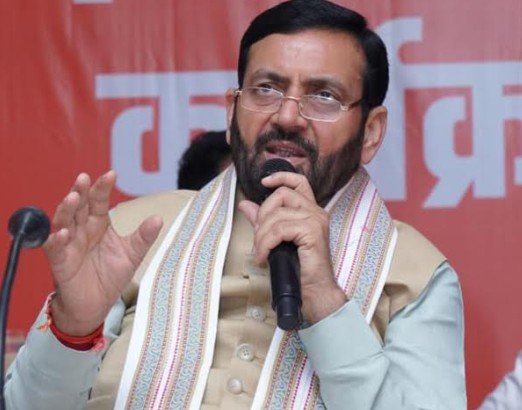
Haryana Chief Minister Nayab Singh Saini on Thursday delivered a strong message on administrative accountability and citizen welfare while addressing a large public grievance redressal programme in Ladwa, Kurukshetra. In a series of firm directives issued during the जनसंवाद programme, the Chief Minister ordered action against an SDO accused of installing electricity poles and a transformer in the middle of an agricultural pathway and also instructed police authorities to register a case against those allegedly threatening the complainant.
The public interaction programme, held at Shivala Ramkundi in Ladwa, turned into a direct demonstration of the state government’s attempt to project responsive governance and administrative accessibility. Accompanied by former Minister of State Subhash Sudha, the Chief Minister personally heard 338 complaints and applications from residents across the constituency, many of whom raised issues linked to land disputes, infrastructure delays, public utilities, education and rural development.
During the proceedings, one complaint from village Bakali drew immediate attention. A farmer alleged that despite a legally demarcated agricultural passage attached to nearly seven acres of purchased land, electricity infrastructure including poles and a transformer had been installed directly on the pathway after alleged collusion with local officials. The complainant further claimed that he was being threatened with dire consequences for raising objections.
Responding sharply to the allegations, Chief Minister Nayab Singh Saini directed the SDM of Ladwa to conduct an inquiry into the role of the concerned SDO and instructed police officials to initiate legal proceedings against those accused of issuing threats. He made it clear that misuse of authority or intimidation of citizens would not be tolerated under any circumstances.
The Chief Minister also used the platform to send a broader message to government departments and administrative officials across Haryana. He stated that officers and employees who force citizens to make repeated visits to government offices without resolving grievances would face strict action. According to him, governance should not become a burden for ordinary people and every complaint must be handled efficiently and transparently.
Addressing the gathering, Saini said the जनसंवाद platform symbolised the government’s commitment to participatory governance, regional development and public welfare. He stressed that development should reach every citizen without bureaucratic delays and directed officials to ensure that complaints are resolved in a time-bound manner so that citizens are not forced into repeated administrative visits.
The programme also highlighted several local development concerns. On a complaint by Jasbir Singh from Dhanora Jattan village regarding educational facilities, the Chief Minister instructed officials to examine the feasibility of upgrading the local school to senior secondary level. In another case, he directed the Haryana State Agricultural Marketing Board to complete the Khidki Viran–Rudki village road before the onset of the monsoon season to ensure uninterrupted connectivity for nearly six villages dependent on the route.
Similarly, the Public Works Department was instructed to expedite the construction of the Kanipla village road before seasonal rains begin. The Chief Minister also intervened in issues related to school admissions and power infrastructure. He directed the Education Department to fast-track online correction procedures to facilitate admissions under the Right to Education scheme in private schools. Power department officials were instructed to immediately replace a damaged transformer in the fields of Balwinder Singh from Kalirano village and install a new transformer in Muniyar Pur village where one had reportedly been stolen.
Alongside grievance redressal, the Chief Minister used the event to showcase the government’s development record in the Ladwa Assembly constituency. He said that over the past eleven and a half years, development works worth approximately ₹807 crore had been carried out in the region, compared to around ₹310 crore spent during the previous Congress government’s ten-year tenure.
According to the Chief Minister, 74 development announcements had been made for the Ladwa constituency under various government schemes and projects, out of which 38 had already been completed while work on the remaining projects was progressing.
He highlighted major infrastructure and welfare initiatives implemented in the region, including the laying of drinking water pipelines across 65 villages at a cost exceeding ₹11.5 crore and the four-laning of the Saharanpur–Kurukshetra road in Ladwa town. Construction of the new SDM office complex is also underway at a projected cost of ₹16.2 crore.
In the urban sector, Ladwa Municipality has reportedly received over ₹16 crore for various development projects under Chief Minister announcements, while separate works under the Divya Nagar scheme have also been completed. Saini further stated that under the Pradhan Mantri Awas Yojana, 364 houses had already been constructed while 249 more were under construction.
The Chief Minister also highlighted welfare initiatives including the Har Ghar Grihini Yojana, under which more than 9,000 families are receiving LPG cylinders at subsidised rates. Under the Ayushman Chirayu scheme, over 1.59 lakh beneficiaries were identified in the region, with more than 1.20 lakh health cards already issued.
He further announced that permanent bridges were being constructed at three locations over the Rakshi river to improve rural connectivity, alongside the approval of a 2,200-foot RCC track project aimed at improving irrigation and agricultural productivity in nearby areas.
Political observers see such जनसंवाद programmes as a key part of the Haryana government’s grassroots outreach strategy ahead of future electoral battles. By combining grievance hearings with public announcements and administrative directives, the state leadership appears to be attempting to strengthen both governance visibility and direct voter engagement at the constituency level.
For residents attending the event, however, the significance of the programme rested less in political messaging and more in the hope that long-pending local issues — particularly those involving land access, roads, education and public services — may finally receive administrative attention after years of delay.