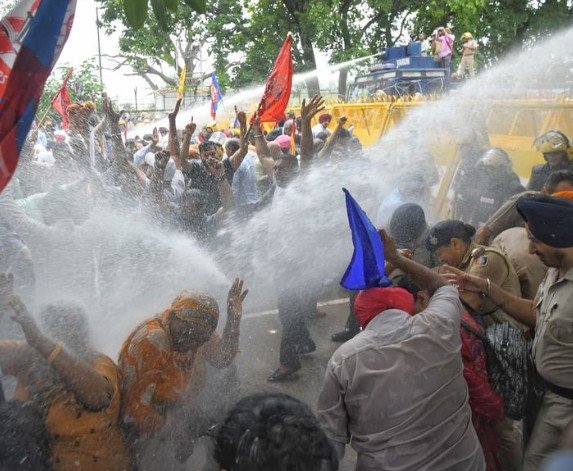
Punjab’s political temperature rose sharply on Friday as thousands of government employees and pensioners gathered in Chandigarh to press for long-pending demands, including payment of dearness allowance arrears and restoration of the Old Pension Scheme. The mobilisation has created a fresh political challenge for the Bhagwant Mann government at a time when the state has already entered the early phase of preparations for the 2027 Assembly election.
The protest is significant not merely as an employees’ agitation but because government staff constitute an influential constituency in Punjab’s electoral politics. Their grievances extend across departments and have the potential to become a wider political issue if the government fails to reach an understanding with employee organisations.
The protesters have been demanding settlement of pending financial benefits, including dearness allowance arrears, along with restoration of the Old Pension Scheme. The demand for pension security has acquired particular importance among employees who argue that retirement benefits cannot be treated simply as a financial liability but as an essential component of public service conditions.
For the Mann government, the timing could hardly be more politically sensitive. The administration has spent much of its tenure presenting itself as a government focused on welfare, employment, administrative reform and the expansion of direct benefits. The employee agitation, however, highlights a different dimension of governance — the ability of the state to meet its commitments to its own workforce.
The government is also operating under financial constraints that have repeatedly featured in Punjab’s political debate. Successive administrations have struggled with a large salary and pension bill, debt obligations and competing demands for social welfare spending. The current government has argued that it is attempting to balance employee welfare with fiscal responsibility.
The opposition is unlikely to allow the issue to remain confined to negotiations between unions and the administration. Congress and other opposition parties can use the agitation to question the government’s financial management and portray the protests as evidence of dissatisfaction within the state machinery itself.
For the AAP government, the political response will therefore require more than assurances. It will need to demonstrate that the grievances are being examined seriously and that there is a credible timetable for resolving issues wherever possible.
The government’s supporters, meanwhile, can point to measures already taken for employees and pensioners and argue that the administration has inherited structural financial problems that cannot be solved overnight. The government can also contend that every financial concession has to be evaluated against Punjab’s overall fiscal position.
Yet politics rarely follows the logic of balance sheets alone.
Employees and pensioners are organised groups, and their concerns can quickly travel beyond government offices into families and communities. In a state where political campaigns are often shaped by issues of dignity, economic security and government accountability, pension and salary disputes can become potent electoral themes.
The protest also comes against the backdrop of a broader political contest in which the AAP government is seeking to defend its record before the 2027 election. The ruling party will have to demonstrate that its welfare-oriented model is financially sustainable and that government employees — many of whom are directly responsible for implementing its policies — do not feel excluded from that model.
For the opposition, the challenge will be to convert the employees’ grievances into a coherent political narrative without appearing to exploit a sensitive service-related dispute.
The coming weeks could therefore be important. If negotiations produce concrete movement, the agitation may remain an industrial relations issue. If demands continue without resolution, the protest could increasingly become part of the larger political argument over the performance of the Mann government.
Punjab’s 2027 election is still months away, but Friday’s mobilisation is a reminder that the campaign will not be fought only over big promises and welfare schemes. Questions of salaries, pensions, fiscal discipline and the government’s relationship with its own employees could also influence the political mood.
For Bhagwant Mann, the message from the streets of Chandigarh is clear: governance will increasingly be judged not only by what the government announces, but by what it is able to deliver to those who keep the state administration running.
This is a web generated news report.