
Punjab Chief Minister Bhagwant Singh Mann has launched a sharp political attack on the opposition, defending his government’s welfare and development agenda and arguing that public money is now being spent directly on improving people’s lives.
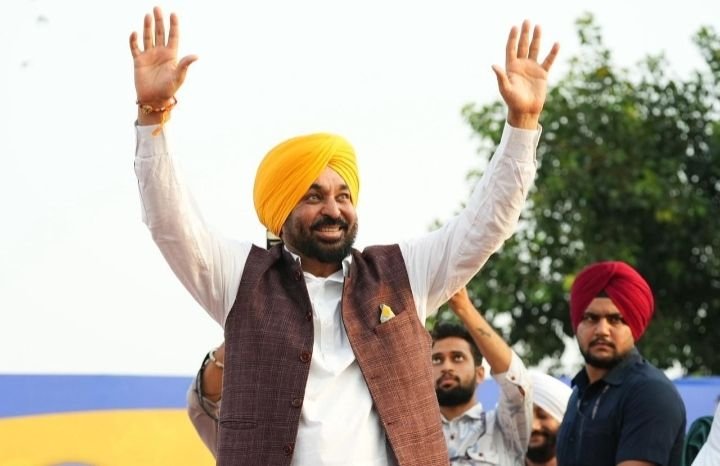
Addressing a Lok Milni programme at Bar Majra village in Mohali on 28 August, Mann said the political debate in Punjab had shifted from the traditional politics of power to issues such as education, healthcare, electricity, employment, rural development and the fight against drugs.
“I’m spending people’s money on the people, but it is the opposition that is suffering,” Mann said, accusing rival parties of opposing schemes that, according to him, are designed to benefit ordinary households.
He said the people of Punjab would not give traditional political parties another opportunity to return to power and claimed that welfare schemes introduced by his government would not be discontinued.
The chief minister also announced Rs 50 lakh for development works in Bar Majra, while saying that projects worth around Rs 1.5 crore were already underway in the village. He described the spending as a direct use of taxpayers’ money for public development.
## Mann turns welfare record into an electoral message
With the 2027 Punjab Assembly election approaching, Mann’s address carried a clear political message. He presented the Aam Aadmi Party government as an alternative to what he described as decades of traditional politics dominated by Congress, the Shiromani Akali Dal and the BJP.
He argued that governments had changed repeatedly over the past seven decades, but the lives of ordinary Punjabis had not changed sufficiently. According to Mann, his government was attempting to break that cycle by directing state resources towards education, healthcare, electricity, infrastructure and employment.
He cited free electricity, government employment, improved schools and hospitals, road development and welfare programmes as examples of what he described as a fundamentally different model of governance.
Mann said more than 90% of households in Punjab were receiving free electricity and claimed that more than 70,000 young people had secured government jobs through a recruitment process that his government says was free from corruption.
He also highlighted the closure of completed toll plazas, claiming that this had saved commuters around Rs 70 lakh every day.
## Education becomes a key part of AAP’s pitch
Education featured prominently in Mann’s address.
He said the government had made schools and teacher training a priority through initiatives such as Schools of Eminence and other education reforms. He claimed that the number of students from government schools clearing the NEET examination had risen from 80 in 2021 to 882 in 2026.
Mann presented the increase as evidence of the impact of government investment in the education system.
His argument was that welfare assistance alone could not permanently remove poverty or social problems, while quality education could give young people the opportunity to improve their economic prospects.
This is likely to remain an important component of the AAP’s political narrative as it prepares to seek another term in office.
## Healthcare and women’s welfare at the centre of the government’s claims
Mann also highlighted the state’s healthcare initiatives, particularly the Chief Minister Health Scheme. He said the programme provides cashless medical treatment of up to Rs 10 lakh to every family in Punjab.
He described the scheme as a major step towards reducing the financial burden of medical treatment on households.
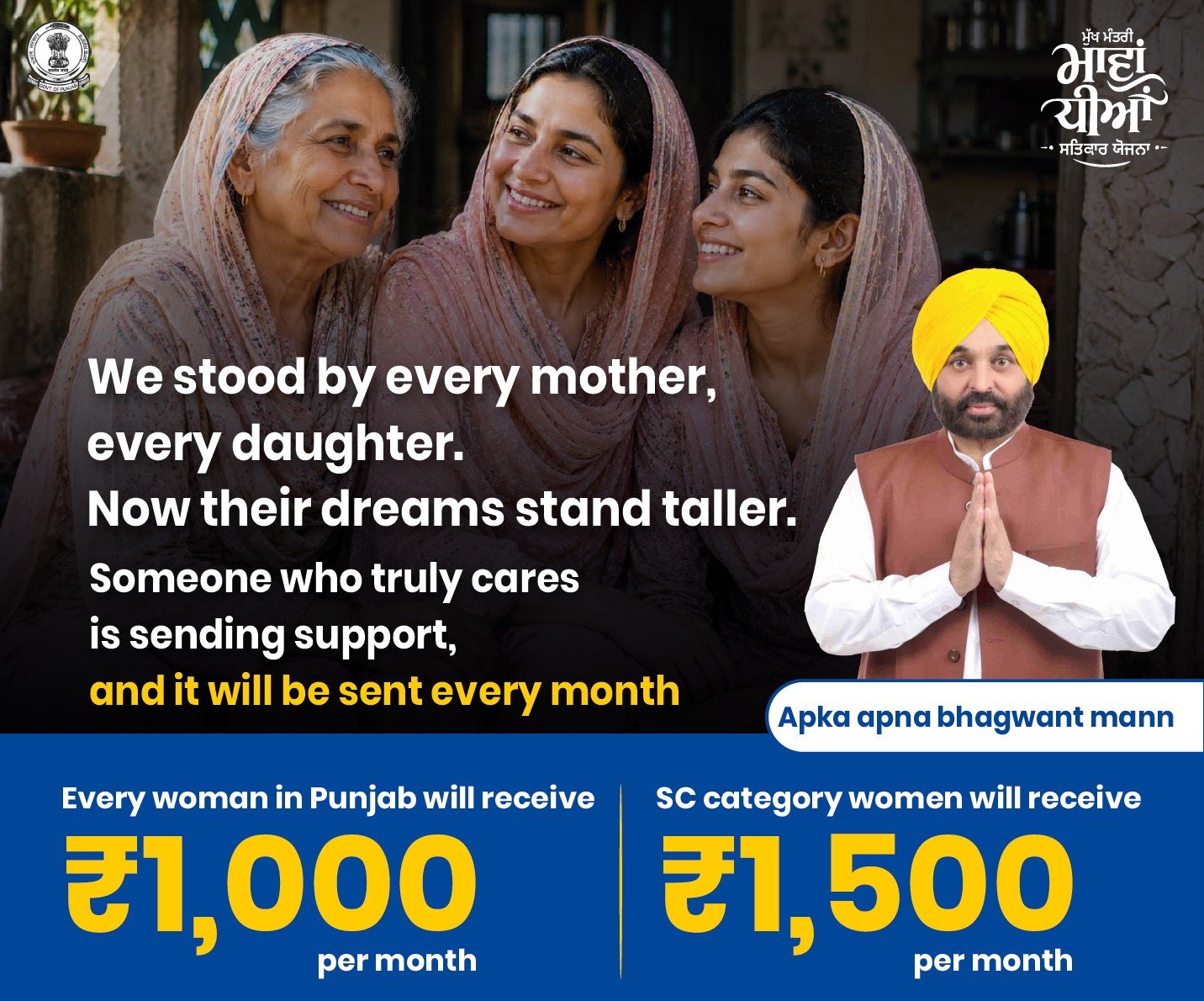
Women’s welfare was another major theme. Mann referred to the Mata-Dhian Satkar Scheme, under which women above the age of 18 are being provided monthly financial assistance, with different amounts applicable to Scheduled Caste women and women from other categories.
According to figures cited by the chief minister, the government has allocated Rs 9,300 crore for the programme and expects it to benefit around 97% of women in the state.
He said more than 70.92 lakh women had already received benefits, while another 5.20 lakh recently registered beneficiaries were being provided Rs 181.50 crore.
## Rural Punjab emerges as a crucial political battleground
Mann’s emphasis on village development comes as political parties prepare for an increasingly competitive 2027 election.
Rural Punjab remains crucial to the state’s electoral arithmetic, with issues such as farming, drugs, employment, irrigation, roads and welfare likely to influence voters.
Mann said his government was working to expand irrigation infrastructure and claimed that canal water had reached 1,587 villages that had previously not received it.
He said the government had spent around Rs 7,200 crore on expanding canal irrigation and claimed that the area receiving canal water had increased substantially since 2022.
The government, he added, was also undertaking the renovation and upgrading of around 45,000 kilometres of roads across Punjab.
## A direct attack on the Akali Dal
Mann reserved some of his strongest criticism for the Shiromani Akali Dal.
He accused the Akalis of first supporting the controversial farm laws and later opposing them after facing public anger. He also attacked the party’s declining electoral strength, contrasting its historical dominance in Punjab with its current political position.
The chief minister also criticised former deputy chief minister Sukhbir Singh Badal, questioning his understanding of Punjab’s rural and agricultural realities.
Mann accused previous governments of failing to address the state’s drug crisis and alleged that traditional political parties had contributed to the destruction of opportunities for Punjab’s youth.
He also criticised the reported attempts by the Akali Dal to revive political ties with the BJP, arguing that such an alliance would be driven by a desire for power rather than ideology or public welfare.
## Congress also comes under fire
The Congress was another target of Mann’s attack.
He accused Congress leaders of fighting among themselves for political power while the state government was concentrating on education, healthcare, employment and development.
Mann claimed that Congress lacked a coherent vision for Punjab and suggested that internal divisions would weaken the party ahead of the next Assembly election.
He portrayed the AAP as a comparatively united political force focused on governance rather than internal competition.
## The 2027 election is already shaping the political narrative
Mann’s Mohali address was more than a defence of his government’s record. It was also an early election argument.
The chief minister is attempting to make welfare delivery and development the central measure by which voters judge the AAP government, while portraying the opposition parties as representatives of an older political system.
For the AAP, the challenge ahead will be to convert these government achievements and welfare announcements into continued political support. The opposition, meanwhile, is likely to focus on issues such as unemployment, drugs, law and order, agriculture, finances and the government’s overall performance.
Punjab’s 2027 Assembly election is therefore beginning to take shape as a contest not only between political parties, but between competing claims about the state’s future.
Mann’s message in Mohali was clear: the AAP wants the next election to be fought on its record of welfare, public services and development, while seeking to convince voters that the era of traditional parties taking turns in power should remain in the past.