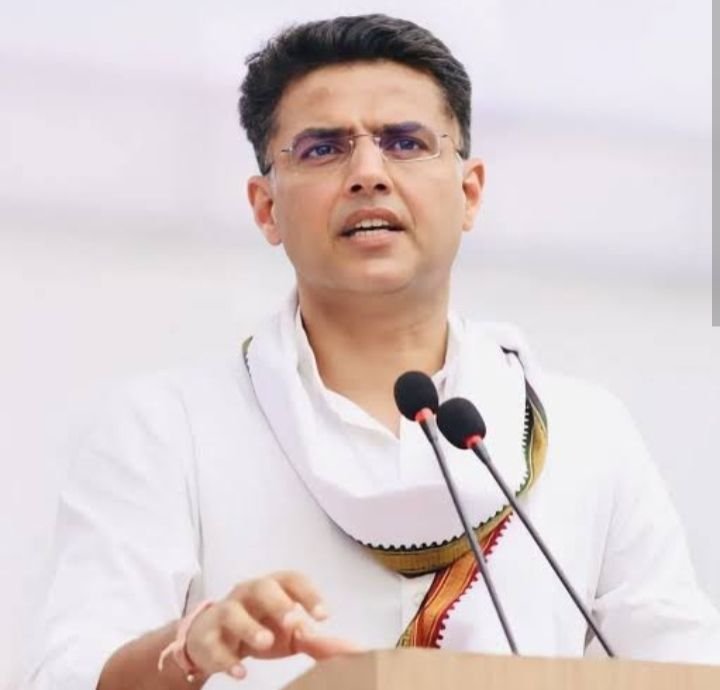
CHANDIGARH : The Punjab Congress has begun the process of assessing potential candidates for the 2027 Assembly elections, with newly appointed party in-charge Sachin Pilot putting greater emphasis on younger leaders, organisational performance and grassroots connect as the party prepares to select its candidates.
The exercise is being viewed within the party as an attempt to bring the principles of the Congress’s 2022 Udaipur Nav Sankalp Declaration into the Punjab ticket-selection process while simultaneously creating space for a second line of leadership.
According to current reports, a third-party survey is being conducted in constituencies where Congress leaders have expressed interest in contesting. Aspirants have also been asked to submit their report cards, including details of their political activities, participation in party programmes, public outreach and social-media engagement. The survey is reportedly assessing the standing of individual aspirants among voters and party workers, with the top three names in a constituency expected to be considered for further scrutiny.
A reported feature of the new exercise is additional weightage for younger and second-line leaders. According to a Punjab report, youth leaders are being given a 4 per cent advantage over senior leaders in the survey assessment. If implemented in this form, the formula could affect the relative position of established politicians and create greater opportunities for younger aspirants.
However, the 4 per cent figure should not be confused with the original Udaipur Declaration. The declaration adopted by the Congress in May 2022 specifically resolved that, beginning with the 2024 Lok Sabha elections, 50 per cent of tickets for Parliament, state legislatures, state councils and other elected posts should go to people below 50 years of age. It also called for 50 per cent representation of people below 50 in key organisational bodies.
The Udaipur document also endorsed the principles of “one person, one post” and “one family, one ticket”. Under the latter, another member of the same family could be considered for a ticket only after acquiring five years of organisational experience. The declaration also proposed limiting the tenure of organisational office-bearers to five years in order to provide opportunities to new leadership.
The Punjab exercise therefore carries significance beyond the immediate question of who gets an Assembly ticket. It indicates an attempt by the state Congress to build a stronger second line of leadership at a time when the party is preparing for a three-cornered political contest involving the ruling Aam Aadmi Party, the Bharatiya Janata Party and the Shiromani Akali Dal, alongside other political formations.
Pilot took charge as the Congress’s Punjab in-charge earlier this month after the party replaced Bhupesh Baghel. His arrival followed a period of factional tensions within the Punjab unit, particularly among senior leaders. Since taking charge, Pilot has held consultations with senior politicians, legislators, workers and younger leaders and has sought feedback on the organisation’s condition and electoral preparedness.
Pilot has also indicated that the Congress will approach the 2027 election through collective leadership rather than announcing a chief ministerial face before the polls. In an interview with The Tribune, he said the party’s immediate objective was to work collectively and secure a majority, after which the question of who would take which role would be decided.
The emphasis on younger candidates is also linked to the Congress’s attempt to strengthen its connection with first-time and younger voters. Recent reporting from Punjab says Pilot has been seeking feedback from Youth Congress office-bearers and younger leaders, with the party examining their organisational activity, booth-level presence, public engagement and ability to connect with younger voters, including Generation Z.
The party is also preparing to seek public input for its election manifesto. According to the same reporting, education, examinations, employment and other youth-related concerns are expected to feature prominently in the consultation process. The Congress has been working on what it describes as a “people’s manifesto”, with feedback already being gathered in parts of the Majha region, including Amritsar and Tarn Taran.
For sitting legislators and long-established aspirants, the emerging selection process could therefore make traditional political standing only one component of the ticket calculation. Reports indicate that the party is examining electoral prospects, organisational activity, public contact, participation in Congress programmes and the ability of prospective candidates to mobilise support at the constituency level. The reported preference for the top three names in constituency-level assessments would also introduce a more structured screening process before the final decision is taken.
Pilot is simultaneously preparing a broader assessment of the Punjab Congress organisation. Reports say a team has been collecting feedback from different sections of the party and that Pilot is expected to submit a report to the Congress high command on organisational weaknesses, coordination among leaders, grassroots mobilisation and preparations for the Assembly election.
The political significance of the exercise lies in the balance Congress will have to maintain between experience and generational change. The Udaipur framework does not call for the exclusion of leaders above 50; rather, it says the experience of senior leaders should continue to be used to strengthen the organisation while creating greater opportunities for younger leadership.
In Punjab, that balance could become particularly important because several senior Congress leaders have established political networks and electoral experience, while the party is simultaneously looking for new faces capable of expanding its appeal among younger voters and rebuilding its organisation at the booth level.
The ticket exercise is still in the assessment stage, and the reported survey formula does not by itself constitute the final candidate-selection decision. The eventual nominations will have to pass through the Congress’s formal organisational and high-command processes.
What is becoming clear, however, is that the 2027 Punjab Assembly election preparations have moved into a more structured phase for the Congress. With Pilot focusing on collective leadership, youth participation, constituency-level feedback and organisational performance, the ticket-selection process is emerging as one of the first major tests of the party’s attempt to combine its established leadership with a new generation of candidates.