

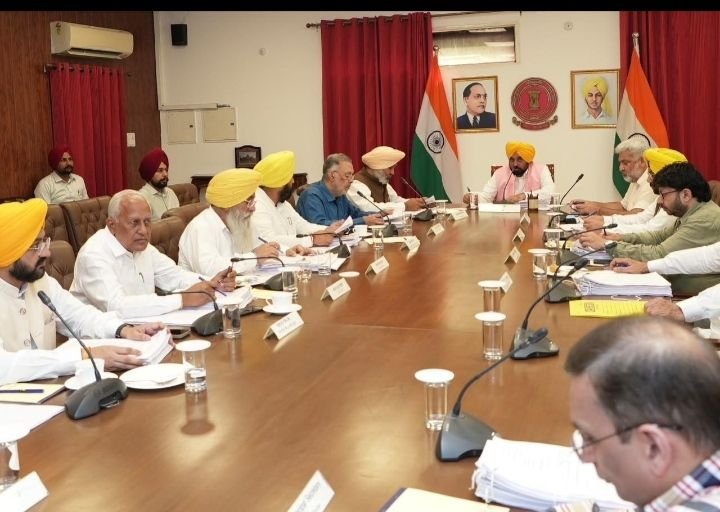
The Punjab Cabinet, chaired by Chief Minister Bhagwant Singh Mann, on Monday approved a series of decisions aimed at promoting planned tourism development, strengthening government administration and addressing service-related issues of employees.
The most significant decision was the approval of the Ranjitgarh Development Authority (RDA) Bill, 2026, paving the way for a statutory authority to oversee integrated development of the areas surrounding the Ranjit Sagar and Shahpur Kandi dams in Pathankot district.
The proposed authority is intended to provide an institutional framework for planned, sustainable and eco-tourism-oriented development of the region. It will function under the administrative control of the Tourism and Cultural Affairs Department and will have administrative, financial and regulatory powers for land management, project implementation and overall destination development.
Under the proposed structure, Chief Minister Bhagwant Mann will head the Ranjitgarh Development Authority, while the Tourism and Cultural Affairs Minister will serve as its Vice-Chairperson. A separate Executive Committee headed by the Chief Secretary will be responsible for day-to-day coordination among departments and implementation of decisions.
The Cabinet’s decision builds on the Punjab government’s earlier efforts to develop the tourism potential of the Ranjit Sagar and Shahpur Kandi dam areas. The Mann government had earlier given in-principle approval to a tourism project for the hilly region around the two dams, with the objective of developing the area as a destination for visitors while improving infrastructure and attracting investment.
The proposed RDA is expected to bring different aspects of development under a coordinated institutional mechanism rather than allowing projects in the region to be handled in isolation by different departments. The emphasis is on tourism infrastructure, sustainable development, land management and coordinated execution of projects.
In another decision, the Cabinet approved the creation of new Driver posts in the office of the Chief Electoral Officer, Punjab. The new positions will be created by surrendering existing permanent posts, including Peon and Moharrir positions. The move is intended to align the staff structure with the operational requirements of the Chief Electoral Officer’s office.
The Cabinet also approved an amendment to the Punjab Nursing Education Service Rules (Group B), 2016. The amendment will facilitate filling Tutor posts at Government College of Nursing, Patiala and Government College of Nursing, Amritsar, through promotion.
Under the revised provisions, eligible regular Staff Nurses and Nursing Sisters working under the Director, Research and Medical Education, Punjab, and possessing an M.Sc. in Nursing in the relevant speciality will be considered for promotion. Preference will be given to candidates having teaching experience in nursing education.
The decision is aimed at creating a clearer promotional pathway for qualified nursing personnel while also strengthening the teaching workforce in government nursing institutions.
The Cabinet also gave its approval for regularisation of contractual non-teaching employees working under the Punjab Information and Communication Technology Education Society (PICTES). The employees covered by the decision will receive the benefit of regularisation under the applicable PICTES framework and prescribed pay scales.
Taken together, the decisions reflect the Mann government’s focus on creating institutional mechanisms for long-term development while simultaneously addressing administrative requirements and employee-related matters.
The Ranjitgarh Development Authority decision is particularly significant for the government’s tourism strategy in northern Punjab, where the Ranjit Sagar and Shahpur Kandi dam areas have been identified for their tourism and investment potential. The creation of a dedicated statutory authority is intended to give the region a more coordinated development structure and facilitate implementation of projects under a common framework.
For Chief Minister Bhagwant Mann, the Cabinet decisions represent a combination of development planning and administrative restructuring, with the government seeking to use institutional mechanisms to accelerate tourism development, improve functioning of key offices and provide career and service-related benefits to eligible government-linked employees.