

Around 25,000 security personnel deployed, mobile internet suspended in parts of the capital and Metro restrictions imposed; INDIA bloc seeks CEC Gyanesh Kumar’s resignation over alleged voter-list irregularities, while Supreme Court questions sweeping curbs on public transport
NEW DELHI : The national capital has witnessed an extraordinary security mobilisation ahead of a protest called by the Cockroach Janta Party (CJP) against Chief Election Commissioner Gyanesh Kumar, escalating a political confrontation over alleged irregularities in electoral rolls and the Election Commission’s handling of the Special Intensive Revision (SIR) exercise.
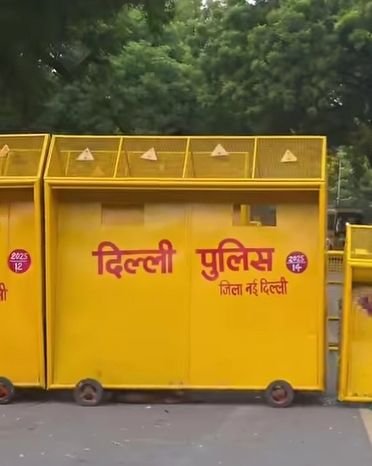
Authorities have deployed nearly 25,000 police and paramilitary personnel, imposed restrictions on public movement, ordered a temporary suspension of mobile internet services in parts of central Delhi and shut entry and exit gates at several Metro stations. The administration has cited concerns over public order and previous disruptions during demonstrations, while protest organisers have challenged the denial of permission and asserted their right to peaceful assembly.
The security measures come amid an intensifying Opposition campaign against the Election Commission. On Friday, October 9, leaders of the Congress-led INDIA bloc met President Droupadi Murmu and submitted a memorandum demanding action over what they described as serious concerns about electoral integrity.
Security Measures Bring Parts of the Capital to a Standstill
Delhi Police denied permission for the CJP’s proposed demonstration at Jantar Mantar, citing the short notice and concerns arising from previous protests. Authorities subsequently introduced extensive security arrangements across central Delhi, with heightened checks at border entry points, railway stations, bus terminals and hotels.
The Delhi Metro Rail Corporation ordered the closure of entry and exit gates at 45 stations from Friday evening until Saturday evening, according to The Indian Express. The arrangements were intended to restrict the movement of large crowds towards sensitive locations. However, the scale of the restrictions prompted concern over their impact on ordinary commuters.
Mobile internet services have also been suspended within a four-kilometre radius of the Janpath-Kartavya Path crossing from 10 pm on October 9 until 10 pm on October 10, following authorisation from the Union Home Secretary. Internet services outside the designated area were not covered by this order.
Reports have also indicated restrictions affecting rail services and the closure of retail liquor outlets during the security operation. These measures have added to the disruption faced by residents and visitors.
The Supreme Court intervened on Friday, questioning the sweeping restrictions on Metro stations and trains. The bench stressed that public safety measures must remain proportionate and that a protest should not result in a blanket shutdown of essential public transport. The court urged the authorities to reconsider the restrictions and minimise inconvenience to commuters.
INDIA Bloc Takes Electoral Integrity Dispute to President
The security clampdown coincides with a wider political confrontation over the conduct of the Election Commission and the revision of electoral rolls.
A 10-member INDIA bloc delegation, including Congress president Mallikarjun Kharge, Leader of the Opposition in the Lok Sabha Rahul Gandhi and Trinamool Congress chief Mamata Banerjee, met President Droupadi Murmu on Friday. The delegation submitted a memorandum outlining its demands and called for intervention over alleged electoral irregularities.
The Opposition sought Chief Election Commissioner Gyanesh Kumar’s resignation, suspension of the SIR exercise and restoration of names it claims were improperly removed from voter lists. It also called for a return to paper ballots and demanded reconsideration of assembly elections held over the previous two years where, according to the memorandum, evidence of electoral malpractice had been presented.
Rahul Gandhi subsequently said the President had asked the Opposition to provide evidence supporting its allegations. He indicated that the bloc was prepared to submit supporting material and pursue the matter through legal channels.
The meeting represents a significant escalation in the Opposition’s strategy: rather than limiting its campaign to street demonstrations, the bloc is seeking to place its objections before the country’s constitutional head and pursue further judicial scrutiny.
SIR and Allegations of ‘Vote Chori’ at the Centre of the Dispute
The controversy centres on the SIR process, through which electoral rolls are revised and verified. Opposition parties allege that large-scale deletions could disenfranchise eligible voters and have questioned the transparency of the exercise.
The INDIA bloc has cited a figure of approximately 13.30 crore voters allegedly removed from electoral rolls in its memorandum. This is an Opposition claim, not an independently established finding that all the deletions were unlawful.
The Election Commission’s procedures and the legality of individual deletions must be assessed on the basis of records, applicable rules and the evidence presented. Allegations of manipulation cannot, by themselves, establish that electoral outcomes were unlawfully altered.
The dispute has also acquired an institutional dimension following reports of disagreements among election commissioners over decisions associated with electoral-roll revisions. The Election Commission’s position and the relevant legal framework remain central to determining whether the allegations have merit.
A Test of Democratic Rights and Public Order
The immediate challenge for the authorities is to maintain public safety without imposing restrictions broader than necessary. The administration has pointed to previous disturbances and the risk of large-scale mobilisation, while critics argue that extensive curbs on transport and communications can affect ordinary citizens as well as demonstrators.
The Supreme Court’s intervention has brought the principle of proportionality into sharp focus: preventing violence and maintaining public order are legitimate responsibilities, but restrictions must be carefully calibrated to the actual threat.
Politically, the confrontation is likely to keep electoral transparency and the credibility of institutions at the centre of national debate. With the Opposition demanding accountability and the Election Commission facing scrutiny over its processes, the dispute is no longer confined to a single protest at Jantar Mantar.
Its eventual resolution will depend on verifiable evidence, transparent explanations from the authorities and any findings emerging from judicial proceedings. For now, Delhi’s security deployment and the Opposition’s appeal to the President illustrate the widening divide over electoral trust, constitutional accountability and the right to peaceful protest.
This is a web generated news report