


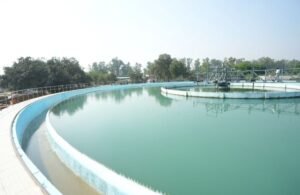
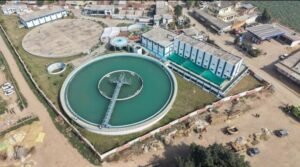
Patiala : In a major push towards safe drinking water and groundwater conservation, Punjab Chief Minister Bhagwant Singh Mann on Monday dedicated two modern water treatment plants at Mandoli in Ghanaur constituency, marking a significant expansion of canal-based drinking water infrastructure in Patiala and adjoining areas.
Built under the ₹432.65-crore Bulk Surface Water Supply Project, the facilities at Mandoli and Pabri are designed to provide treated canal water to 316 villages across five Assembly constituencies, benefiting an estimated 4,50,421 residents and around 75,000 households. A 752-kilometre transmission pipeline network, supported by upgraded village distribution systems and water storage facilities, will carry treated water to communities that have long faced concerns over groundwater quality and availability.
Addressing the gathering, Mann described the occasion as an important milestone for Patiala and Fatehgarh Sahib, observing that access to safe drinking water is directly linked to public health. He said the region’s dependence on groundwater had become increasingly problematic because of excessive extraction and the presence of fluoride and other contaminants in several areas. The government, he said, had therefore opted for a canal-based supply system to provide a more sustainable alternative.
The Chief Minister said the two plants had been established at a cost of ₹266.20 crore at Mandoli and ₹166.46 crore at Pabri. Together, they will treat canal water before its distribution to the beneficiary villages. He regretted that even decades after Independence, residents in many villages continued to struggle for access to clean drinking water, adding that the basic infrastructure should have been developed much earlier. He accused successive previous governments of neglecting the needs of these communities and said his government had taken up the long-pending task.
The project is intended to reduce dependence on underground water sources, particularly in areas where groundwater quality has been affected by excessive concentrations of fluoride and heavy metals. The identified contaminants include aluminium, lead, sulphate, arsenic and uranium. According to the project details, 250 of the 316 villages have been identified as having groundwater-quality concerns, while other villages are covered along the transmission network.
The scale of Punjab’s groundwater challenge provides the wider context for the initiative. The state is extracting groundwater at around 156.36 per cent of its annual natural recharge capacity, an unsustainable level that has intensified concerns over long-term water security. Patiala is among the districts facing particularly severe pressure, with reported groundwater extraction substantially exceeding the available recharge.
Mann said the treatment facilities would have the capacity to process large volumes of canal water every day and provide a dependable source of drinking water to the region. However, the figures in the project information released by the government require clarification: the Chief Minister’s address cited a combined capacity of 69 million litres per day, while the detailed project note specified 58 MLD. The exact operational capacity should therefore be confirmed by the department.
The distribution infrastructure includes 752 kilometres of ductile iron transmission pipelines, along with 1,216 kilometres of upgraded pipelines across the villages. Water will be supplied through an extensive network of storage reservoirs, enabling households to receive treated canal water through existing village-level supply systems. The project has been planned to meet the region’s drinking water requirements up to 2049, giving it a long-term infrastructure perspective.
To maintain quality and operational reliability, the facilities have been equipped with Supervisory Control and Data Acquisition (SCADA) systems for monitoring water treatment and distribution. Automatic sensors, storage-level monitoring, overflow alerts and pumping controls are intended to help maintain continuity in supply. Water-testing laboratories have also been established at the project sites, with samples examined before and after treatment. Testing reports are forwarded periodically to the state-level water testing laboratory.
The Chief Minister said the agency responsible for executing the project had also been assigned its operation and maintenance for ten years. Water Supply and Sanitation Committees have been constituted in all 316 villages to encourage community participation and support monitoring of the system at the local level.
Residents welcomed the initiative, describing the arrival of treated canal water as a major relief for families concerned about groundwater quality. Gurpreet Singh, a resident of Patiala district, said that obtaining safe drinking water had been a persistent concern, but the new supply system was bringing clean water directly to household storage tanks. Harpreet Kaur of Sanaur also said the improved supply had eased worries about the quality of water used by families for daily needs.
Beyond the rural project, Mann said work was progressing on major surface-water supply schemes for Ludhiana, Amritsar, Jalandhar and Patiala cities. These projects are intended to shift urban areas towards more sustainable surface-water sources and reduce pressure on depleted groundwater reserves. The government has projected that the combined initiatives will eventually benefit around 78 lakh urban residents, with a planned treatment capacity of 1,410 MLD and extensive pipeline, reservoir and pumping infrastructure. Their execution, however, continues to face challenges relating to land acquisition, clearances and labour availability.
The government has also highlighted parallel efforts to strengthen sewage treatment infrastructure across Punjab. At present, 152 sewage treatment plants with a combined capacity of 2,243.7 MLD are reported to be operational in the state’s 23 districts. With around 58 additional plants planned, the total treatment capacity is expected to rise to approximately 2,676 MLD by December 2027. Two major 50-MLD facilities are proposed at Amritsar and Zirakpur as part of this expansion.
In another infrastructure-related update, 114.24 kilometres of desilting work has been reported across various urban local bodies in Patiala district.
The Mandoli and Pabri water treatment plants represent a significant intervention in a region where groundwater depletion and contamination have become pressing public concerns. Their long-term success, however, will depend not only on the infrastructure created but also on consistent water-quality testing, reliable distribution, transparent monitoring and effective maintenance. For thousands of rural families, the real measure of the project will be whether safe drinking water reaches their homes regularly and sustainably.