

Saptrishi Soni
With the 2027 Punjab Assembly elections drawing closer, the Bharatiya Janata Party has stepped up its organisational preparations by assigning important responsibilities to a group of senior political leaders, former ministers, parliamentarians, former legislators and prominent public figures. The constitution of a 13-member Manifesto Committee under former MP Avinash Rai Khanna, alongside a separate 14-member Chargesheet Committee headed by former Punjab BJP president Sunil Jakhar, signals the party’s move towards a more structured and issue-driven electoral campaign.
The appointments are significant because they bring together leaders with varied political, administrative and public-policy experience at a time when the BJP is seeking to expand its political footprint in Punjab. Rather than relying solely on campaign rhetoric, the party appears to be putting in place teams that can shape its policy promises, identify public grievances, assess the performance of the incumbent government and develop arguments for the next electoral contest.
For the BJP, these committees could serve as important instruments in preparing an election narrative around governance, economic challenges, agriculture, employment, law and order, drug-related concerns and public services. Their effectiveness, however, will depend on how successfully the party converts the experience of its members into credible proposals and connects those proposals with the concerns of voters across Punjab.
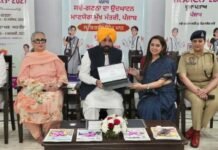
Parampal Kaur Sidhu’s inclusion in the Manifesto Committee has attracted particular attention. The former IAS officer, who currently serves as the BJP’s State Media Co-incharge, is among the prominent faces entrusted with a role in shaping the party’s policy agenda. Her nomination also reflects the organisational space she has been building within the Punjab BJP since entering active politics.
A broad-based team to shape the BJP’s Punjab agenda
The Manifesto Committee includes Manpreet Singh Badal, Ashwani Sharma, Manoranjan Kalia, Som Parkash, Rana Gurmeet Singh Sodhi, Ashwani Sekhri, Satnam Singh Sandhu, Raghav Chadha, Rajinder Gupta, Harbhajan Singh, Parampal Kaur and advocate H.S. Phoolka, with Avinash Rai Khanna as its chairman. The panel brings together people with experience in state and national politics, legislative work, public life and administration.
The presence of Raghav Chadha and Harbhajan Singh is also politically noteworthy. Both were associated with the Aam Aadmi Party before joining the BJP, and their inclusion gives the party an opportunity to draw upon their political experience and public profiles as it prepares to challenge its former rival in Punjab. Their participation may also help the BJP communicate beyond its traditional support base, although the real test will be whether this translates into stronger organisational support and voter confidence.
Parampal Kaur Sidhu’s place on the panel adds an administrative dimension to its composition. Having served as an IAS officer in the Punjab cadre before entering politics, she brings familiarity with government procedures, policy implementation and institutional functioning. As State Media Co-incharge, she is also involved in communicating the party’s positions on political and public-interest issues. Her role in the manifesto exercise could help connect policy discussions with governance-related concerns and the way these issues are presented to the public.
For a party attempting to broaden its presence in Punjab, the composition of the committee is important. The BJP needs an electoral document that goes beyond general promises and responds to the state’s specific circumstances. Agriculture and farmers’ livelihoods, industrial investment, employment, education, healthcare, infrastructure, fiscal pressures, law and order, and the drug menace are among the issues likely to shape the political debate in the run-up to 2027.
Sunil Jakhar to lead the chargesheet committee
Alongside the manifesto panel, the BJP has constituted a 14-member State Chargesheet Committee under former Punjab BJP president and former MP Sunil Jakhar. The committee includes Iqbal Singh Lalpura, Vijay Sampla, Shwet Malik, Maharani Preneet Kaur, Ravneet Singh Bittu, Dinesh Babbu, Sushil Rinku, Geja Ram, Vikramjit Singh Sahney, Ashok Mittal, Sandeep Pathak, S.S. Channi and Jagmeet Singh Brar.
The panel has been assigned the task of compiling the BJP’s charges against the incumbent government, particularly concerning its performance and alleged shortcomings. This is expected to provide the party with an organised framework to raise questions on governance, fulfilment of promises, public finances, employment, law and order, the drug problem and the delivery of public services.
The two committees therefore have complementary political responsibilities. While the Manifesto Committee will work on what the BJP proposes to do if given the mandate, the Chargesheet Committee will prepare its case against the present administration. Together, they can help the party build a campaign that combines criticism of the government’s record with an alternative policy agenda.
A test of political consolidation ahead of 2027
The appointments also indicate that the BJP is seeking to bring different strands of its Punjab leadership and public representatives onto a common platform. The inclusion of former ministers, parliamentarians, experienced legislators, public figures and leaders with administrative backgrounds gives the committees a wider pool of experience. It may also help the party coordinate its state-level and national-level political resources more effectively.
For Parampal Kaur Sidhu, the assignment represents a further step in her organisational responsibilities. Working alongside senior leaders on a document that will outline the BJP’s proposed approach to Punjab’s future could increase her role in policy discussions and the party’s public outreach.
The wider political significance lies in the timing. With the 2027 Assembly election approaching, the BJP has to address the challenge of expanding its electoral base in a state where regional identity, farmers’ concerns, religious and social considerations, economic distress and local political equations carry considerable weight. The party will need to demonstrate that it understands these realities and can offer practical, financially credible solutions.
The formation of the committees is an early organisational move, not a guarantee of electoral success. Their contribution will be judged by the quality of the manifesto, the credibility of the chargesheet and the party’s ability to take both documents to voters. The BJP leadership has also indicated that more committees will be announced, suggesting that its election-preparation structure is still taking shape.
Ultimately, the challenge for Avinash Rai Khanna, Sunil Jakhar and the members of their respective panels will be to convert political experience into a coherent campaign strategy. If the BJP can translate its committees’ work into locally relevant commitments, clear answers on Punjab’s pressing problems and a sustained organisational campaign across constituencies, these appointments could strengthen its preparation and improve its prospects in the 2027 Assembly contest. The decisive factor, however, will be whether voters see the party’s proposed solutions as realistic, credible and capable of delivering change.