


Saptrishi Soni
High-level meeting in Chandigarh focuses on border surveillance, drone activity, drugs, gangster networks and real-time intelligence sharing; election authorities seek coordinated action to prevent criminal elements from influencing the polls
Chandigarh, November 20:
With the 2027 Punjab Assembly elections approaching, the state police have stepped up preparations to address the security challenges that could affect the electoral process, bringing together law-enforcement agencies from neighbouring states, central security organisations and intelligence units to develop a coordinated strategy.
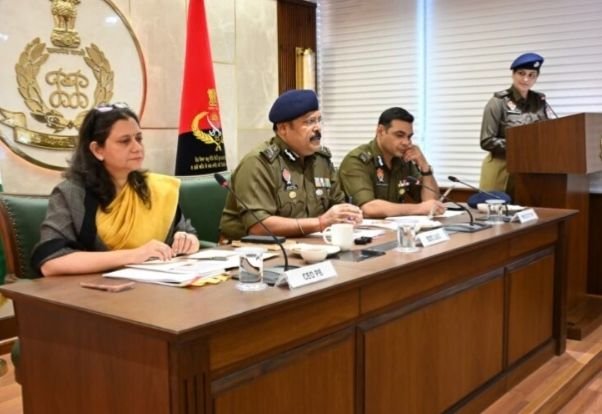
A high-level Inter-State Coordination Meeting at Punjab Police Headquarters in Chandigarh on Friday focused on strengthening border security, disrupting criminal networks, preventing the movement of narcotics and illegal weapons, and improving intelligence-sharing between agencies. The exercise reflects the importance of coordinated action in a state where criminal networks, drug supply chains and cross-border security concerns cannot be tackled through the efforts of a single police force.
The meeting was chaired by Special Director General of Police (Law and Order) Praveen Kumar Sinha, representing Punjab DGP Gaurav Yadav, along with Chief Electoral Officer Anindita Mitra. Inspector General of Police (Counter Intelligence) and State Police Nodal Officer for Elections Ashish Choudhary coordinated the deliberations.
Senior police officers and state nodal officers from Punjab, Rajasthan, Haryana, Jammu and Kashmir, Himachal Pradesh and the Union Territory of Chandigarh participated. Drug Controllers and their representatives from Punjab, Haryana, Himachal Pradesh and Chandigarh were also present.
The participation of central agencies, including the Border Security Force (BSF), Central Reserve Police Force (CRPF), Railway Protection Force (RPF), Intelligence Bureau (IB) and Narcotics Control Bureau (NCB), gave the meeting a wider security dimension. Punjab’s Anti-Narcotics Task Force and the Excise and Taxation Department were also represented.
Drugs, gangsters and illegal weapons among key concerns
A major focus was the prevention of inter-state trafficking of narcotics, illicit liquor, illegal firearms, ammunition and explosives. These networks often operate across administrative boundaries, making cooperation between neighbouring police forces essential for effective enforcement.
The officers discussed measures to identify and track wanted criminals, gangsters and their associates, besides strengthening action against anti-social elements who could exploit inter-state routes to evade law enforcement.
The meeting also examined the need for a unified approach to handling communal and other sensitive issues that could create tension during the election period. Maintaining public order will require not only preventive policing but also rapid communication and coordinated responses when incidents have the potential to spill across district or state boundaries.
For Punjab, the drug trade and organised criminal activity remain particularly important security concerns. The movement of narcotics and weapons through different routes, including those connecting the state with neighbouring regions, requires sustained surveillance and intelligence-led enforcement rather than isolated operations.
Border surveillance and drone monitoring
Border management and monitoring of drone activity featured prominently in the discussions. Officers deliberated on improving surveillance along vulnerable stretches, strengthening coordination between adjoining jurisdictions and developing mechanisms for prompt action whenever suspicious movement or activities are detected.
The use of drones for illicit consignments has emerged as an important security challenge in Punjab’s border areas. The involvement of the BSF and other agencies is therefore significant, as effective monitoring requires coordination between border forces, state police and intelligence organisations.
The participants also discussed joint enforcement operations across adjoining jurisdictions. Such operations can help prevent criminals and suspected traffickers from exploiting state boundaries to escape detection or frustrate investigations.
Real-time intelligence sharing to close operational gaps
A central objective of the meeting was to improve the flow of actionable intelligence between agencies. Officials emphasised real-time information sharing, quicker exchange of inputs and stronger communication among field officers posted in neighbouring districts.
The intention is to ensure that information about wanted persons, suspected criminal movements, illegal consignments and emerging security threats reaches the relevant agencies without delay.
Better coordination between district police units is particularly important during elections, when security arrangements extend beyond polling stations to include campaign events, sensitive locations, transport routes and areas vulnerable to intimidation or disruption.
The meeting also sought to address existing operational gaps and establish institutional mechanisms through which agencies can coordinate their responses instead of working in isolation.
Election security extends beyond polling day
The significance of the exercise lies in the fact that election security is not limited to the deployment of personnel at polling stations. It begins well before the announcement of the election schedule and involves monitoring criminal activity, preventing the distribution of illegal material, maintaining communal harmony and ensuring that voters can participate without fear or pressure.
Punjab’s geographical position and its connections with several neighbouring states make inter-state cooperation especially relevant. Criminal networks operating across jurisdictions can undermine local enforcement if information is not shared quickly or if agencies fail to coordinate their operations.
The presence of the Chief Electoral Officer alongside senior police officials also underlines the importance of linking election management with law-and-order preparedness. A credible election requires both effective security arrangements and public confidence in the impartiality of the process.
The preparations will ultimately be judged by the ability of the agencies to prevent intimidation, curb unlawful activities and respond swiftly to any threat without disrupting legitimate political campaigning or the rights of voters.
A test of coordination ahead of 2027
The November 20 meeting marks an important step in Punjab’s preparations for the Assembly elections expected in early 2027. However, the real test will lie in translating the decisions and discussions into regular coordination at the operational level.
The effectiveness of the strategy will depend on whether intelligence is exchanged promptly, border surveillance remains consistent, joint operations produce results and district-level officers maintain close contact with their counterparts across state boundaries.
For the Punjab Police and election authorities, the objective is clear: to prevent criminal networks and unlawful activities from influencing the electoral environment and to ensure that the forthcoming Assembly elections are conducted in a peaceful, free, fair and transparent atmosphere.
With several states and central agencies now part of the coordination framework, the emphasis is shifting towards a wider security network in which preparedness, information-sharing and timely intervention will be crucial to protecting the integrity of the 2027 electoral process.