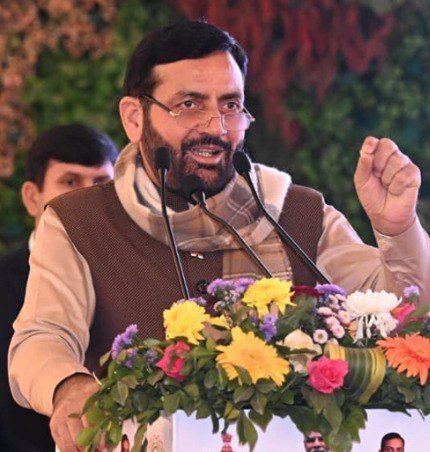
Haryana Chief Minister Nayab Singh Saini on Wednesday announced the establishment of an international-level textile institute in Panipat, marking a major policy push for the state’s traditional textile hub. The announcement was made during a pre-budget consultation meeting with representatives of the textile, food processing and other industrial sectors from Panipat, Sonipat and Karnal. The state government will make 10 acres of land available through HSIIDC for the proposed institute, which is expected to provide world-class technical training and skill development facilities.
Addressing industry stakeholders, the Chief Minister described Panipat as a historic centre of weaving and textiles that has brought recognition to Haryana across India. He said the city is also emerging rapidly as a food processing hub, reflecting diversification in the local industrial base. The proposed international textile institute, he said, would strengthen Panipat’s global competitiveness by creating a skilled workforce trained to international standards and by supporting innovation in advanced textile technologies.
The Chief Minister also announced that the Haryana Aatmanirbhar Textile Policy has been extended by one year, with its validity now continuing until December 18, 2026. The extension, he said, was in response to demands from industry bodies and is aimed at ensuring continuity in incentives and policy support for investors and entrepreneurs. He described the textile policy as a sign of growing trust between the government and the industry, noting that hundreds of applications have already been received under the scheme.
Highlighting the importance of pre-budget consultations, the Chief Minister urged stakeholders to treat the exercise as “the people’s budget” rather than just a government document. He said the suggestions received from industry would play a guiding role in shaping the Budget 2026–27, and assured that the government would seriously consider practical inputs from the ground. He also said that those whose key suggestions are incorporated into the budget would be specially invited to witness the budget proceedings in the Haryana Assembly.
Speaking on the broader industrial vision, the Chief Minister referred to the national five-F framework — farm to fibre, fibre to factory, factory to fashion and fashion to foreign — and said Haryana is committed to aligning its policies with this integrated value chain approach. He said this vision would help link farmers, manufacturers and exporters, creating a seamless ecosystem that benefits both rural and urban economies.
The Chief Minister said that under the Haryana Aatmanirbhar Textile Policy, 354 applications have been received so far, and grants worth around Rs. 367 crore have already been approved. He noted that global demand is increasingly shifting towards chemical-free and naturally dyed textiles, and expressed confidence that Panipat could emerge as a global leader in this segment. He also pointed out that local entrepreneurs are moving beyond traditional products and are adopting innovations such as waste-to-wealth, PET-to-fibre technologies and specialised products like antibacterial towels.
Urging exporters to adapt to global market trends, the Chief Minister said Haryana’s textile products must meet international quality expectations. He stressed that when products from Panipat reach markets in Europe or the United States, the labels “Made in India” and “Made in Haryana” should be seen as guarantees of quality and reliability. He also encouraged greater focus on medical textiles and technical textiles, noting that special budgetary provisions are being planned to promote research, new machinery and advanced training in these areas.
The Chief Minister also spoke at length about the growing role of the food processing industry in Haryana. He said the sector is acting as a strong bridge between farmers and consumers, helping farmers secure better prices while adding value to agricultural produce. He cited national trends showing rapid growth in the food processing sector and said Haryana is well positioned to benefit due to its strong agricultural base and improving infrastructure.
He informed that more than 28,000 food processing units are already operating in the state, and said the government has notified multiple infrastructure schemes to support the sector. These include capital investment subsidies for setting up, expanding and diversifying food processing units, as well as incentives for backward and forward linkages, cold chain infrastructure, value addition facilities and integrated mini food parks. The objective, he said, is to reduce post-harvest losses, improve storage and logistics, and strengthen the entire agri-processing value chain.
The Chief Minister underlined that industrial associations play a crucial role in bridging the gap between policy and ground realities. He said resolving industry concerns and creating a business-friendly environment remains a top priority of the state government. According to him, the strength of Haryana’s growth story lies in close coordination between the government and the private sector.
Senior ministers, administrative officers and industry leaders were present at the meeting, reflecting the importance being attached to industry inputs in the run-up to the Budget 2026–27. The announcements made in Panipat are being seen as a strong signal of the state government’s intent to position Haryana as a major textile, food processing and export-driven manufacturing hub in the coming years.