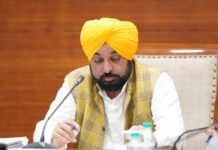

Punjab Chief Minister Bhagwant Mann has mounted a strong political response to the Union Budget, accusing the Centre of repeatedly ignoring the needs of a border state grappling with agrarian distress, unemployment and security challenges. From the very first hours after the Budget presentation, Mann positioned himself at the forefront of the backlash, framing the issue not as partisan politics but as a matter of Punjab’s rights and federal fairness.
Speaking to the media, the Chief Minister said the Budget had “nothing concrete” for Punjab despite the state’s strategic importance and economic contribution. He alleged that the Centre continues to treat Punjab with a “step-motherly attitude,” failing to address long-pending demands related to agriculture diversification, industrial revival, and border infrastructure.
Bhagwant Mann argued that Punjab bears the burden of feeding the nation, guarding international borders, and managing the fallout of past policy decisions, yet receives inadequate fiscal support in return. He pointed out that there was no special allocation for farmers struggling with rising input costs, no meaningful package for youth employment, and no relief for a state already under financial stress.
The Chief Minister also criticised the absence of any targeted intervention for drug control and rehabilitation, calling it a missed opportunity to support states fighting the menace at the grassroots. According to Mann, speeches about development mean little unless backed by region-specific commitments.
What distinguishes this response is Mann’s effort to frame the criticism as a collective Punjabi concern rather than an AAP-versus-BJP confrontation. He urged opposition leaders, including those from Congress and Shiromani Akali Dal, to rise above party lines and demand justice for Punjab.
Senior AAP leaders echoed Mann’s position, stating that fiscal centralisation is weakening federalism. They argued that border states like Punjab incur higher costs due to security responsibilities but are not compensated accordingly.
The opposition largely supported the criticism, though with varying degrees of intensity. Congress leaders accused the Centre of continuing policies that marginalise Punjab, while Akali Dal leaders said the Budget exposed the BJP’s lack of understanding of Punjab’s socio-economic realities.
Political analysts view Mann’s aggressive response as a calculated move to reinforce his image as a defender of Punjab’s interests. By directly challenging the Centre, he has sought to occupy the political space traditionally associated with regional assertiveness.
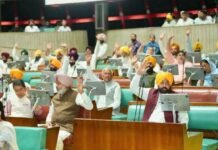
As debates around the Budget continue inside and outside the Assembly, the issue has evolved into a broader conversation about Centre-state relations. For the Mann government, the challenge will be to convert political protest into tangible outcomes, while keeping public expectations grounded.