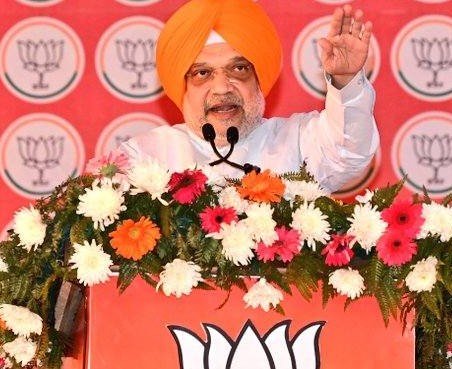
Moga/Chandigarh: India’s Union Home Minister Amit Shah launched a sharp political offensive in Punjab while addressing a large public gathering in Moga, signalling the Bharatiya Janata Party’s intent to emerge as a decisive political force in the state ahead of the 2027 Assembly elections. Speaking at what the party described as a “Badlaav Rally,” Shah targeted both the ruling Aam Aadmi Party and the Congress, accusing them of failing to address key issues such as the drug menace, corruption and governance in Punjab. His speech also attempted to reinforce the BJP’s outreach to Sikh communities while positioning the party as a viable alternative in a state where regional and national political equations remain fluid.
The rally, held in the politically significant district of Moga, comes at a time when national parties are recalibrating their strategies in Punjab after the sweeping victory of the Aam Aadmi Party in the 2022 Assembly elections. Addressing party workers and supporters, Shah said the BJP is preparing for a long-term political expansion in Punjab and urged voters to give the party an opportunity to transform governance in the state.
One of the central themes of Shah’s address was the issue of drug abuse, which has been a persistent socio-political concern in Punjab for years. The Home Minister said that if the BJP comes to power in the state, it would launch an aggressive crackdown on drug trafficking networks and eliminate the narcotics problem within two years. He argued that the drug crisis has deeply affected youth and families across the state and accused successive governments of failing to tackle the issue effectively.
Shah also spoke about religious conversion, saying that a BJP-led government would introduce stringent legal measures to curb forced or illegal conversions. According to him, protecting cultural and religious identity would be a priority if the party forms the government in Punjab. These remarks were seen by political observers as an attempt to address concerns among certain sections of society while expanding the BJP’s ideological messaging in the state.
During the rally, Shah launched a direct attack on Punjab Chief Minister Bhagwant Mann and Delhi Chief Minister Arvind Kejriwal, accusing them of misusing public resources. He alleged that the Punjab government was functioning as a financial conduit for political activities outside the state and claimed that taxpayer money was being diverted for political campaigns elsewhere. According to Shah, such practices had weakened governance and pushed Punjab into deeper administrative challenges.
The Home Minister also criticised the Congress, particularly targeting statements made by Rahul Gandhi. In his speech, Shah referred to historical political events, stating that during the era of Jawaharlal Nehru, efforts were made to politically marginalise B. R. Ambedkar. Shah used the reference to question the Congress leadership’s moral authority in contemporary political debates and criticised what he described as attempts by opposition leaders to influence political leadership decisions across states.
A significant portion of Shah’s address focused on the Sikh community and the BJP’s outreach efforts. He said the government led by Prime Minister Narendra Modi had taken steps to deliver justice to victims of the 1984 anti-Sikh riots, including legal action against individuals accused in the violence. He also highlighted the government’s decision to provide financial assistance of ₹5 lakh to riot victims, arguing that these measures demonstrated the BJP’s commitment to justice for Sikh families affected by the tragic events.
Shah also sought to reassure farmers, an influential constituency in Punjab’s political landscape. He said the central government had significantly increased the agricultural budget to ₹1.40 lakh crore and emphasised that the procurement of crops at Minimum Support Price had expanded under the current administration. Addressing concerns circulating in political debates about international trade agreements and agricultural policies, Shah urged farmers not to believe what he called “misleading narratives” being spread by political opponents.
Political analysts view the rally as part of the BJP’s broader attempt to strengthen its organisational base in Punjab, where the party historically played a supporting role in coalition politics but is now attempting to establish an independent electoral identity. The party has been intensifying grassroots outreach, especially in urban constituencies and among sections of youth and traders.
The speech also reflected the BJP’s strategy of linking state-level governance issues with national political narratives, particularly around corruption, security and social justice. By invoking topics such as the drug crisis, farmers’ welfare and Sikh community concerns, Shah sought to frame the BJP as a credible governing alternative in Punjab.
With the next Punjab Assembly election scheduled for 2027, political parties have already begun early mobilisation efforts across the state. Shah’s rally in Moga is being interpreted as an indication that the BJP intends to invest significant political capital in Punjab over the coming years. Whether this strategy will translate into electoral gains remains uncertain, but the rally has clearly intensified political discourse in a state that continues to hold strategic importance in India’s northern political landscape.