
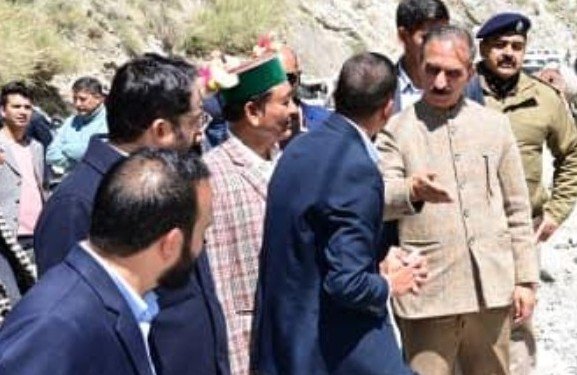
During a significant two-day visit to the strategically important tribal district of Kinnaur, Chief Minister Thakur Sukhvinder Singh Sukhu underscored his government’s dual focus on strengthening Himachal Pradesh’s clean energy capacity while simultaneously promoting innovation in the horticulture sector. The visit reflected a broader policy vision that seeks to align economic growth with environmental sustainability in one of India’s most ecologically sensitive regions.
The Chief Minister began his visit by reviewing the progress of the ambitious 450 MW Shongtong–Karcham Hydroelectric Project on the Satluj River, a key infrastructure initiative expected to play a transformative role in the state’s energy landscape. Personally inspecting critical components of the project, including the powerhouse, surge shaft, and barrage areas, Sukhu interacted directly with engineers and on-ground workers, signaling the government’s hands-on approach in ensuring timely execution of high-value projects.
Expressing satisfaction over the pace of construction, the Chief Minister noted that nearly 75 percent of the work has already been completed. He emphasized that major civil structures such as the barrage, head race tunnel, and powerhouse are now in advanced stages, while electro-mechanical installations are progressing in alignment with the project timeline. However, he also issued clear directives to accelerate the remaining work, setting a target for the completion of the first phase by January 2027 and the full project within the current financial cycle.
Highlighting the broader implications of the project, Sukhu stated that once operational, it is expected to generate approximately 1,579 million units of electricity annually. This would not only significantly enhance Himachal Pradesh’s power generation capacity but also strengthen grid stability and energy self-reliance. The project is also projected to contribute nearly Rs. 900 crore annually to the state’s economy, making it a cornerstone of Himachal’s long-term fiscal and energy strategy.
The Chief Minister reiterated that despite geographical and technical challenges typical of mountainous terrain, the state government has adopted proactive monitoring mechanisms and improved planning frameworks to keep the project on track. He stressed that hydropower remains central to Himachal’s identity as a clean energy leader and reaffirmed the government’s commitment to environmentally sustainable development.
In a parallel push towards innovation in agriculture and allied sectors, Sukhu also visited Tapari, where he inspected what is being described as the world’s first geothermal-powered combined apple cold storage and fruit drying unit. Developed through a collaboration between the Himachal Pradesh Horticultural Produce Marketing and Processing Corporation (HPMC) and an Iceland-based company, the facility represents a pioneering step in integrating renewable energy into post-harvest management systems.
With a storage capacity of 1,000 tonnes, the unit has already demonstrated promising results. Over the past two years, a total of 16,963 kilograms of fruit has been processed at the facility. Notably, more than 11,900 kilograms were processed between mid-2025 and early 2026, indicating growing utilization and acceptance among local farmers.
What sets this facility apart is its reliance on geothermal energy sourced from the region’s naturally occurring thermal springs—among the hottest in the area. Unlike conventional cold storage and drying units that depend heavily on electricity, this system uses geothermal heat, making it both energy-efficient and environmentally sustainable. The initiative is expected to significantly reduce post-harvest losses while also lowering operational costs for farmers.
Sukhu described the project as a model for the future of sustainable horticulture, particularly in hill states where energy access and cost remain key challenges. He emphasized that such innovations will not only enhance farmers’ incomes but also position Himachal Pradesh as a leader in climate-resilient agricultural practices.
The visit, taken as a whole, highlighted a strategic convergence of infrastructure development and sustainable innovation. While the hydroelectric project strengthens the backbone of the state’s clean energy ambitions, the geothermal horticulture facility demonstrates how technology and natural resources can be leveraged to empower rural economies.
Senior officials, including Revenue Minister Jagat Singh Negi, senior bureaucrats, and district administration representatives, accompanied the Chief Minister during the visit, reflecting the importance attached to both projects at the highest levels of governance.
As Himachal Pradesh navigates the challenges of development in a fragile ecological zone, Sukhu’s Kinnaur visit sends a clear message: the state is committed to pursuing growth that is not only economically viable but also environmentally responsible and socially inclusive.