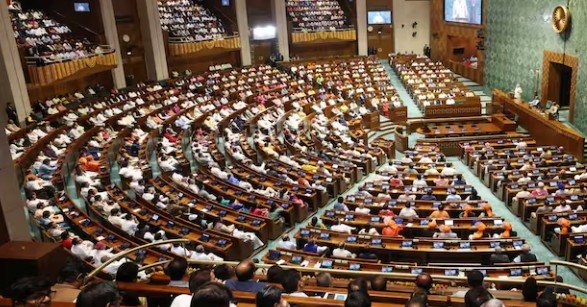
A crucial legislative effort to modify the framework of women’s political representation suffered a setback in the Lok Sabha after the proposed Constitution (131st Amendment) Bill, 2026 failed to secure the constitutionally mandated two-thirds majority. The development marks a significant moment in India’s ongoing debate over gender representation, electoral restructuring, and the future of parliamentary democracy.
The Bill, which sought to refine provisions related to the implementation of women’s reservation, could not cross the required threshold despite receiving majority support. A total of 298 Members of Parliament voted in favour of the legislation, while 230 opposed it. However, constitutional amendments in India require a two-thirds majority of members present and voting, a benchmark the government ultimately did not meet.
Announcing the outcome, Om Birla confirmed that the Bill stood defeated due to its inability to achieve the necessary majority. The result effectively stalls, at least for now, the Centre’s attempt to recalibrate the mechanism for introducing 33 percent reservation for women in the lower house of Parliament and state legislatures.
The legislative effort was part of a broader package of reforms, with two additional proposals—relating to delimitation of constituencies and a potential increase in the total number of Lok Sabha seats—closely tied to the women’s quota framework. Following the defeat of the primary Bill, the government chose not to put these related proposals to vote, stating that they were intrinsically linked and could not proceed independently.
The debate preceding the vote was both intense and prolonged, stretching late into the night and resuming the following day. The government strongly advocated for the Bill, framing it as a landmark step toward enhancing women’s representation in Indian politics. Ministers argued that structural adjustments were necessary to ensure that reservation could be implemented effectively in the future, particularly in the context of population changes and constituency realignment.
However, the opposition raised fundamental concerns about the intent and structure of the proposed legislation. Rahul Gandhi, Leader of the Opposition, emerged as a key critic, arguing that the Bill’s linkage with delimitation raised serious questions about its underlying objectives. He suggested that the proposal was less about empowering women and more about reshaping the electoral map in a way that could politically benefit the ruling establishment.
Gandhi also highlighted concerns about representation, particularly for Other Backward Classes (OBCs), alleging that the Bill did not adequately address the need for inclusive representation across social categories. He argued that bypassing a caste-based census while pushing structural electoral changes could undermine equitable political participation.
The broader issue of delimitation—redrawing constituency boundaries based on population changes—remained central to the debate. Critics cautioned that any such exercise must be conducted with transparency and fairness, as it has far-reaching implications for political representation and federal balance.
The failure of the Bill underscores the complexity of constitutional reforms in India, where political consensus is often essential for transformative legislation. While there is broad agreement across parties on the need to increase women’s participation in politics, disagreements persist over the method, timing, and associated structural changes.
For now, the outcome leaves the future of the proposed amendments uncertain. The government may revisit the legislation with modifications or attempt to build broader political consensus before reintroducing it. Meanwhile, the debate has once again brought into focus the challenges of balancing gender justice, social equity, and electoral integrity within India’s democratic framework.
As the dust settles on this parliamentary episode, one thing is clear: the path to meaningful reform in political representation remains contested, requiring not just legislative numbers but also trust, transparency, and inclusive dialogue across the political spectrum.